Feeds:
Posts
Comments

Los Angeles, Calif.

Autry National Center
4700 Western Heritage Way

The Los Angeles Times carried an interesting story about queers in the Old West this week. It seems there’s a new series on the history of homosexuals and transgendered people at L.A.’s Autry National Center of the American West. The shirts worn by Heath Ledger and Jake Gyllenhaal in Brokeback Mountain have been on exhibit at the Autry since July of this year (see above), but this is a broader exhibit, a milestone in the presentation and recognition of queer history – it’s the first exhibit of its kind at a western heritage museum.

Here’s the complete story from the LA Times. And just to remind you, I had already written about Charley/Charlotte Parkhurst on this blog, so take a look at that if you missed it the first time around.

The Feminist Palate

Bridgeport, Conn.

Bloodroot
85 Ferris Street

The 1970s saw a flourishing of women-owned feminist and/or lesbian businesses, including bookstores, cafes, and publishing companies. Among the many ventures was Bloodroot, a “feminist restaurant/bookstore with a seasonal vegetarian menu,” which is, remarkably, still in operation after more than 30 years. The name derived from an Eastern wildflower. “We found something symbolic in its slow spreading rhizomatous root system and the way each piece of root throws up its own grey-green leaf furled protectively around the eight-petaled white flower,” say owners Selma Miriam, 74, and Noel Furie, 64.

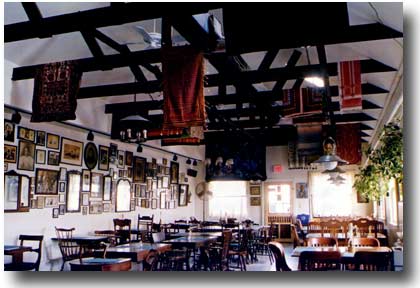
At its waterfront site, Bloodroot consists of a large room furnished with mismatched tables and chairs, and one wall covered in herstoric photos of women (see photo). “People gave us pictures [for] the wall,” Miriam told The Connecticut Post; one person gave her a photo and said, “This is my sister. I want her here.”

Off the restaurant is a small bookstore crammed with books by women, where authors occasionally come to read. There is also an outdoor patio facing scenic Long Island Sound.  Meals are strictly self-service – from ordering to picking up food to bussing tables. The veggie menu – printed daily on a chalkboard – includes ethnic soups and salads, crusty breads, and rich desserts.

Bloodroot also published four cookbooks in its “Political Palate” series, which included not only recipes but the most appropriate seasons in which to make the various dishes. Although the older cookbooks are now out of print, two Best of Bloodroot volumes are available.

An Innovative Experiment

Asheville, N.C.

Black Mountain College Museum and Arts Center
56 Broadway

Fifteen miles east of Asheville was the location of Black Mountain College, an experimental school in existence from 1933 to 1956. According to gay historian Martin Duberman, who chronicled its history in his exhaustive group biography, Black Mountain College: An Exploration in Community, the college was “the forerunner and exemplar of much that is currently considered innovative in arts, education and life style.” At Black Mountain, there were no required courses, no exams, and no formal grades. Students were responsible for planning their own course of study, participating in classes that often had fewer than 10 students each.

Black Mountain was also the nurturing ground of numerous queer writers and artists, including Paul Goodman, Merce Cunningham, and John Cage. Other queer lecturers during its history included Thornton Wilder, Ted Shawn, and Robert Duncan. Artists Robert Rauschenberg was a student at Black Mountain. The college’s literary journal, Black Mountain Review, published the work of Allen Ginsberg and Jack Kerouac, among many others. Though gay men taught and studied there, however, homosexuality was not openly tolerated. When Paul Goodman, a lecturer in “psychotherapy (his own), literature, history, community planning and sex,” according to Duberman, applied for a full-time teaching position, the faculty voted against him, fearing that he would prove to be a sexual predator.

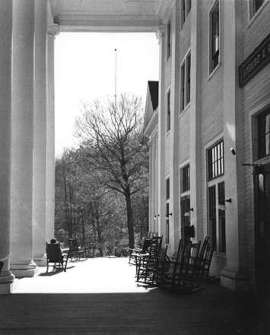
The original site of the school consisted of church buildings constructed by the Blue Ridge Assembly as a summer conference center for its members. For most of the year, the buildings were vacant, and Black Mountain founder John Andrew Rice saw it as the perfect location for his school. The main building, called Lee Hall (the photo below is of the porch), included both common rooms and individual living and study spaces for students.

The rental agreement with the church stipulated that the buildings and grounds had to be cleared of all college equipment and furniture by the beginning of the summer. Because of this, Lee Hall had a “Shaker plainness” to it, and many students had to construct their own desks and furniture. After a few years, the college purchased a more stable site at Lake Eden, a former summer resort with cottages and lodges on a human-made lake.

The college suffered chronic financial problems, and lack of students and money forced it to close in 1956. The property was sold off piece by piece, and part was leased as a boys’ summer camp. This museum and arts center in nearby Asheville documents the history and mission of the innovative school.

Goodbye, Liberty Avenue

Pittsburgh, Pa.

Pegasus
818 Liberty Avenue

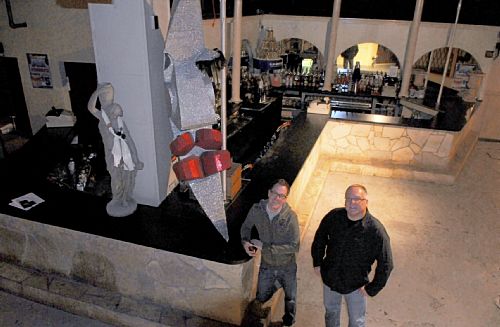
Pittsburgh’s longtime gay men’s bar, Pegasus, has closed in the location it occupied for the past 30 years; it has moved across the river to a new space. “If you ever saw Queer as Folk on TV, that’s what Pittsburgh was like back then [in the ’80s],” according to one bar-goer.

Read the complete story here.

For World AIDS Day

(photo by Dan Vera, Beltway Poetry Quarterly)


Washington, D.C.

Tim Dlugos apartment
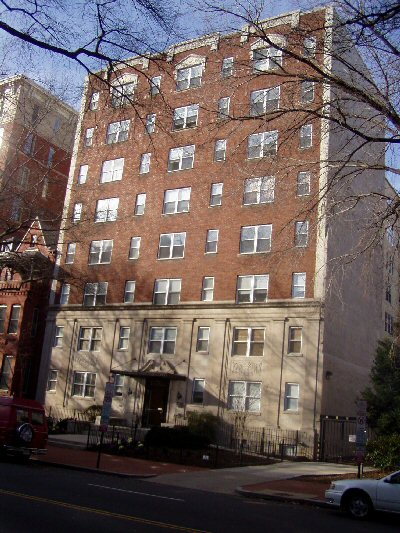
1437 Rhode Island Avenue, N.W.

Gay poet and activist Tim Dlugos (1950-1990) lived at this address as a young man, while working for Ralph Nader’s organization, Public Citizen. Raised Catholic in Arlington, Va., Dlugos joined the Christian Brothers as a teenager, but left the order and came out as gay in 1971.

While Dlugos was living in Washington, he was an active member of Mass Transit, a peer poetry workshop that convened weekly at the Community Book Shop in Dupont Circle. Mass Transit started a publishing venture called Some of Us Press, which published Dlugos’ first poetry collection, High There, in 1973.

In the late ’70s, Dlugos moved to New York City, where he edited the St. Mark’s Poetry Project newsletter and was a contributing editor of Christopher Street magazine. He published his own work widely, in magazines, anthologies, and chapbooks. His poem “G-9,” an account of his time in an AIDS ward, appeared posthumously in The Paris Review.

When he died in December 1990, Dlugos was enrolled in graduate studies at Yale Divinity School, with the intention of becoming an Episcopal priest. Poet David Trinidad is currently compiling Dlugos’ collected poems for publication.

My list of daily intercessions
is as long as a Russian
novel.  I pray about AIDS
last.  Last week I made a list
of all my friends who’ve died
or who are living and infected.
Every day since, I’ve remembered
someone I forgot to list.

–from “G-9,” by Tim Dlugos

A Writer’s Life

Red Cloud, Neb.

Willa Cather home
241 North Cedar

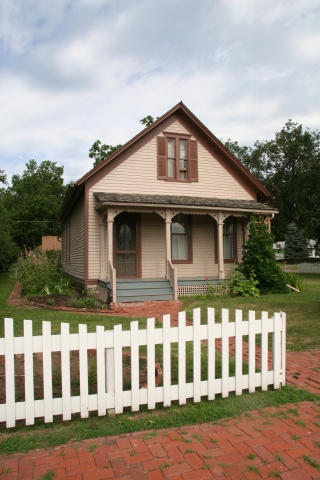
I’ve written on this blog about Willa Cather’s (1873-1947) adult life in Pittsburgh, but now we turn to the place most associated with her in readers’ minds: Nebraska. Cather set six of her best-loved novels (including O Pioneers! and My Antonia) and several short stories in Red Cloud, the small town in which she lived from the ages of 9 to 17. “My deepest feelings were rooted in this country,” she later wrote of the region where she grew up, “because one’s strongest emotions and one’s most vivid mental pictures are acquired before one is fifteen.” Even after she left the area to attend college and start her career as an editor and writer, Cather repeatedly returned to Red Cloud to visit. Though she lived most of her adult life in New York City, Cather’s small-town roots continued to feed her creative work.

The Cather family home is a modest frame structure built in 1879, which Cather depicted lovingly and realistically in her novel The Song of the Lark. So faithful were Cather’s descriptions of the house that guides there read from Cather’s texts as they escort visitors through the various rooms. (You can take a virtual tour of the house courtesy of the Cather Foundation.) The most interesting part of the house is Cather’s attic room, which was sealed off for years and has remained largely untouched since the late 19th century, when the writer occupied it. Cather’s siblings lived in a separate, dormitory-style room, but as the oldest child, she rated her own space. The room is still papered with the wallpaper (“small red and brown roses on a yellowish ground,” she wrote in Lark) that Cather purchased herself with her earnings from working at Cook’s Drug Store, and appointed with the shabby, secondhand furniture she sketched in such detail in Lark.

It was in this home at age 14 that the budding lesbian created a male persona for herself, William Cather Jr., which she identified with throughout her teen years, trimming her hair to a crewcut and donning boys’ clothes. For more about young William and his influence on Cather’s work, pick up Sharon O’Brien’s insightful biography of the writer, which examines her life and work with an eye to her sexuality and gender presentation.

In addition to the Cather home, Red Cloud boasts many other sites related to the writer’s life. The Willa Cather Foundation offers a walking tour, which you can now also take online.

From the Dark Tower

New York, N.Y. (Harlem)

“The Dark Tower”
108-110 West 136th Street

This was the site of A’Lelia Walker’s (1885-1931) home and famous salon, “The Dark Tower,” which she hosted for writers, musicians, and other artists during the 1920s. It was named after a sonnet by queer poet Countee Cullen, which has been said to capture the spirit of the Harlem Renaissance (see below).

A’Lelia Walker’s fortune came from her mother, Madame C.J. Walker, an enterprising woman who created a million-dollar empire from beauty salons and hair-straightening products for black women, and who died in 1919. With her inheritance, A’Lelia purchased these two Stanford White-designed town houses on West 136th Street in “Sugar Hill,” combined them into one residence with a new façade, and furnished them lavishly. Here the woman dubbed “the Mahogany Millionairess” hosted cultural soirees for the Harlem and Greenwich Village “glitterati,” white and black, serving caviar and bootleg champagne and providing entertainment by queer performers Alberta Hunter and Jimmy Daniels. Langston Hughes later wrote that A’Lelia’s parties “were as crowded as the New York subway at the rush hour.” She herself was a striking figure, whom Hughes called “a gorgeous dark Amazon.”

Sadly, Walker’s historic home was demolished by the city in 1941. Appropriately, the Countee Cullen branch of the New York Public Library now stands on the site.

We shall not always plant while others reap
The golden increment of bursting fruit,
Not always countenance, abject and mute,
That lesser men should hold their brothers cheap;
Not everlastingly while others sleep
Shall we beguile their limbs with mellow flute,
Not always bend to some more subtle brute;
We were not made to eternally weep.

The night whose sable breast relieves the stark,
White stars is no less lovely being dark,
And there are buds that cannot bloom at all
In light, but crumple, piteous, and fall;
So in the dark we hide the heart that bleeds,
And wait, and tend our agonizing seeds.

– “From the Dark Tower,” by Countee Cullen

Paris Was Janet Flanner

Indianapolis, Ind.

Janet Flanner birthplace
952 North Delaware

It’s a paint store now, but it was at this location in the St. Joseph Historic District – a fashionable neighborhood of large homes and wide avenues – that journalist Janet Flanner (1892-1978) was born. Her father was a mortician who co-owned a funeral home, ambulance service, and the state’s only crematorium. Her mother was a published poet and producer of amateur theatricals. Though his family was embarrassed by his profession, Frank Flanner’s social position in Indianapolis was suggested by a notice in a local newspaper: “A newcomer to our fair city asked what she might do to become adjusted socially and correctly in our city. The reply was join the Riviera Club, send your children to Mrs. Gates’ Dancing School, and be buried by Flanner and Buchanan.”

Sadly, when Janet was 20 years old, her father poisoned himself in his own mortuary. The scandal rocked Indianapolis, and gossip-mongers blamed everyone from his wife to his business partner to his mother. In her novel The Cubicle City (1926), Janet Flanner based the idealistic, yet suicidal real estate broker, James Poole, on her own father.

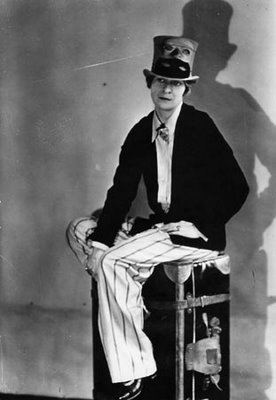
Flanner became a journalist after a brief stint at the University of Chicago. After a few years in New York mingling with the literati and married to a man she didn’t love, Flanner spent most of her adult life abroad, following her first love, journalist Solita Solano, there in 1922. The two women settled in Paris, becoming part of the American artists’ community. Flanner was a regular at Natalie Barney’s salon, and she and Solano were so well known among expatriate lesbians that they appeared as “Nip and Tuck” in Djuna Barnes’ lesbian roman a clef, Ladies Almanack. (She is shown above in a 1927 photo by another lesbian expatriate, Berenice Abbott.)

Flanner is perhaps best remembered for the column “Letter from Paris,” on French culture and personalities, which she wrote for The New Yorker for 50 years, from 1925 until 1975. For her pen name, New Yorker publisher Harold Ross suggested “Genet,” a Gallicized “Janet.” The best of her columns were later collected in the volume Paris Was Yesterday (1972).

At home in a sleepy town

nyackhouse2

Nyack, N.Y.

Carson McCullers home
131 South Broadway

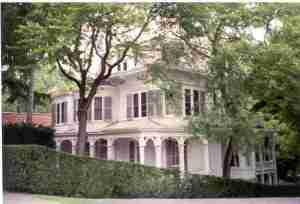
This rambling, three-story house in the sleepy village of Nyack was home to the writer Carson McCullers (1917-1967) from 1945 until her death. The front of the grand Victorian house faces one of the main streets of Nyack, while the rear sun porch enjoys a stunning view of the Hudson River. It is still a private residence, and was added to the National Register of Historic Places in 2006.

After the death of Carson’s father in 1944, her mother, Marguerite Smith, didn’t have the heart to remain in the Georgia house where she and her husband, Lamar, had raised their family. At the time, Carson’s husband, Reeves, had gone into the army, and she, too, was faced with living alone. She loved the scenic village of Nyack, just twenty-five miles up the river from New York City, so she, her mother, and sister decided to take up residence there in the fall of 1944. Nyack reminded Marguerite of the small, friendly towns she had known in Georgia, so she felt immediately at home.

Carson’s family first rented a specious apartment at 129 South Broadway, and then in the spring of 1945, moved to the house next door, which Marguerite purchased with $9,000 from the sale of her Georgia home. When her mother’s funds dipped in the early 1950s, Carson purchased the house from her with the money she received from selling the screen rights to The Member of the Wedding.

Carson used Nyack as her base in between trips to the artists’ colony of Yaddo, where she did much of her writing, and speaking and teaching engagements all over the country. It was at this home that she gave a luncheon to honor her idol, Isak Dinesen, after the two met at a literary function in 1959. Other guests included Marilyn Monroe and husband Arthur Miller. The high point of the afternoon was apparently a spellbinding tale Dinesen related – in true Scheherazade fashion – about killing her first lion in Africa.

Plagued by ill health, depression, and alcoholism through much of her adult life, Carson suffered her final stroke in this house in the summer of 1967. According to her biographer, Virginia Spencer Carr, the last words she spoke were to the young actor who rented living space in the basement. He stopped by her bedroom and told her he was appearing in the play Stop the World, I Want to Get Off. “Oh, darling, isn’t that a marvelous title,” Carson said. “Ahh, to get off. Wouldn’t that be something. Wouldn’t that be marvelous.” She suffered a massive brain hemorrhage twenty minutes later and died at Nyack Hospital.

A Community of Women

Henry-st-settlement

New York, N.Y.

Henry Street Settlement
265 Henry Street

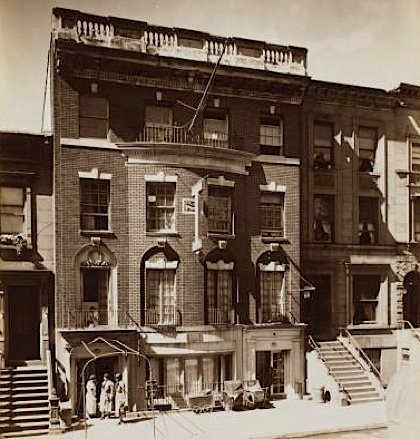
Lillian D. Wald (1867-1940) was one of many women of her generation who felt the need to make a contribution to society rather than settle into a comfortable, middle-class life. After training as a nurse, an experience that brought her into contact with the dire health-care needs of the immigrant poor on New York’s Lower East Side, Wald and classmate Mary Brewster decided to start a settlement house in the neighborhood in 1895. International banker Jacob Schiff provided the red-brick building that became the Henry Street Settlement and Visiting Nurse Service, which is still standing and in operation today.

Like Jane Addams in Chicago, Wald attracted a group of dedicated women to live and work with her at Henry Street, providing low- or no-cost health care to the poor in their homes. Within the next dozen years, the Visiting Nurse Service included 100 nurses, who made almost a million house calls a year. One nurse recalled later that Wald was always “the first to hear a knock at the front door to respond to an incoherent stumbling appeal for a nurse.” But Henry Street became more than a health care facility; it acted as a community center, too, providing classes and cultural experiences.

Wald shared her life with a community of women and enjoyed intimate relationships with several. Among them were Mabel Kittredge, a wealthy donor, and Helen Arthur, a lawyer and theater producer, who once wrote to Wald of longing “to get back to your comfortable lap… instead of being solicitously hustled from your room at ten o’clock.” Wald’s intimate companions quickly discovered that her relationship with Henry Street Settlement would always be primary.

During World War I, Wald became actively involved in the peace movement, which made her work and travel schedule more hectic. She purchased a country house in Westport, Connecticut, in 1917, and periodically took time off there as a retreat. She finally retired from her settlement work in 1933 and spent her remaining years in Westport.