Feeds:
Posts
Comments

Literary Thanks

Baltimore, Md.

Diana Press

12 West 25th Street

First housed in this brick building in Baltimore, Diana Press was one of the earliest lesbian-feminist publishing companies in the country. Established in the mid-1970s, it was committed to publishing openly lesbian material, which was not available from mainstream houses. Before she became a mass-market star with Rubyfruit Jungle, Rita Mae Brown published her collections of lesbian poems, Songs to a Handsome Woman and The Hand That Cradles the Rock, and a volume of essays, Plain Brown Wrapper, with Diana Press. Other titles from Diana included Elsa Gidlow’s Sapphic Songs and Judy Grahn’s True to Life Adventure Stories, as well as early poetry by Pat Parker. In the late ’70s, Diana Press relocated to the San Francisco area. If not for the efforts of this pioneering press, along with Naiad Press, Persephone Press, Daughters Inc., and many others, a lot of openly lesbian writing would have never seen print. As a writer who is also a lesbian, I’m grateful.
“Stella!”

St. Louis, Mo.

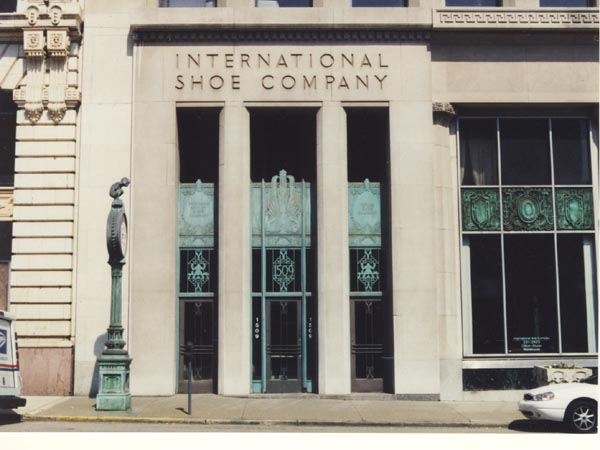
International Shoe Company

1501 Washington Avenue

International Shoe Company warehouse

701 N. 15th Street

In 1931, Tennessee Williams’ father secured his son a summer job as an office clerk at the show company where he himself was sales manager. Later, when the Depression leveled the family’s finances and Cornelius withdrew his son from the university, Tennessee lived at home and labored full-time as a clerical worker at the company’s warehouse during 1934 and early 1935. Because he hated it and dreamed of being a writer, Williams later exaggerated his employment time there, saying it dragged on for three or four years. (Or maybe it just felt that way to him?) Williams wrote after work and late into the night at the kitchen table, getting by mostly on cigarettes and coffee.

At International Shoe, there was a brawny worker named Stanley Kowalski, a “ladies’ man,” who became Williams’ closest companion. According to one biographer, there is no evidence that the two men had a sexual relationship, but it is clear that Williams was infatuated with his co-worker, much as Blanche DuBois was drawn to the fictional Stanley in A Streetcar Named Desire.

Williams’ employment records at International Shoe list “ill health” as the reason for his resignation in the spring of 1935. Suffering from anxiety attacks that felt like cardiac arrest, Williams went to recuperate at his grandparents’ house in Memphis.

Queer D.C.

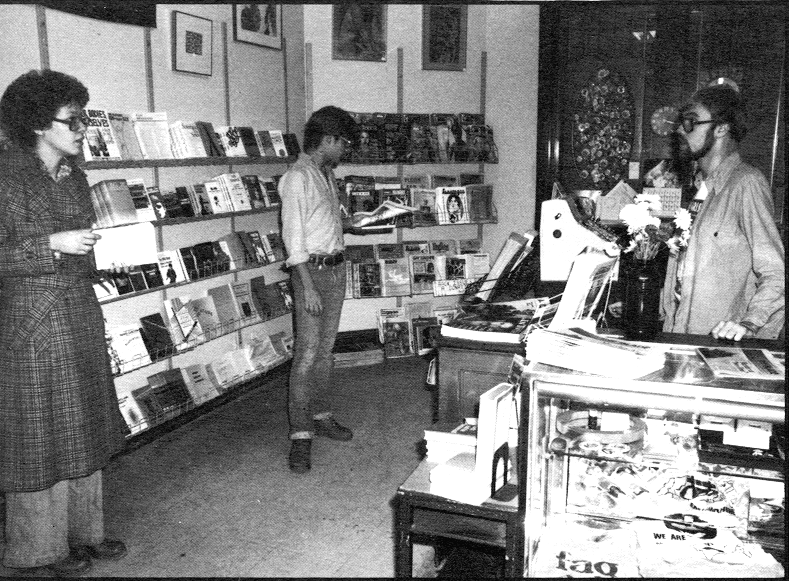
Lambda Rising Bookstore at its original location


For fans and friends of our nation’s capital, there’s an amazing online history project that attempts to pinpoint and chronicle the social spaces frequented by LGBT people in Washington, D.C., from 1920 to 2000. You’ll have to squint to read the map, but if you click on the database link, you’ll find an exhaustive list of places where queers congregated in the 20th century. Many, of course, were bars, which served as informal queer community centers (and in many places in the country they still serve that function today); but there were also bathhouses, social clubs, parks, churches, bookstores – see the photo above of Lambda Rising Bookstore at its first location in 1974; sadly, the store closed last month after 35 years – and other queer spaces. The author of the project is Mark Meinke, who did a wonderful job of documenting our physical past.

It’s a Drag

January is National Drag History Month. Catch this slide show of photos from the legendary Jewel Box Revue.

I know, I know…  there’s been lots of New York City on this blog recently. But things just keep presenting themselves to me, and hey, I did live there for two decades. Here’s an article I just found in the New York Times in which biographer Joan Schenkar talks about novelist Patricia Highsmith’s comings and goings in Manhattan.

And while you’re reading about Highsmith, check out an interview my friend Jill Dearman recently did with Schenkar.

Strange Fruit

Clayton, Ga.

Lillian Smith home
383 Hershey Lane

This was the home of writer Lillian Smith (1897-1966), best remembered for her groundbreaking first novel, Strange Fruit (1944). Though it sounds like pulp fiction with homosexuality as its theme, Strange Fruit was actually a tale of miscegenation, which was turned down by seven publishers before eventually reaching print. The novel was banned in cities like Detroit and Boston for its realistic treatment of the controversial theme. Despite that (or more likely because of it), the book was a runaway best-seller, which sold three million copies and was translated into 16 languages.

Smith was a white woman with a lifelong interest in racial issues. When she was growing up in Jasper, Fla., her parents took in a foster child they believed to be a white orphan, only to find out she was part black. The girl was immediately sent away, and the cruel incident left a lasting impression on young Lillian. Besides Strange Fruit (in which Jasper was thinly disguised as Maxwell, Ga.), Smith published five nonfiction books on the topic of racial justice, and numerous articles in Redbook, The Saturday Review, and The Nation.

The Smith family moved from Jasper to Clayton in northern Georgia in 1915. Smith met her life partner, Paula Snelling, when the two helped run the Smith family’s summer camp, Laurel Falls Camp for Girls, on top of Old Screamer Mountain. Beginning in the 1930s, the two women collaborated to publish a magazine called Pseudopathia, devoted to reviewing literary works by African Americans.

Today, the home where Smith did much of her writing is the Lillian E. Smith Center for Creative Arts, a compound of several cottages that accepts writers, artists, and other creative types for retreats at a small weekly fee. The center is run by Smith’s niece, a former professional dancer.

Personal Herstory

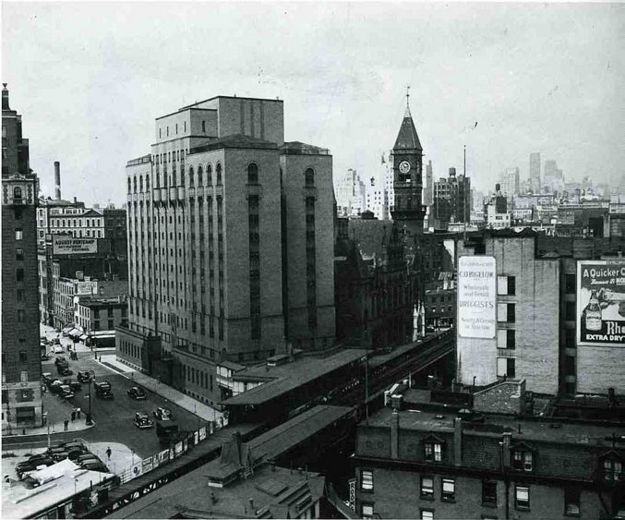
And while we’re in New York City… I just ran across and thought I would share this wonderful essay by Joan Nestle, co-founder of the Lesbian Herstory Archives and dyke extraordinaire, about the Women’s House of Detention that used to stand at the spot where Sixth Avenue and Greenwich Avenue form a triangle, adjacent to the Jefferson Market branch of the New York Public Library. The essay is an evocative mixture of history and personal account. The prison was demolished in 1974, and there’s a community garden on the spot now. I often heard stories about the prison when I lived in New York, but never saw a picture of it until now. Don’t miss Nestle’s memories of it. In her words:

Sites like the Women’s House of D are prisms of shifting queer historical concerns; urbanity, what it will bear and what it will not, race and class divisions and connections–imprisonment both within jails and without.”

At Home on 26th Street

New York, N.Y.

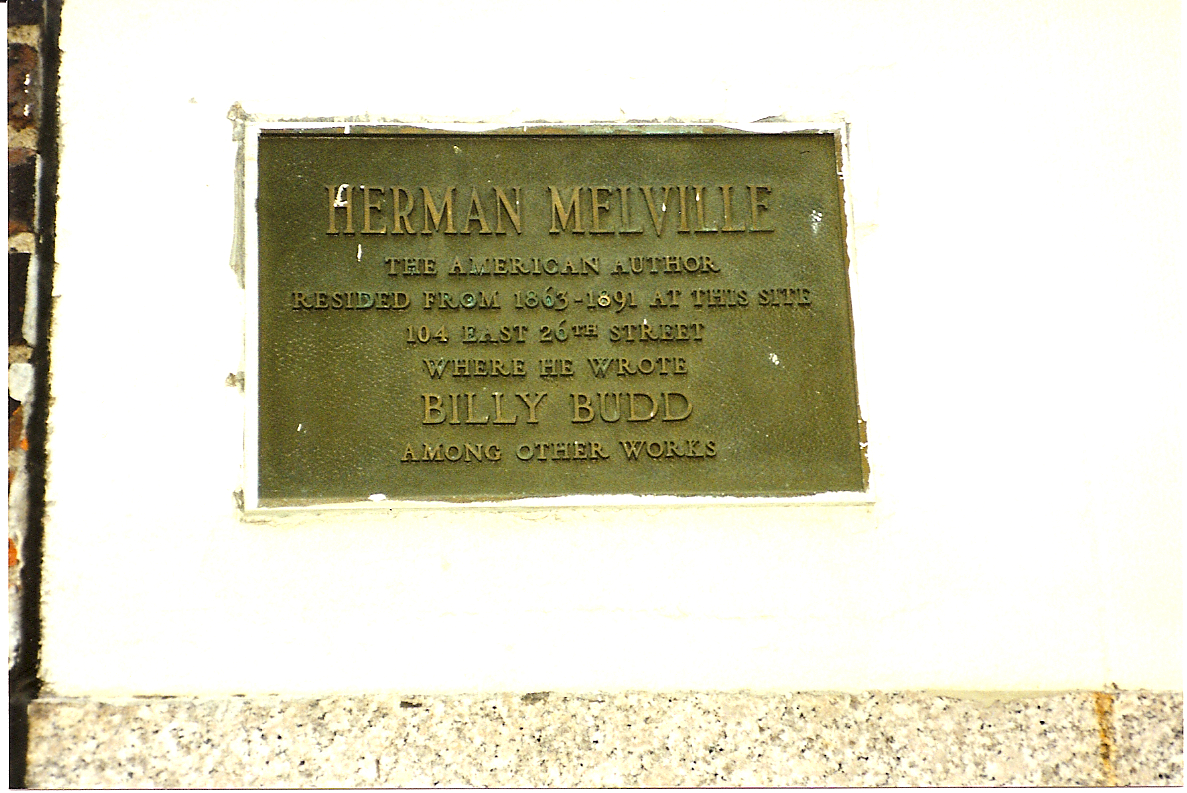
Herman Melville plaque
104 East 26th Street

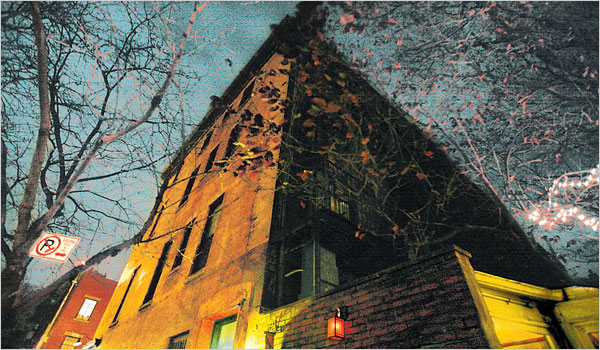
After giving up on farming in 1863, Herman Melville moved his family to New York City, into an apartment building at this address. Though the building is no longer standing, a plaque marks its location, and the intersection of 26th Street and Park Avenue South, which is just west of here, is called “Herman Melville Square.” From this address, Melville commuted daily to his job in lower Manhattan as deputy inspector of customs, earning about four dollars a week. In the evenings, he worked on Billy Budd, which remained in manuscript at his death and is the only known fiction he wrote during his time in New York.

In 1891, Melville died at home in relative obscurity. Many of his contemporaries thought he had died years earlier!

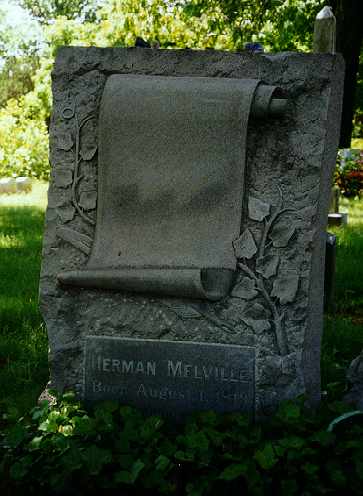
His brief obituaries labeled his first book, Typee (1846), his most famous. At Woodlawn Cemetery in the Bronx, his small marble tombstone also has remarkably little to say about a man whose work has passed into the literary canon: it simply gives his name and dates.

A personal aside: I lived on East 26th Street from 1991 to 2003, just east of this plaque, and used to pass it every day on my walk across town to work.

A Native “Boy-Girl”

East Glacier Park, Mont.

Running Eagle Falls
Glacier National Park
Two Medicine Entrance

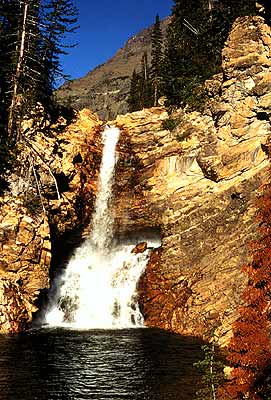
Near this eastern entrance to Glacier National Park (adjacent to the Blackfeet Reservation) is the beautiful Running Eagle Falls, formerly known as “Trick Falls” for the way water flows out of different parts of the falls during different seasons. The falls are named for Running Eagle, the only female-born war chief of the Blackfeet.

In 1916, a white man, James Willard Schultz, published an account called Blackfeet Tales of Glacier National Park, concerning his experiences among the Native Americans of northwestern Montana. Schultz’s was the first written account of the story of Running Eagle, a 19th-century war chief who was born female but rejected traditional female activities and dress and was known as “sakwo’mapi akikwan,” or, in English, “boy-girl.”

From an early age, Running Eagle wished to be a boy. “But if I cannot be one,” she said, “I can do a boy’s work.” She joined her father in hunting, and when he was killed by members of the Crow Nation, Running Eagle began dressing in men’s clothes and joined the war party that avenged his death. By age 20, she had achieved the name “Girl Chief.” (Which is why I use the feminine pronoun.)

As an adult, Running Eagle kept her own lodge and took a wife named Suya’ki, a woman “who wanted nothing to do with men.” According to Schultz, their lodge was “a visiting place for many girls, young married women, and not a few old women.” Honored and respected for her achievements, Running Eagle’s exploits were still recalled in oral history accounts 100 years after her death in 1840.

Newcastle, Maine

Frances Perkins home
“The Brick House”
River Road

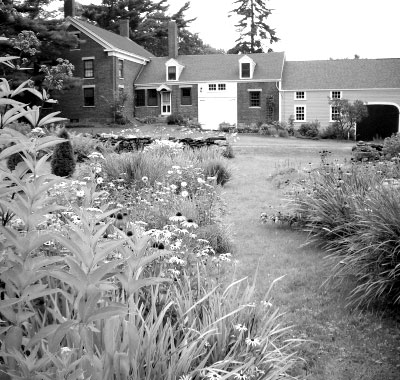
Frances Perkins (1880-1965), FDR’s secretary of labor, was the first woman ever to hold a presidential Cabinet post. The primary architect of some of the New Deal’s greatest programs, including Social Security and unemployment insurance, she played a major role in helping to bring the country out of the Great Depression. This 1836 house (see photo) on the coast of Maine was her family home; she and her sister inherited the site, and Perkins used it as a special retreat. It is still standing, and plans are in the works to transform it into the Frances Perkins Center, a place for students and scholars to work on projects that mesh with Perkins’ vision.

A graduate of Mount Holyoke College and Columbia University, Perkins was a lifelong social reformer and activist. Early in her career, she was part of the committee that investigated the tragedy of the Triangle Shirtwaist Factory fire in 1911, which killed 146 workers, mostly immigrant women, who were trapped in the burning building. Following a career as a settlement worker and factory inspector, Perkins eventually held the post of N.Y. State Commissioner of Labor under Gov. Franklin Roosevelt. When Roosevelt became president in 1932, he invited her to join him in Washington, and the rest is herstory. Perkins served in the Cabinet for the next 12 years. In her later life, she was guest professor at Cornell University’s School of Industrial and Labor Relations.

Although she married economist Paul Wilson in 1913, a 2009 biography of Perkins by journalist Kirstin Downey reveals that she had a secret affair with Mary Harriman Rumsey, the sister of Averell Harriman. The book further examines how and why Perkins, surely one of the greatest Cabinet members and social reformers of all time, has slipped into oblivion.