Feeds:
Posts
Comments

Lush Life

strayhorn.jpg

Pittsburgh, Pa.

Billy Strayhorn marker
Westinghouse High School
1101 North Murtland Street

Billy Strayhorn home
7212 Tioga Street Rear (demolished)

Born in Ohio, composer Billy Strayhorn (1915-1967) lived in the Homewood section of Pittsburgh from his early years until he left for New York as a young adult. In those days, white families lived on the main streets of Homewood, while blacks lived in the alleys behind them (the “Rear” in the Strayhorn address). The Strayhorn home was “a four-room shack,” according to one of Billy’s childhood friends, with two rooms on each floor and a toilet in the basement. The kitchen was the biggest and most significant room in the house. Because of the crowded living conditions and Billy’s father’s alcoholic binges, Billy’s mother often sent her eldest son for long stays with his grandparents in Hillsborough, North Carolina. Billy’s grandmother owned and played a piano, and it was in Hillsborough that Billy first learned to play.

Though he was a musical prodigy, Strayhorn’s family could not afford lessons to further his talent. As an adolescent, Billy found odd jobs selling papers and working as a soda jerk to purchase his first piano, a broken-down upright. “All the money he [Billy] could get hold of,” a friend remembers, “he bought [sheet] music….the house was swamped with music.”

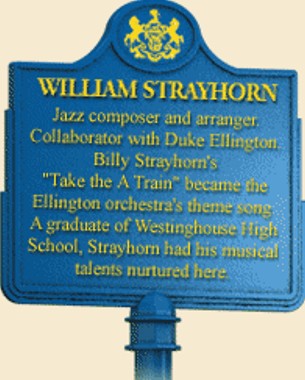
At Westinghouse High School (where there is now a historical marker honoring him), Strayhorn pursued music, becoming first pianist in the Senior Orchestra and playing at local social events and banquets with the school’s Orchestra Club. Though he was often made fun of at school for being a “sissy,” the shy, withdrawn Strayhorn concentrated on his work and his passion for music. After graduation, Strayhorn formed his own interracial jazz trio, The Madhatters, and played local nightspots. But he still had to work days at the drugstore soda fountain and pick up extra money by arranging music.

His big break came in 1938, when a friend of a friend got him an “audience” with Duke Ellington, who was playing with his band at the Stanley Theater in downtown Pittsburgh (now the Benedum Center, a performing arts space). Ellington was impressed by the talented young pianist who could seemingly do everything – write music, lyrics, and arrangements. But he didn’t have an opening in his band. Ellington made Strayhorn a promise of a job if the young musician ever got to New York and gave him exact directions to his home in Harlem. Eager to please Ellington, Strayhorn turned the directions into a song – “Take the A Train” turned out to be his most famous composition and eventually became Ellington’s theme song.

Strayhorn did indeed make it to New York, where he hooked up with Ellington and worked with him for the next 30 years. While Ellington was the public artist, Strayhorn worked behind the scenes as collaborator and arranger. Ellington supported Strayhorn’s career, but he also occasionally took credit for the younger man’s work. Strayhorn consoled himself with drink and died of cancer and alcohol abuse at the age of 51. His song “Lush Life” (1936) sadly defines his own short, intense life.

Strayhorn knew early on that he was gay and was open about his sexual orientation. According to his biographer, he never even danced with a girl. Ellington, who was straight, seems to have been supportive and tolerant of his collaborator’s homosexuality. Strayhorn had a number of significant relationships in his life, most notably in his final years with a graphic designer, a white man named Bill Grove. Grove was the only man Strayhorn ever brought home to meet his family.

736alabama.jpg

Lawrence, Kan.

Langston Hughes home
732 Alabama Street (demolished)

Langston Hughes statue
Elizabeth Watkins Community Museum
1047 Massachusetts Street

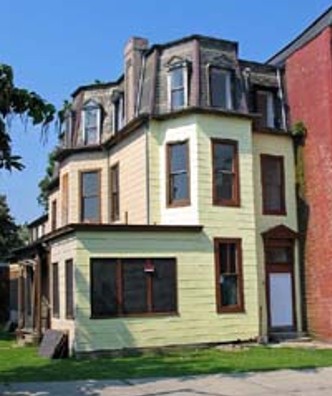
Poet and memoirist Langston Hughes (1902-1967) was born in Joplin, Missouri, but his earliest memories were of living at his grandmother’s house in Lawrence, Kansas, at 732 Alabama Street after his parents’ marriage fell apart. The house is no longer standing, but the one pictured here, which was just next door to his grandmother’s and possibly similar in style, is being renovated.

Hughes was one of Lawrence‘s most celebrated residents, and a bronze statue of him at the age of the age of 13 stands in the local Watkins Community Museum. Hughes spent most of his childhood in his grandmother’s simple, two-bedroom house with a wood shed and outhouse in the back, plus a pump for water. Occasionally, his grandmother rented out a room to make money, and sometimes she let the entire house, moving herself and Langston to the home of friends James and Mary Reed, who lived at 731 New York Street. Later, Langston remembered “the mortgage man…always came worrying my grandmother for the interest due.”

Langston endured a solitary boyhood in a mostly white Lawrence neighborhood; he did not play with many other children and felt his loneliness like “a dull ache.” One of his favorite pastimes was visiting the morgue at the nearby University of Kansas, where he snuck in and watched, fascinated, as students worked on cadavers. Langston attended predominantly white schools and though he rarely studied, he was always near the top of his class.

Langston’s grandmother died in 1915, and he lived briefly with the Reeds. When his mother remarried, he moved with her to Lincoln, Ill., where her new husband had secured work. It was in Lincoln, Langston later said, that he first started writing poems and was chosen class poet in eighth grade, where he was again one of only a few black students. “My classmates,” he recalled, “knowing that a poem had to have rhythm, elected me unanimously – thinking, no doubt, that I had some, being a Negro.”

caffe_cino_exterior.jpg

New York, N.Y.

Caffe Cino
31 Cornelia Street

From 1958 to 1967, Joe Cino ran a coffeehouse at this address that has gone down in performance history as the place where both gay theater and Off-Off-Broadway were born. The Beat generation cafe was not intended at the beginning as either a theater or a gay hangout, though Cino himself was gay. “My idea,” he said in a Village Voice interview in 1965, “was…to start with a beautiful, intimate, warm, non-commercial, friendly atmosphere where people could come and not feel pressured or harassed. I also thought anything could happen. The one thing I never thought of was fully staged productions of plays.” But that’s exactly what happened. On a dark, narrow street in Greenwich Village, in a room described by one reporter as a “shoebox,” gay playwrights such as William M. Hoffman, Doric Wilson, Robert Patrick, and Lanford Wilson got their start, as did gay-friendly writers Sam Shepard and John Guare.

Sadly, the accidental death of his lover, lighting designer John Torrey, sent Cino into despair and drugs. Cino committed suicide in 1967, and the “magic time,” as William Hoffman called it, came to a close.

A Lesbian Mormon

ada_dwyer_russell.jpg

Salt Lake City, Utah

Ada Dwyer Russell home
166
W. North Temple Street

Born in 1863, actress Ada Dwyer (later Russell) was raised as a Mormon. Her father, James Dwyer, had come west in a covered wagon and opened the first bookstore in the far west. He also helped found the Latter Day Saints University. The Dwyers’ residence is listed at this location on North Temple Street beginning in 1867, when Ada was four, but the building is no longer extant.

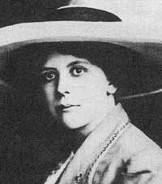
Ada grew up to be an actress who first performed at the Salt Lake Theater (corner of South First and State) and later on the Broadway and London stages. She married the British actor Harold Russell, and was later widowed. In 1912, she met poet Amy Lowell, a cigar-smoking butch 11 years her junior, at a women’s luncheon club in Boston. The two were instantly smitten; Lowell wrote that “between us lept a gold and scarlet flame.” Two years later, after much coaxing on Lowell‘s part, Russell moved into the Lowell family estate, Sevenels, in Brookline, Mass. She gave up her own career for Lowell‘s, organizing her partner’s life, and became the subject of Lowell‘s explicit lesbo-erotic poetry. Lowell died in 1925, leaving her fortune to Russell; still, Russell maintained until her own death in 1952 that the two of them had only been “friends.”

Gertrude in Baltimore

stein.jpg

Baltimore, Md.

Gertrude Stein residence
2408 Linden Avenue (private)

Gertrude Stein’s (1874-1946) first ambition was not to be a writer, but a psychologist. After studying psychology with William James at Harvard, Stein was accepted at the John Hopkins Medical School, where her brother, Leo (with whom she was very close), was also enrolled. She lived with relatives at this address (on the National Register of Historic Places since 1985) for about a year, then moved in with Leo at 215 East Biddle Street.

Stein was unhappy and unfulfilled in medical school. She was also on the brink of discovering her lesbianism. While living in Baltimore, Stein ran with a lesbian crowd, a group of Bryn Mawr College graduates led by a young woman named Mabel Haynes. Sadly for her, Stein fell unrequitedly in love with Haynes’ “romantic friend,” May Bookstaver. The experience made a deep impression on Stein, whose first novel, Q.E.D., completed in Baltimore in 1903, was an autobiographical account of this lesbian love triangle.

Unlike most of Stein’s work, Q.E.D. was openly lesbian in content and language. Stein put the finished manuscript away for 30 years, and then, in 1932, unearthed it and showed it to her agent, who advised against trying to publish it because of its “controversial” theme. Q.E.D. was finally published in 1950, four years after Stein’s death.

Stein left Baltimore in 1903 to visit Leo, who had moved to Paris, and to try to forget May Bookstaver. Paris agreed with her, and she lived there the rest of her life, meeting Alice B. Toklas, her life companion, in 1907. And May Bookstaver and Mabel Haynes? They both pursued much more traditional lives, ending their affair and marrying men.

newportarmynavyymca.jpg

Newport, R.I.

Army and Navy YMCA
50 Washington Square

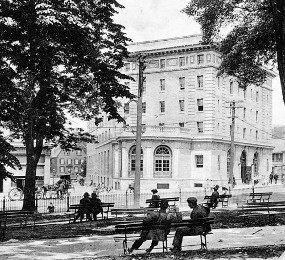
Since the early 20th century, YMCAs have been gathering places for gay men. Newport‘s Army and Navy YMCA, a Beaux Arts-style building, opened in 1911, and when the fleet was in – Newport was home to an important naval training station – the building was often filled beyond capacity. Here soldiers and sailors could bank, shop at the canteen, and eat a homestyle meal. Activities included swimming, bowling, and jogging (and numerous other “indoor sports,” to be sure). The administrators also showed movies and sponsored cabaret evenings of song and performances.

In his article, “Christian Brotherhood or Sexual Perversion? Homosexual Identities and the Construction of Sexual Boundaries in the World War I Era,” historian George Chauncey relates the story of an official navy investigation in 1919-20 of homosexuality in Newport. Under orders from then-Assistant Secretary of the Navy, Franklin Roosevelt, young enlisted men acted as decoys to entrap homosexuals, gathering information and later testifying before a naval court of inquiry and at several civilian trials. Twenty sailors and sixteen civilians were arrested as a result of the “investigation.”

The decoys reported that the YMCA, as well as nearby beaches and wharfs, were havens of homosexual activity. Some gay sailors lived at the Y, while others just rented rooms for the night. “Fagott” [sic] parties, the investigators found, were commonplace at the Y in the evenings. The gay men who frequented the Y also engaged in homosexual activities in other cities and maintained contacts with gay men in New York, Providence, and Fall River. But, Chauncey found, in addition to the men who identified as “queer,” there were men who regularly enjoyed homosexual sex but thought of themselves as heterosexual.

Newport‘s YMCA reached its peak in 1951, during the Korean War. When the Navy began downsizing during the Nixon administration, attendance at the Y fell off, and it was closed in 1973. It is now an apartment building for low-income residents.

“The Army and Navy Y.M.C.A. was the headquarters of all cocksuckers [in] the early part of the evening…. everybody who sat around there in the evening…knew it.”

–Navy investigator, 1920

We’wha

wewha.jpg

Zuni, N.M.

Zuni Pueblo
1203B State Highway 53 (off U.S. 40)

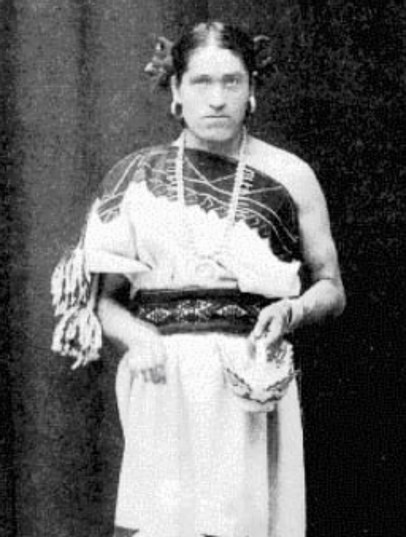
On the border of New Mexico and Arizona is the Pueblo of Zuni, which was once home to one of the most famous two-spirited people, We’wha (1849-1896). Today, the Zuni still relate stories about We’wha, an accomplished weaver and potter who was one of the first Zuni to sell wares for cash. Anthropologist Mathilda Coxe Stevenson described We’wha as “the strongest character and the most intelligent of the Zuni tribe.” In 1886, We’wha spent six months in Washington as Stevenson’s guest, becoming the hit of the capital’s social scene and being generally accepted as an “Indian princess.”

In Zuni culture, We’wha was a lhamana, an individual who combined male and female work and social roles and often dressed in women’s clothing. (Among whites, such individuals were commonly known as berdaches, a French colonialist word meaning “slave boy.”) A lhamana was neither exclusively female or male; of We’wha, they said, “She is a man.” Gay historians disagree about whether or not the lhamana role was exalted or lowly. Some contend that lhamana were holy people – priests and artists – while others say their role was one of humiliation and passivity.

As a child, We’wha lost both parents and was adopted into the family of an aunt. In many photographs at the Smithsonian Institution, We’wha can be seen weaving in front of the family dwelling, which was located in the southeast corner of the Zuni pueblo. The pueblo is open to “respectful guests” every day until dusk. (For more info, visit http://www.experiencezuni.org/home.html.)

Glass House


glasshouse.jpg

New Canaan, Conn.

Glass House
798-856 Ponus Ridge Rd.

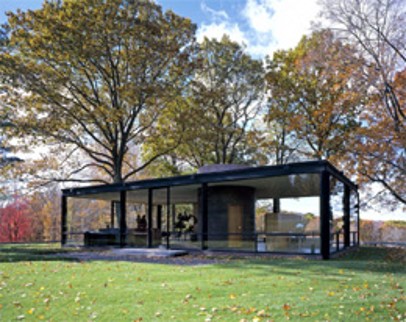
Philip Johnson (1906-2005) – the celebrated architect who designed the sculpture garden and east wing of the Museum of Modern Art, among numerous other structures – built this home in 1949 in one of the wealthiest areas of Connecticut. The idea for a “glass house” came from an argument with his mentor, Mies van der Rohe – could it actually be done? The two competed to solve the problem at the same time, with Johnson finishing his house first. (Van der Rohe’s, located in Plano, Ill., was not completed until the following year.)

Johnson’s Glass House is located in a thickly wooded area on a knoll overlooking a pond. “I learned from the Japanese…[that] a shelf keeps good spirits from straying, and the evil spirits will be unable to climb up to you,” Johnson noted about the location. The Glass House is a simple, modern structure, a 32-x-56-foot rectangle with one door centered on each side. Eight black steel columns form the framework, holding sheets of clear glass between them. A central brick cylinder extending the height of the house contains a bathroom. When Frank Lloyd Wright visited the completed house, he reportedly asked, “Am I indoors or am I out?” Said Johnson, “With the lights out and the snow falling, it is almost like a celestial elevator.”

Over the next 30 years, Johnson added other structures to his 40 acres of land – a solid brick guesthouse to contrast with the glass structure; an arched pavilion in the pond; an underground art gallery; and a climbable tower in the woods, built to honor his friend Lincoln Kirstein, co-founder of the New York City Ballet. One critic calls the compound Johnson’s “architectural autobiography”; he himself labeled it “the diary of an eccentric architect.” Johnson willed the property and all the buildings to the National Trust for Historic Preservation in 1986. The architect died in 2005, followed shortly thereafter by his longtime partner, David Whitney. The compound – complete with a visitors’ center designed by Johnson – opened to the public in April, 2007. 

Judy, Judy, Judy

garland.jpg

Grand Rapids, Minn.

Judy Garland home
2727 US Highway 169 South

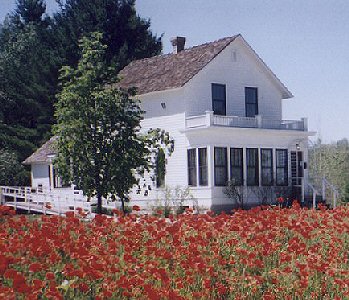
This house in Grand Rapids was the first home of Frances Gumm/Judy Garland (1922-1969), the singer/actor/gay icon whose death has occasionally been credited with setting the flame that ignited the Stonewall Rebellion. Garland‘s father was reportedly gay, as was her second husband, director Vincente Minnelli, and there have been rumors about her own bisexuality.

The Gumms owned the New Grand Theater on Pokagama Avenue in Grand Rapids in the 1920s. Baby Gumm gave her first public performance there at age 2, singing “Jingle Bells” with her two older sisters. When she was 4, her parents moved the family to California to pursue their show business ambitions – and also apparently to escape the rumors of Frank Gumm’s sexual inclinations.

Judy’s best-loved role is undoubtedly as Dorothy Gale in the classic 1939 musical The Wizard of Oz. Every June since 1975, Grand Rapids has celebrated its most famous resident with a Judy Garland Festival, complete with bands and floats. In 1989, the 50th anniversary of the movie, the town dedicated its very own Yellow Brick Road, a pathway of 5,000 bricks, about one-fifth of which have been engraved with personal messages (at an average cost of about 50 dollars).

The Gumm house has been restored to look like it would have in the 1920s, and is open to the public, with family items and photographs and Wizard of Oz memorabilia on display.

babe.jpg

Beaumont, Texas

Babe Didrikson Zaharias Museum and Visitors Center
1477 N. Martin Luther King Parkway (at I-10)

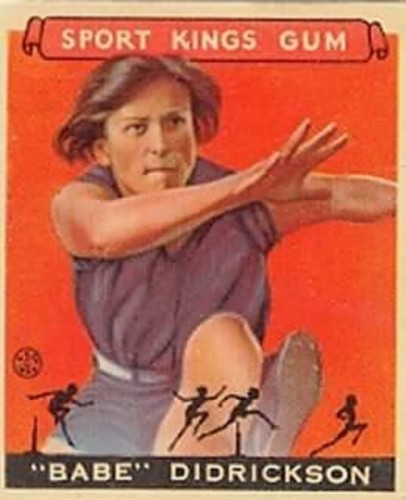
Beaumont was home to the young Mildred “Babe” Didrikson (1911-1956), one of the greatest athletes of all time. The Didriksons moved here when Babe was a child, after a flood destroyed their Port Arthur home. As one biographer put it, the Didrikson home (at 850 Doucette Avenue) was in an area “full of rednecks and roughnecks, hard-knuckled families living in washboard poverty.” The busy, noisy street had an oil refinery at one end and a trolley line running down the middle. Around the neighborhood, Babe wore boys’ pants, overalls, and athletic undershirts. Her boyish manner made her a social outcast at school, but she later advised that “a girl that wants to become an athlete and do some winning should…start by being a tomboy.”

And she was indeed an athlete who did “some winning.” From 1930 to 1932, Babe held the American, Olympic, or world records in five different track and field events. After her stunning gold-medal victories at the Los Angeles Olympics in 1932, one newspaper headline declared, “Babe Breaks Records Easier Than Dishes.” When she returned from her Olympic triumph, Babe’s father built an apartment for her and her sister on the second floor of the Doucette Avenue house, consisting of two small rooms, a hallway, and a bathroom. Her sister called the bathroom “Babe’s Hollywood bathroom…the most beautiful bathroom in Beaumont,” complete with a bright green tub like one that she had seen and admired in Los Angeles.

Babe went on to excel in numerous sports, including softball, bowling, javelin throwing, boxing, billiards, tennis, and diving. But her greatest distinction by far was as a golfer. In 1935, she came under the protective wing of Bertha Bowen, a powerhouse in Texas golf, who not only helped her game but transformed her looks and physical demeanor as well. Babe – whose “masculine” appearance and competence in male sports had given rise to the suspicion that she was a lesbian – went from cross-dressing to cultivating a traditionally feminine look, including skirts, waved hair, rouge, red nails; she even acquired a husband, the wrestler George Zaharias, in 1938. During her short career, the “ultimate Amazon” won 82 professional and amateur golf tournaments; was named Associated Press’s Woman of the Year six times; and was a founding member of the Ladies Professional Golf Association (LPGA).

The museum documents Babe’s life and achievements, housing many of her athletic trophies. Don’t be surprised when you don’t find any reference to her bisexuality, or that her intimate companion, the young golfer Betty Dodd, is treated as solely a friend. Babe, Betty, and George all lived together in Florida from 1950 until Babe’s death from colon cancer in 1956. Of Babe’s husband, Betty later said, “We always had a lot more fun when he wasn’t around.”

Babe is buried at the Forest Lawn Memorial Park, 5220 Pine Street, in Beaumont. The state of Texas maintains a historical marker at her gravesite.