Feeds:
Posts
Comments

“Attached” to Women

Frances_E_Willard_House,_1730_Chicago_Avenue,_Evanston_(Cook_County,_Illinois)

Evanston, Ill.

Frances Willard home
“Rest Cottage”
1730 Chicago Avenue

Frances Willard (1839-1898) left her hometown in Wisconsin to attend Evanston College for Ladies. After a teaching career at various women’s colleges, she became president of her alma mater in 1871 and then dean of women at Northwestern University when the schools merged two years later. In 1874, with the founding of the Women’s Christian Temperance Union, Willard resigned from her post to become the WCTU’s corresponding secretary. Five years later, as WCTU president, she led a national movement for “Home Protection.” Her temperance campaign was a direct reaction against the violence (both physical and emotional) perpetrated on women and children by alcohol-abusing men, and it eventually led to the enactment of Prohibition in 1919.

In her autobiography, Glimpses of Fifty Years, Willard included a chapter titled “Companionships,” in which she outlined her passionate friendships with women over the years. One was with a woman in Evanston she calls “Mary B., for whom my attachment was so great that when she properly preferred my brother… the loss of her was nothing less than a bereavement, a piteous sorrow for a year or more, as my journals testify, one of the keenest of my life.” She referred to her relationships with women as “attachments, so much less restful than friendships.”

For 33 years, Willard’s live-in private secretary was Anna Gordon, also a devoted temperance worker. Willard called Gordon “the rarest of intimate friends” and by the pet name “Little Heart’s-ease.” Gordon stayed on in the house after Willard’s death, becoming president of the WCTU herself in 1914.

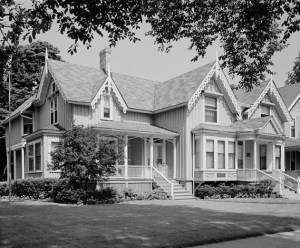
Willard and Gordon’s restored home in Evanston, a National Historic Landmark, is open to the public, appearing much as it did when they lived there. On exhibit are many memorabilia of Willard’s years as a temperance warrior.
Arzner

Los Angeles, Calif.

Dorothy Arzner/Marion Morgan home
2249 Mountain Oak Drive

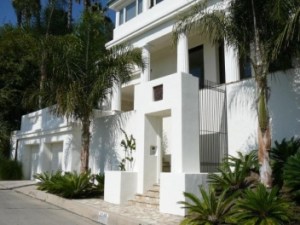
While doing research for a study of film director Dorothy Arzner (ca. 1900-1979), professor Judith Mayne discovered boxes of material relating to Arzner in the UCLA research collection. Inside one box was a photograph of the atrium of Arzner’s opulent home in the Hollywood Hills, with an annotation in the director’s own writing: “Home of Marion Morgan and Dorothy Arzner/1930-1951.” “That moment of discovery was thrilling,” Maybe later wrote in Directed by Dorothy Arzner, “for here was evidence of a home and a life shared by two women.”

Starting as a script typist and working her way up to film editor on such silent movies as Blood and Sand, Arzner progressed to directing in 1927. With credits including The Wild Party, Working Girls, Christopher Strong, Dance, Girl, Dance, and The Bride Wore Red, the butchy Arzner was the only successful female director in Hollywood during its golden age.

arzner-crop

It was on the set of her first movie, Fashions for Women, that Arzner met Marion Morgan, a vaudeville dancer with her own performance troupe and a busy career choreographing movie dance sequences. After working together on several movies, the two women set up their home together in 1930, and they remained devoted to each other until Morgan’s death 40 years later.

Also in the boxes Mayne discovered were numerous snapshots of Arzner and Morgan entertaining guests (among them, Marlene Dietrich) at their elegant home. The photos of the house’s lush atrium suggest a love of natural light and greenery. After Arzner’s retirement from directing in 1951, they moved to a new home in La Quinta, a community in the Southern California desert. There Arzner was an avid gardener whose correspondence made frequent and proud mention of her roses. But even in her retirement, Arzner continued to keep a hand in the industry, teaching at UCLA’s film school, producing plays, and directing Pepsi Cola commercials for Joan Crawford.

RU12

Burlington, Vt.

RU12? Community Center
34 Elmwood Avenue

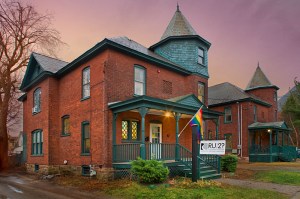
The LGBT community center which would perhaps win the “most unique name” contest celebrates its 10th anniversary this year, founded in 1999 by University of Vermont students who “believed that Vermont needed a multi-generational, substance-free queer space open to people of all ages, races and genders,” to quote its mission statement. The first location for RU12 was “on the waterfront,” but the center moved to this charming building downtown in 2003 (see photo above by Travis Dubreuil, who travels the country photographing queer community centers; visit him at www.thecentersproject.org). Over the years, RU12  merged with the Anti-Violence Project and Equality Vermont, making it a powerful agent for change in the Green Mountain State.

You’ll find an array of programs at the center, such as social and support groups, lesbian health care, a cyber center, a lending library, the Vermont Queer Archives, Vermont TransAction, and the LGBTQ Elder Project. They also sponsor an annual queer community dinner; the Run Against Rape; and the Transgender Day of Remembrance.  Don’t miss it if you travel to scenic little Vermont: it’s the only queer center in the state!

1034627404_l

Albany, N.Y.

Capital District Gay and Lesbian Community Center
332 Hudson Avenue

One of the two LGBT community centers founded in 1971, Capital District Gay and Lesbian Community Center has a unique distinction: it has been in this same location for all of its 38 years. (See photo above.) Executive Director Norah Yates wrote to me that:

We’ve been in this building since 1971; we were started in 1970 and had a storefront at one point, but then started meeting at our address when it was the home of one of our founders.

CDGLCC provides numerous services, including youth programs, cultural events, a café, an art gallery named after lesbian painter Romaine Brooks, an LGBT library, confidential AIDS testing, and a newspaper, commUNITY. The center also sponsors Albany’s annual Capital Pride celebration in June.

steuben

Remsen, N.Y.

Baron Von Steuben Memorial Park
Starr Hill Road at Steuben Memorial Drive

I recently received an email from Lyle in L.A., informing me about a site I hadn’t heard of – the Baron Von Steuben Memorial Park in Remsen, N.Y., Oneida County. Here’s what Lyle has to say about the site:

…there is a monument, a log cabin with historical memorabilia, and huge park grounds.  (The information that I always heard is that while they were building a road on Starr Hill around there, … his body was discovered, and subsequently the park came into being.)  I first knew that Baron Von Steuben was gay from reading Randy Shilts’ book Conduct Unbecoming.

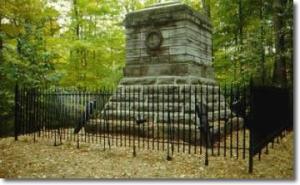
And here’s a bit more about the Baron: He was nicknamed “Drillmaster of the American Revolution.” (Hmm – no comment.) After the war and in recognition of his valuable services to the new country, Congress granted Von Steuben a large plot of land in upstate New York, where he spent summers in a two-room log cabin until his death. The cabin Lyle mentions in his email is a replica of Von Steuben’s original. The monument (see photo) that Lyle notes marks the Baron’s final resting place.

Finally, I think Lyle sums up the need for queer historic sites in one sentence:

To think that this park, which I frequented for twenty years while [I was] growing up in Remsen, was in honor of a gay man is truly fascinating, and I wonder if I had known that while growing up it would have made my life a bit easier.

Cleveland, Ohio

2266 East 86th Street

The home where queer poet Langston Hughes lived while he was in high school – and began developing his voice as a poet – has fallen victim to the recent wave of foreclosures. The East 86th Street house was sold at a sheriff’s auction earlier this year for under $17,000. Read the complete story in the Cleveland Plain Dealer.

Los Angeles, Calif.

Gay Community Services Center
1614 Wilshire Boulevard

With news that the Billy DeFrank LGBT Community Center in San Jose, Calif., which was founded in 1981, may be forced to close its doors unless it can raise $50,000 by September, I decided this was an apt time to start a series of blog entries on LGBT community centers around the country and why they are so important to our people. Thanks to Richard Burns (former ED of the NYC LGBT Community Services Center) for the idea, and Terry Stone of CenterLink for sending me some terrific photos of centers, which you’ll see in upcoming posts.

The gay community center movement got its start just a couple of years after the Stonewall Riots. As noted by CenterLink, the national association of LGBT centers, the idea was “revolutionary”: “that lesbian and gay people deserve to live open, fulfilling and honest lives free of discrimination and bigotry, with access to culturally appropriate social services, as equal partners in the cultural and civic life of the community.” Prior to the founding of centers, many gay people had no organized meeting places in which to find support, friendship, lovers, and services, other than bars and ad-hoc meeting spots, like the early gay bookstores. Now, many LGBT people will tell you how local community centers saved their lives.

The Los Angeles, Calif., and Albany, N.Y., LGBT centers both claim the distinction of being the first in the country. Since the founding of those two organizations in 1971, the community center movement has grown exponentially, with 181 now listed in the CenterLink directory.

This address on Wilshire Boulevard was the first location of what was then called the L.A. Gay Community Services Center (they added “lesbian” nine years later, and dropped the word “Services” along the way). The physical space changed locations several times over the next three decades; its main building is now at 1625 North Shrader Boulevard (there are four additional buildings). From humble origins, the L.A. center grew to be the largest in the country, with a $43 million budget, serving a quarter of a million people annually. The center provides mental health services, legal help, a cyber center, recovery services, youth programs, an HIV/AIDS clinic, a lesbian health clinic, senior services, and much more.

(Next in the series: the Capital District Gay and Lesbian Community Center, Albany, N.Y.)

800px-Macondray_Lane_1

San Francisco, Calif.

Macondray Lane

Macondray Lane is best known as the inspiration for Barbary Lane, the fictional Russian Hill street of Armistead Maupin‘s Tales of the City series. In 1976, Maupin’s story began as a daily serial in the San Francisco Chronicle, relating the adventures of an eclectic group of residents at 28 Barbary Lane. When it was published as a book in 1978, Tales was an immediate best-seller. Maupin followed a community of friends and lovers, straight and gay, through six volumes, ending with Sure of You in 1989. His chronicle of Barbary Lane proved a keenly observant satire of the ’70s and ’80s, and was an early chronicler of the AIDS epidemic in fiction. In 2008, he revisited the characters in a new novel, Michael Tolliver Lives.

A Queer Connection

Fort

Harpers Ferry, W.V.

John Brown’s Fort
Shenandoah and Potomac Streets

On a recent trip to the Harpers Ferry area, I didn’t expect to find any “queer places.” But sure enough, there was a tangential one.

Among the men who joined abolitionist John Brown in his famous raid on Harpers Ferry on Oct. 16, 1859, was Lewis S. Leary, an African-American harness-maker from Oberlin, Ohio. Brown’s plan was to seize the federal arsenal, arm African-Americans for an uprising, and rid the country of slavery.

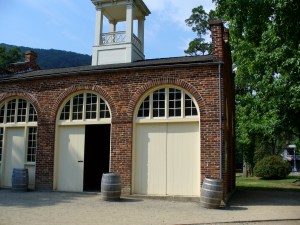
At first the plan seemed to work, as Brown’s “army” stormed the town and took captives. But then the U.S. Marines, under the command of J.E.B. Stuart, were called in, and Brown and his men holed up in this “fort” (above), which was actually the town fire house. The raid was squelched, Brown was executed, and Leary died at age 24 of wounds he suffered during the raid. The event, which has its sesquicentennial this year, is widely considered a prelude to the Civil War.

So what’s the queer part? Leary’s widow, Mary Patterson Leary, went on to marry a second time, to abolitionist Charles Henry Langston. Among her grandchildren was queer poet Langston Hughes, who lived with her in Lawrence, Kansas, during his early childhood.

california_hall

San Francisco, Calif.

California Hall
625 Polk Street

You’ve probably been reading about the police raid on a gay bar in Fort Worth, Texas, just last month – an unusual and shocking event these dayss. In the 1960s, however, police harassment of gay people was de rigueur. Take the New Year’s Ball of 1965, held at this San Francisco site on January 1. The ball was a “respectable” event, organized by six homophile organizations to raise money for the newly formed Council on Religion and the Homosexual, which was designed to open communication between the established church and the city’s gay community. Though council members met with police in advance to ensure a smooth-running event without incident, the police didn’t hold up their end of the bargain. (Surprise!) As intimidation, they took photographs of each person entering the fundraiser and parked patrol wagons outside the hall. Several attorneys were arrested for arguing with a policeman at the entrance.

Despite the deliberate police harassment, 500 people, gay and straight, lay and clergy, attended the ball. Outrage against police interference ran high after the event and led to a greater politicization of the homophile community, which demanded certain changes in police dealings with gays. Concessions ultimately obtained from the city included having a police liaison to the gay community, a hotline for minority groups against police brutality, and a National Sex Forum to educate officials and police about human sexuality.