Feeds:
Posts
Comments

Archive for the ‘historic sites’ Category

stein.jpg

Baltimore, Md.

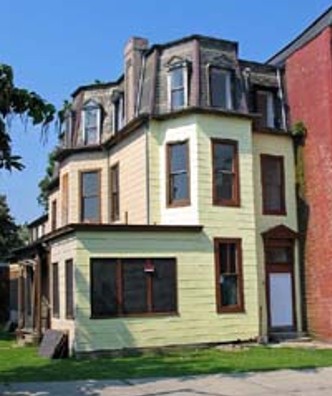
Gertrude Stein residence
2408 Linden Avenue (private)

Gertrude Stein’s (1874-1946) first ambition was not to be a writer, but a psychologist. After studying psychology with William James at Harvard, Stein was accepted at the John Hopkins Medical School, where her brother, Leo (with whom she was very close), was also enrolled. She lived with relatives at this address (on the National Register of Historic Places since 1985) for about a year, then moved in with Leo at 215 East Biddle Street.

Stein was unhappy and unfulfilled in medical school. She was also on the brink of discovering her lesbianism. While living in Baltimore, Stein ran with a lesbian crowd, a group of Bryn Mawr College graduates led by a young woman named Mabel Haynes. Sadly for her, Stein fell unrequitedly in love with Haynes’ “romantic friend,” May Bookstaver. The experience made a deep impression on Stein, whose first novel, Q.E.D., completed in Baltimore in 1903, was an autobiographical account of this lesbian love triangle.

Unlike most of Stein’s work, Q.E.D. was openly lesbian in content and language. Stein put the finished manuscript away for 30 years, and then, in 1932, unearthed it and showed it to her agent, who advised against trying to publish it because of its “controversial” theme. Q.E.D. was finally published in 1950, four years after Stein’s death.

Stein left Baltimore in 1903 to visit Leo, who had moved to Paris, and to try to forget May Bookstaver. Paris agreed with her, and she lived there the rest of her life, meeting Alice B. Toklas, her life companion, in 1907. And May Bookstaver and Mabel Haynes? They both pursued much more traditional lives, ending their affair and marrying men.
Read Full Post »

newportarmynavyymca.jpg

Newport, R.I.

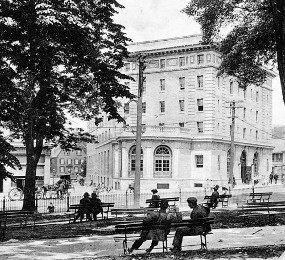
Army and Navy YMCA
50 Washington Square

Since the early 20th century, YMCAs have been gathering places for gay men. Newport‘s Army and Navy YMCA, a Beaux Arts-style building, opened in 1911, and when the fleet was in – Newport was home to an important naval training station – the building was often filled beyond capacity. Here soldiers and sailors could bank, shop at the canteen, and eat a homestyle meal. Activities included swimming, bowling, and jogging (and numerous other “indoor sports,” to be sure). The administrators also showed movies and sponsored cabaret evenings of song and performances.

In his article, “Christian Brotherhood or Sexual Perversion? Homosexual Identities and the Construction of Sexual Boundaries in the World War I Era,” historian George Chauncey relates the story of an official navy investigation in 1919-20 of homosexuality in Newport. Under orders from then-Assistant Secretary of the Navy, Franklin Roosevelt, young enlisted men acted as decoys to entrap homosexuals, gathering information and later testifying before a naval court of inquiry and at several civilian trials. Twenty sailors and sixteen civilians were arrested as a result of the “investigation.”

The decoys reported that the YMCA, as well as nearby beaches and wharfs, were havens of homosexual activity. Some gay sailors lived at the Y, while others just rented rooms for the night. “Fagott” [sic] parties, the investigators found, were commonplace at the Y in the evenings. The gay men who frequented the Y also engaged in homosexual activities in other cities and maintained contacts with gay men in New York, Providence, and Fall River. But, Chauncey found, in addition to the men who identified as “queer,” there were men who regularly enjoyed homosexual sex but thought of themselves as heterosexual.

Newport‘s YMCA reached its peak in 1951, during the Korean War. When the Navy began downsizing during the Nixon administration, attendance at the Y fell off, and it was closed in 1973. It is now an apartment building for low-income residents.

“The Army and Navy Y.M.C.A. was the headquarters of all cocksuckers [in] the early part of the evening…. everybody who sat around there in the evening…knew it.”

–Navy investigator, 1920

Read Full Post »

We’wha

wewha.jpg

Zuni, N.M.

Zuni Pueblo
1203B State Highway 53 (off U.S. 40)

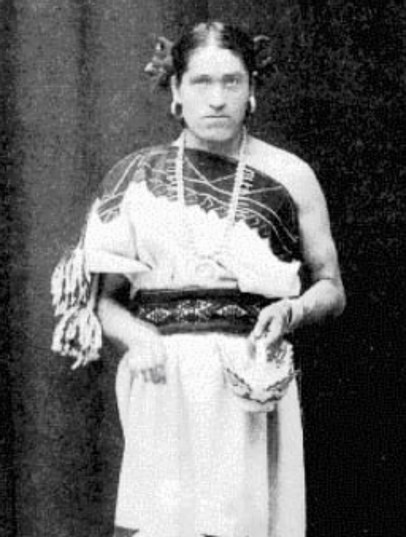
On the border of New Mexico and Arizona is the Pueblo of Zuni, which was once home to one of the most famous two-spirited people, We’wha (1849-1896). Today, the Zuni still relate stories about We’wha, an accomplished weaver and potter who was one of the first Zuni to sell wares for cash. Anthropologist Mathilda Coxe Stevenson described We’wha as “the strongest character and the most intelligent of the Zuni tribe.” In 1886, We’wha spent six months in Washington as Stevenson’s guest, becoming the hit of the capital’s social scene and being generally accepted as an “Indian princess.”

In Zuni culture, We’wha was a lhamana, an individual who combined male and female work and social roles and often dressed in women’s clothing. (Among whites, such individuals were commonly known as berdaches, a French colonialist word meaning “slave boy.”) A lhamana was neither exclusively female or male; of We’wha, they said, “She is a man.” Gay historians disagree about whether or not the lhamana role was exalted or lowly. Some contend that lhamana were holy people – priests and artists – while others say their role was one of humiliation and passivity.

As a child, We’wha lost both parents and was adopted into the family of an aunt. In many photographs at the Smithsonian Institution, We’wha can be seen weaving in front of the family dwelling, which was located in the southeast corner of the Zuni pueblo. The pueblo is open to “respectful guests” every day until dusk. (For more info, visit http://www.experiencezuni.org/home.html.)

Read Full Post »

carson-mccullers.jpg

Columbus, Ga.

Smith-McCullers House Museum
1519 Stark Avenue

This modest white frame house was the childhood home of writer Carson McCullers (1917-1967), who was born Lula Carson Smith. (Her actual birthplace was at 423 Thirteenth Street in downtown Columbus.) Carson‘s first fantasy was to be a concert pianist, but a childhood spent reading books and writing and performing skits eventually led to her true vocation. In a 1948 article, “How I Began to Write,” she remembered writing and producing plays in the Stark Avenue house, using the front sitting room as an auditorium and the back sitting room for the stage. The two rooms were separated by walnut pocket doors that functioned as a stage curtain. Carson enlisted her brother and sister as performers, and their proud and supportive mother invited people from the neighborhood to the performances. Carson described their theatrical repertory as “eclectic, running from hashed-over movies to Shakespeare and shows I made up and sometimes wrote down in my nickel Big Chief notebooks.”

Carson was not popular in school – she was withdrawn and cared little about her clothes or appearance – and she was taunted by other girls as being “freakish” or “queer.” She never dated boys until she met Reeves McCullers, a soldier stationed at Fort Benning, in the summer of 1935. Reeves courted Carson at the Starke Avenue house, bringing her mother flowers and candy – and beer and cigarettes for Carson – and they married here two years later. Carson and Reeves had a stormy relationship, rife with drama, that ended finally with Reeves’ suicide. Both were bisexual and at one time were in love with the same man, composer David Diamond.

Carson‘s mother lived in this house until her husband’s death in 1944. Plagued by illness throughout her life, Carson frequently returned to Columbus to recuperate under her mother’s care. Eventually, mother and daughter lived together in Nyack, N.Y., in a house bought with the money from the sale of the Stark Avenue house. The house is now open to the public by appointment (706-327-1911); it also operates as an artists’ retreat, offering residencies to writers and musicians.

Read Full Post »


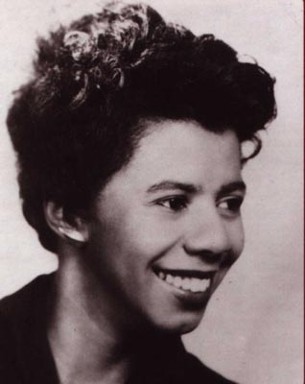
lorrainehansberry.jpg

Chicago, Ill.

Lorraine Hansberry homes and sites

5330 S. Calumet Avenue on the Southside of Chicago was the first home of playwright Lorraine Hansberry (1930-1965). Hansberry later described the black neighborhood as having “scrubbed porches that sag and look their danger. Dirty gray wood steps. And always a line of white and pink clothes scrubbed so well, waving in the dirty wind of the city.”

When Hansberry was a young child, her father, a prosperous businessman, moved his family to a middle-class white neighborhood of Chicago (6140 Rhodes Avenue), where their house was surrounded by an angry white mob and a brick thrown through the window. It was the difficulty of blacks seeking better housing in traditionally white neighborhoods that Hansberry placed at the center of her celebrated play, A Raisin in the Sun (1959). Raisin was the first play by an African-American woman to be produced on Broadway.

Hansberry was committed to the discussion of social injustice. After college, she moved to New York City, where she worked for Paul Robeson’s journal, Freedom, and studied African history with W. E. B. DuBois. Hansberry also became an ardent feminist. Though she married Robert Nemiroff in 1953, they separated amicably a few years later, when Hansberry began the process of coming out as a lesbian in Greenwich Village. A subscriber to the early lesbian magazine, The Ladder, she wrote several letters to the editor – signed “L.H.N.,” for Lorraine Hansberry Nemiroff in 1957 in support of lesbian rights and feminism.

Sadly, Hansberry died of cancer at the young age of 34, with plans for many more plays than she was able to write. Her contribution as an African-American woman to literature is recognized at the Lorraine Hansberry branch, Chicago Public Library, 4314 South Cottage Grove Avenue.

I’m glad as heck that you exist. You are obviously serious people and I feel that women, without wishing to foster any strict separatist notions, homo or hetero, indeed have a need for their own publications and organizations. Our problems, our experiences as women are profoundly unique as compared to the other half of the human race…. I feel that THE LADDER is a fine, elementary step in a rewarding direction.

–extract from Lorraine Hansberry [L.H.N.] letter to the editor, The Ladder, May 1957

Read Full Post »


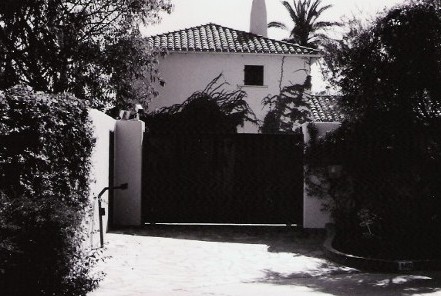
Los Angeles, Calif.

Rock Hudson home – “The Castle”
9402 Beverly Crest Drive (private)

Situated on a ridge overlooking Beverly Hills, “The Castle” was home to actor Rock Hudson (1925-1985) from 1962 until his death. At the height of his career, Universal Studios purchased it for him as part of his contract renewal. Made of Spanish-style stucco with a red tile roof, the house was protected by a massive gate in the front and high cliffs on three sides, which ensured the closeted actor’s privacy. Oddly, though, the gate to the house and the front door were never locked. A friend explained, “He liked the excitement of the unknown.”

In his authorized biography, Hudson gave a detailed description of the house he loved and spent 23 years meticulously restoring. The interior included two living rooms, a steam room and gym, a theater with stage and footlights, and four fireplaces. Hudson liked to name the rooms of the house, and he christened his bedroom “the blue room” because it was carpeted in a rich royal blue. His bed was an immense wooden fourposter carved with a nude male figure. One of his favorite spots was the “playroom,” or theater, which had originally been a garage. It housed a vast collection of films and all the best in projection equipment. A collection of rare records filled one wall. On the wooden stage, he rehearsed upcoming roles.

The Castle was decorated in what one of Hudson‘s friends termed “early butch” – dark wood, pewter candlesticks, zebra skins, and an assortment of wrought iron. On the red-tiled patio stood sculptures of naked boys. The patio led to a 40-foot pool with jacuzzi and lion’s head fountain, and a 20-foot barbecue that could cook enough meat to feed a hundred people. Also on the three-and-a-half acres was a greenhouse overflowing with orchids.

For most of his years at The Castle, Hudson lived alone with his female housekeeper and seven dogs. But occasionally, he had a live-in lover. When he did, he was careful to maintain two separate phone lines for “appearances,” and to make sure he was never photographed with the other man.

After his death from complications of AIDS, Hudson‘s memorial service was held at The Castle, attended by several hundred guests who were treated to chili, margaritas, and a mariachi band. If Hudson‘s life in Beverly Hills had screamed ostentation, then so did his death.

Read Full Post »

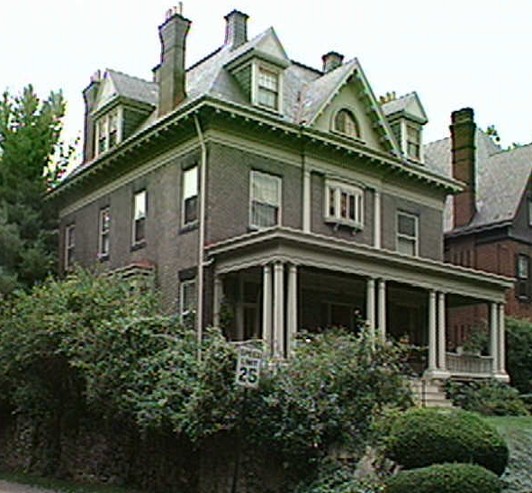
McClung house

Pittsburgh, Pa.

Willa Cather residence
1180 Murray Hill Avenue (private)

Although we generally associate her with Nebraska, where she grew up, novelist Willa Cather (1873-1947) lived in Pittsburgh from 1896 to 1906, during which time she worked as managing editor of the women’s magazine, Home Monthly, and then as drama critic for the Pittsburgh Leader; she also did a stint as a high school English teacher. In 1899, she met and fell in love with Isabelle McClung, a young socialite and patron of the arts, whose father was a prominent judge. McClung invited Cather to move from her South Craig Street boarding house and live with her and her wealthy family in their mansion in the Squirrel Hill neighborhood. The two young women shared a bedroom at the back of the 13-room house, and took an extended tour of Europe together in 1902.

At a social occasion at the McClungs’ house, Cather met the publisher of McClure’s Magazine, who offered her an editor’s job in New York. She moved to Manhattan and found a life partner in Edith Lewis, but stayed in close contact with McClung throughout her life; the pair even took vacations together until McClung married a man in 1915. There are no surviving letters between them, as Cather destroyed all her correspondence.

Read Full Post »

Dickinson homestead

Amherst, Mass.

Emily Dickinson home
280 Main Street

Emily Dickinson, pre-eminent 19th-century American poet, rarely left her stately yellow clapboard house in the sleepy town of Amherst. Literary history has portrayed her as a recluse, a pathologically shy spinster, when, in fact, she suffered from Graves disease, which caused frequent urination and quite possibly the need to stay close to home. A dedicated artist, she enjoyed a full life writing in her second-floor bedroom, where she composed reams of poems that she sewed together into handmade books. When Dickinson died, her sister discovered the books in a bureau drawer and unwittingly took apart the stitching, so that the poet’s original intent in ordering her manuscripts has been lost.

Dickinson’s home is now owned by Amherst College and is open only by appointment. When I was there, the caretakers of the Dickinson Homestead seemed a tad nervous about the suggestion that the great poet was a lesbian – in affectional orientation, if not in actual sexual practice. During the tour, visitors see the famous photograph of Emily at eighteen (the only one in existence), in which she looks every inch the serious poet. But they also see a retouched photo, in which Emily is burdened with elaborately curled hair and a frilly lace collar – a painstaking attempt on the part of the curators to “femme” her up. This is probably how she looked in later life, the guide contends, not as “plain” as in the early photo.

On the tour I took, there was much discussion about the men in Emily’s life – her alleged “gentlemen callers” – and almost nothing about Sue Gilbert, the sister-in-law with whom she shared an ardent daily correspondence via a clothesline connecting their adjacent homes. “If you were here – and Oh that you were, my Susie, we need not talk at all, our eyes would whisper for us, and your hand fast in mine, we would not ask for language. . . .” Beloved “Susie” may also have been the subject of some of Emily’s passionate poetry. One of Emily’s bedroom windows wistfully faces the home Sue shared with Austin Dickinson. Describing Emily’s room, the guide told us, “There were no closets in the 19th century” – ironic, considering how careful the Dickinson caretakers are to “straighten out” Emily!

“Susie, will you indeed come home next Saturday, and be my own again, and kiss me as you used to? . . . I hope for you so much and I feel so eager for you, feel that I cannot wait, feel that now I must have you–that the expectation once more to see your face again, makes me hot and feverish. . . .”

–Emily Dickinson to her sister-in-law, Sue Gilbert Dickinson

Read Full Post »

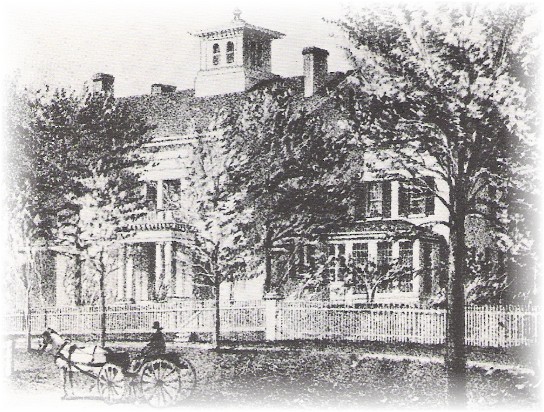
Whitman birthplace, 1903

Huntington, N.Y.

Walt Whitman birthplace
246 Old Walt Whitman Road (off Route 110)

In the midst of a sprawl of suburban development (across from the “Walt Whitman Mall”) is the carefully preserved family home of the Good Gray (Gay?) Poet, Walt Whitman. Built somewhere between 1810 and 1816 by Whitman’s father, the small shingle house, originally located on sixty acres of farmland, was the site of the poet’s birth and very early childhood. By that year, Whitmans had been farming in the vicinity known as West Hills since the mid-1600s, and the region is still sprinkled with historic structures associated with the extended family.

Whitman’s birthplace is now a museum and state historic site that is open to the public. (It’s shown above in a 1903 photo.) Downstairs are period rooms, while upstairs is a modern exhibit with photos and documents from Whitman’s life, including a first edition of Leaves of Grass. Not surprisingly, the museum’s interpretation of Whitman is missing any overt reference to his homosexuality. His lover Peter Doyle, for example, is referred to as his “Confederate veteran pal” – but to their credit, the curators do display the well-known photo of Walt and Pete sitting close together, looking very much like a queer couple.

Whitman’s father moved his family to Brooklyn in 1823 to pursue a career in carpentry and construction, but when an economic depression hit in the late 1830s, the family returned to Long Island. Over the next few years, young Walt – who himself left his formal schooling behind at age 11 – taught school in a number of Long Island towns, including briefly at the Smithtown Schoolhouse, 9 Singer Lane, earning $72.70 for five months of work. The desk he used as a schoolmaster at the Woodbury School, Woodbury Road and Jericho Turnpike, is on display at the birthplace.

During his teaching years, Whitman used his early training in printing to found The Long Islander, a weekly newspaper out of Huntington that is still in circulation (its masthead includes, “Founded by Walt Whitman”). On his own, he wrote, edited, typeset, and delivered the paper. Restless to try something else, he sold the paper the following year, but over the next 20 years, he continued to hold editorial positions at various newspapers on Long Island, in Brooklyn, and in New York. In his editorials he was outspoken in his advocacy of social, economic, and political reform.

The years he spent on Long Island proved an influential part of Walt Whitman’s upbringing. A frequent swimmer at Montauk Point, Whitman’s poetry abounds with sensual references to the power and beauty of the ocean. Many of his early sketches and short stories from the 1830s contain typical Long Island scenes. And his 1882 reminiscences, Specimen Days and Collect, include many recollections of the people among whom he had lived – the most “hospitable, upright, common-sensible people anywhere about.”

You sea! I resign myself to you also – I guess what you mean,
I behold from the beach your crooked inviting fingers,
I believe you refuse to go back without feeling of me,
We must have a turn together, I undress, hurry me out of sight of the land,
Cushion me soft, rock me in billowy drowse,
Dash me with amorous wet, I can repay you.

–Walt Whitman, “Song of Myself”


Read Full Post »

“A past lacking tangible relics seems too tenuous to be credible.”

–David Lowenthal, The Past Is a Foreign Country

I can’t remember a time when I wasn’t attracted to historic places. As a child, my parents didn’t have to drag me to Civil War battlefields and historic house museums; I went willingly. As an adult, my first professional job was at a restored historic village. I still think a vacation is incomplete unless I’ve taken in at least one town that time forgot. Once asked about my favorite magazines, I named Preservation, the magazine of the National Trust for Historic Preservation, at the top of my list. Judging from the popularity of places like Plimoth Plantation and Colonial Williamsburg, there are a lot of other people out there like me.

But one thing that historic sites and travel guides never taught me was about a most important part of myself – my heritage as a gay person in this country. If it weren’t for the work of lesbian and gay historians in the past few decades, queer history would be buried, right where many homophobic people would like it to be. Even in the late 1990s, when I first compiled a print guide called The Queerest Places (published by Henry Holt 12 years ago; now out of print), many gay people I spoke to were unaware that they had any significant collective history at all. “That’ll be a short book!” one lesbian actually said to me when I told her about the project. On the contrary, I found an abundance of historic sites related to lesbian, gay, bisexual, and transgender history. Some were popular tourist attractions that had never been written about from a queer perspective. Others were sites that had not been written about at all. Still others no longer existed, victims of time or urban renewal projects. Now, the age of blogging seems the perfect time to revive and expand my project.

For my purposes, I define a “historic site” as any house, structure, or geographic location with an association to an historic queer person or event. A site need not be listed on the National Register of Historic Places, nor does a structure need to be still standing to be included in this study. By “queer” I mean individuals of gay, lesbian, or bisexual orientation, either of an affectional or sexual nature, and also transgendered people.

Some folks will undoubtedly find this site and snort, “Hrmph! Herman Melville’s gay? Where’s her proof?” I don’t always have the kind of evidence that would hold up in a court of law or that traditional (heterosexual) scholars would accept. In fact, I don’t actually believe that “proof” of gay or lesbian sexual relations is required to reclaim a historical figure as queer, any more than “proof” of heterosexual intercourse is required to name a person straight. The very idea that we need “proof” assumes that being queer is “wrong” and that to “accuse” someone of homosexuality is a terrible thing to do.

Like others investigating the queer past, I have had to devise an alternate detective system. Because lesbians and gay men have had to hide for such a long time, many of the rules of evidence simply don’t apply. Something as seemingly cut-and-dried as heterosexual marriage and children, for example, can’t rule out that someone was gay – how many of your gay friends were in heterosexual marriages once, too? In claiming people as queer, I look at how they lived their lives – their friends and community, their work, their relationships. And yes, I sometimes rely on rumor and gossip, which has been called the “oral history” of queer people.

So welcome, read and learn, suggest sites you’ve visited, and come back often to explore some of the “tangible relics” of the queer past.

Paula Martinac 


Read Full Post »

« Newer Posts