Feeds:
Posts
Comments

Archive for the ‘gay and lesbian’ Category

ingefrontyard

Independence, Kansas

William Inge Center for the Arts
Independence Community College
1057 W. College Avenue

Included in this center’s collections are books, tapes, and records from the private cache of playwright William Inge (1913-1973), who attended college here and gave his original manuscripts to the school in 1969. Inge is best known for four successful Broadway plays that were subsequently made into films – Come Back, Little Sheba (1950), Picnic (1953 – won the Pulitzer Prize), Bus Stop (1955), and The Dark at the Top of the Stairs (1957). Also a screenwriter, Inge won an Academy Award in 1961 for the original script of Splendor in the Grass.

Inge was born and raised in Kansas, and all of his plays took that state as their setting. His boyhood home at 514 N. 4th Street is still standing (see above), and was the setting for The Dark at the Top of the Stairs. The home is owned by the William Inge Festival Foundation, and each year, playwrights-in-residence are selected to come to Independence to live in the house and write for nine weeks at a time.

Inge’s work often focused on the repressed sexuality and stultifying social norms that he must have experienced in his own life. A closeted gay man and an abuser of alcohol, Inge included a few characters who were gays stereotypes in his later, lesser-known plays, written in the 1960s after his success had faded. His one act, “The Boys in the Basement,” dealt with a man’s discovery of his homosexuality and was his only play to address the topic directly. Sadly, Inge committed suicide at his home in Hollywood in 1973. He is buried in Independence.
Read Full Post »

150px-LucyDiggsSlowewindow

Washington, D.C.

Lucy Diggs Slowe window
Howard University chapel
Sixth Street & 
Howard Place, N.W.

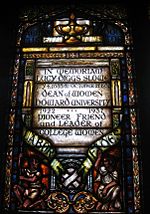
Lucy Diggs Slowe (1883-1937) was the first dean of women at Howard University, a position she held from 1922 until her death. A window in the university chapel (see above) honors her memory. As dean, Slowe worked for empowerment of women, urging female students into the social sciences and other (at that time) nontraditional fields. Concerned for the safety of young women in the “big city,” Slowe expanded the university’s dorm facilities so women could live on campus. Outspoken and headstrong, Slowe often locked horns with the university president over the welfare of the female students.

Slowe shared a home at 1256 Kearney Street, N.E., with her life partner, writer and teacher Mary Powell Burrill, who had earlier been involved with Angelina Weld Grimke. Their residence was an informal gathering place for young Howard women, many of whom idolized their intrepid dean. In a bid to curb her power, Howard’s president once suggested that Slowe herself live in a dorm – a seemingly homophobic attempt to break up the household that had become a source of strength for her.

Read Full Post »

Casting a Vote

Parkhurst_image

Soquel, Calif.

Soquel Firehouse
4747 Soquel Drive

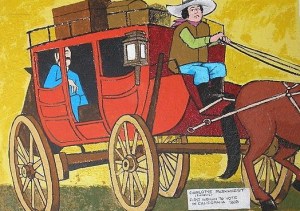
A plaque at this location honors the memory of Charlotte “Charley” Parkhurst (1812-1879), a passing woman. As a young girl, Charlotte escaped from an orphanage in the East by donning boys’ clothing and learning how to drive a six-horse team. Heading west, Parkhurst made a living as a stagecoach driver (see the painting above, from the Soquel post office), beginning in the early years of the California gold rush. On November 3, 1868, Parkhurst reputedly marched into this firehouse, the local polling place, and cast a vote in the presidential election, fifty years before women were granted suffrage. The plaque notes that Parkhurst “shot and killed at least one bandit.” Like so many other passing women, Parkhurst’s birth sex was discovered only after death. Parkhurst is buried in Watsonville.

Read Full Post »

219sdurhamdisp

Baltimore, Md.

Billie Holiday home
219 South Durham Street

Billie Holiday (1915-1959) had a rough childhood. As a young girl named Eleanora Fagan, she cut school so often she was sent to live at the House of the Good Shepherd, a home for “colored girls” run by the Little Sisters of the Poor (Claverton Road and Franklin Street). There, she may have had her first lesbian experiences.

Returned to her mother after a year, the two took up residence at this address, one of dozens they occupied over the years. The house is still standing, but the original brick façade was covered over with Permastone in the 1950s. It was in this house, in 1926, that Eleanora was raped by a neighbor and subsequently sent back to Good Shepherd. But she was a handful, and the sisters refused to keep her for long.

At only 11 years old, Eleanora earned money cleaning for a whorehouse madam. The madam let her listen to the records of Louis Armstrong and Bessie Smith, who had a combined influence on her singing style. Eleanora began singing at various storefront churches, but her first professional gig was at Buddy Love’s, a club located at Orleans and Wayside.

As a young teenager, Eleanora moved to New York with her mother, and pursued a singing career, transforming herself into Billie Holiday. After years of touring with Count Basie, she was offered her first steady job at Café Society in 1938, earning $75 a week. From that, she went on to be featured soloist at clubs all over the country, acquiring the nickname “Lady Day.” Her distinctive voice, which she used like a musical instrument, transformed jazz singing. “I don’t think I’m singing,” she once said of her style. “I feel like I’m playing a horn.”

Holiday had many affairs with both men and women, but was known as a “les” among many of her peers in the music industry. One of her female lovers reported that “Billie even got the name Mister Holiday, because she was seldom seen with fellas.” Holiday once told a colleague, “Sure, I’ve been to bed with women… but I was always the man.”

Sadly, by the 1940s Holiday was addicted to heroin and alcohol, and she was arrested on drug charges several times. Many club owners would no longer take the risk of hiring her because she was often high during performances. Her career went progressively downhill, and she finally died in 1959 of liver cirrhosis and other complications of substance abuse.

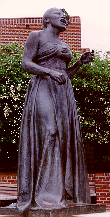
A commemorative statue of Holiday stands in Baltimore at 1300 Pennsylvania Avenue.

holi

Read Full Post »

columbus_ga_ma_raineys_house

Columbus, Ga.

Ma Rainey home
805 Fifth Avenue

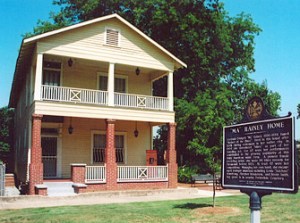
Gertrude Pridgett / Ma Rainey (1886-1939) was born in Columbus to parents who were minstrel performers, and she began her own singing career at the tender age of 14 at the local Springer Opera House. She went on the road in 1902, and two years later married Will Rainey (nicknamed “Pa”), who led a touring company called the Rabbit Foot Minstrels (billed as “The World’s Most Famous Colored Show”).

Although her marriage didn’t last long, Rainey herself enjoyed a 30-year career, and through her live performances and recordings became a nationally recognized blues singer nicknamed “Mother of the Blues.” In 1935, she retired to this house, which she had built for her mother; she is buried in the town’s Porterdale Cemetery. Once endangered and almost demolished by the city, Rainey’s house was saved through an arduous fundraising process. It has been lovingly restored, and is now open to the public.

Besides her own prodigious talents, Ma Rainey also gave the world Bessie Smith, whom she discovered as a young girl on the streets of Chattanooga, and with whom she may have been lovers. Throughout her life, Rainey pursued affairs with women, and in the 1920s was arrested for holding a lesbian orgy in her apartment. Among her gutsy queer blues numbers was “Prove It On Me Blues,” in which she openly defended cross-dressing and lesbianism. An advertisement for the recording showed a woman in full male drag escorting two very feminine flappers. Rainey also wrote about her husband’s sexual relationship with a “queen” named Miss Kate, in a song called “Sissy Blues.”

Went out last night with a crowd of my friends,
They must have been women ’cause I don’t like no men.
They say I do it, ain’t nobody caught me,
They sure got to prove it on me.

–from “Prove It On Me Blues” by Ma Rainey

Read Full Post »

williams

Nantucket Island, Mass.

Tennessee Williams retreat
31 Pine Street

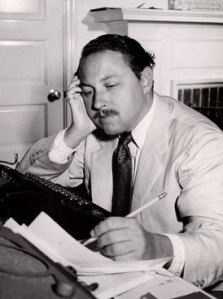
In the summer of 1946, playwright Tennessee Williams and his lover at the time, Panch Rodriguez y Gonzalez, were renting a “wind-battered, gray two-storied house” at this address on the island of Nantucket. (It’s still there – see it at Google Maps.) Williams had been ailing on and off all year and was having difficulty with the play he was trying to write, which was then called Chart of Anatomy.

Earlier that year, Williams had read Carson McCullers’ novel The Member of the Wedding, and wrote her a fan letter. A mutual friend arranged for McCullers to visit Williams on Nantucket for a weekend. The two writers had an immediate rapport, and the “weekend” quickly turned into half the summer. Together they swam, rode bicycles, and enjoyed candlelit dinners. Stationed at opposite ends of the cottage’s long dining room table, Williams worked on his play’s first draft, while McCullers began transforming The Member of the Wedding into a play.

At the end of his new friend’s visit, Williams presented McCullers with a jade ring that had belonged to his beloved sister, Rose, who like McCullers had suffered from depression and ill health. And when completed, Williams’ play – with the revised title Summer and Smoke – was dedicated to McCullers.

Read Full Post »

Carriage

San Antonio, Texas

Hertzberg Circus Museum (closed)
210 West Market Street

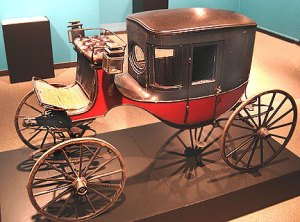
Harry Hertzberg (1884-1940) was a prominent local lawyer and state senator, who was also gay, according to recent research. Hertzberg and his longtime partner, Tom Scaperlanda, were circus fans who began collecting Big Top memorabilia in the ’20s and amassed one of the largest collections of that type in the country, totaling more than 42,000 items on circus history from 1893 to the 1930s. Among the items collected were a miniature model of a three-ring circus, posters, photographs, sheet music, costumes, literature, and specialty items, such as an 1843 carriage built for Tom Thumb (above), and memorabilia from Buffalo Bill’s Wild West shows.

The two men left their collection to the City of San Antonio, and, beginning in 1968, many items were on permanent exhibit at this location, a former public library. Unfortunately, in 2001, the museum closed due to the deteriorating condition of the building. Two years later, the city reached an agreement with the Witte Museum to take in the circus collection. The book and document archives are still in the San Antonio Public Library system and are available on an appointment-only basis to researchers (210-207-2500).

Read Full Post »

kerouacburroughs

St. Louis, Mo.

William S. Burroughs home
4664 Pershing Avenue

Author William S. Burroughs (1914-1997) was born on this quiet, tree-lined street, and the large, 3-story house belonging to his family is still standing. Burroughs’ family was wealthy: in 1885, Burroughs’ grandfather had invented the adding machine.

Young Burroughs began writing at age 8, and his first effort was a 10-page “novel” entitled “The Autobiography of a Wolf.” From then on, he wanted to be a writer, and penned everything from westerns to adventure stories to horror. As a teenager, he became obsessed with true crime and began writing detective and gangster fiction.

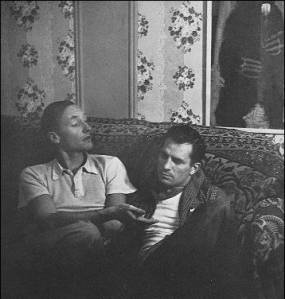
It was also in his teens that he first experimented with drugs (he later became addicted to heroin), and formed a romantic attachment with another boy at his boarding school. Drug addiction and homosexuality would become the primary themes of his adult fiction. Living off a monthly stipend from his family, he moved to New York City, where he and pals Jack Kerouac (above, right, with Burroughs) and Allen Ginsberg formed the core of the Beat Movement.

After Burroughs was arrested for possession of narcotics, he tried to start a new, drug-free life as a cotton farmer in Texas. But he was on and off junk and in and out of rehab, and when he was arrested a second time, he and his wife, Joan, decided to relocate to Mexico. There, in 1951, he accidentally shot and killed Joan during a drunken game of “William Tell.”  He lived much of the rest of his life in self-imposed exile in Europe and Tangiers.

Burroughs later claimed that his wife’s tragic death “motivated and formulated” his writing, but Kerouac and Ginsberg – who considered him a genius – were instrumental in spurring him on. Ginsberg (Burroughs’ occasional fuck buddy) helped get his first novel, Junkie (1953) published. Burroughs’ most famous novel was Naked Lunch (1959), a title suggested by Kerouac. It was a surrealistic account of an addict’s life, which was banned in Boston and was at the center of a famous censorship trial.

In all of his work, Burroughs drew on the genres that had fascinated him as a child writer in St. Louis and transformed them, creating his own distinctive and subversive brand of literature.

Read Full Post »

Ladder

San Francisco, Calif.

Daughters of Bilitis / The Ladder
693 Mission Street

Started in 1955 as a social group providing an alternative to the bars, the Daughters of Bilitis (DOB), the first U.S. lesbian organization, expanded rapidly into a lesbian rights organization. The name “Bilitis” was taken from a poem by Pierre Louys about a lesbian of the ancient Greek poet Sappho’s time.

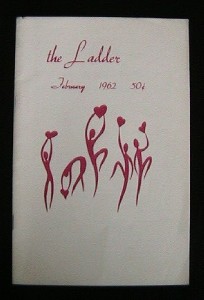
Launched in 1956, DOB’s magazine, The Ladder, started with a post office box number but by its fourth issue was listed at this Mission Street address. Its masthead listed Phyllis Lyon as editor and Del Martin as assistant editor. Lyon and Martin were a couple, and remained so until Martin’s death in 2008. They were the first couple to be legally married in San Francisco after the state Supreme Court legalized same-sex marriage.

Early issues of The Ladder contained articles such as “A Citizen’s Rights in Case of Arrest” and the regular column “Lesbiana,” which briefly reviewed books of interest. The magazine’s subscription coupon specified that is cost “$2.50 a year, mailed in a plain, sealed envelope.” The Ladder also included a monthly calendar of DOB events.

The Ladder remained at this location until 1958, when DOB membership and magazine subscribers had grown so much that the group found new, roomier quarters on O’Farrell Street. (Did they know that Alice B. Toklas, lover of Gertrude Stein, had once lived on O’Farrell Street?) The magazine remained in publication until 1972.

Read Full Post »

Nichols & Kameny 1965

Washington, D.C.

Frank Kameny house (private)
5020 Cathedral Avenue, N.W.

The house that gay rights pioneer Frank Kameny (b. 1925) has called home since 1962 won’t win any architectural prizes; it’s just a modest, two-story brick house built in 1955. But in February 2009, it was designated a Washington, D.C. historic landmark, in recognition of its significance, as the Washington Post put it, as “the epicenter of the gay rights movement in the nation’s capital” for 13 years.

Kameny served in World War II, earned a doctorate at Harvard, and came to D.C. to work as an astronomer for the Army Map Service. But in 1957, he was fired for being gay. He didn’t give up, and took his case all the way to the U.S. Supreme Court in 1961. The discrimination he experienced turned him into a lifelong activist for gay rights. One of his many accomplishments was helping head up the struggle to have homosexuality removed from the American Psychiatric Association’s list of mental illnesses.

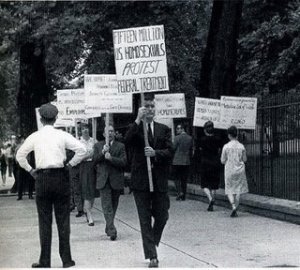
Kameny’s papers are now at the Library of Congress, and the Smithsonian Institution houses artifacts related to his gay activism, such as placards used in protests (like that shown above, in 1965). Many of those placards, Kameny has said, were made in the living room of this house. His home has now been nominated for recognition on the National Register of Historic Places.

Read Full Post »

« Newer Posts - Older Posts »