Feeds:
Posts
Comments

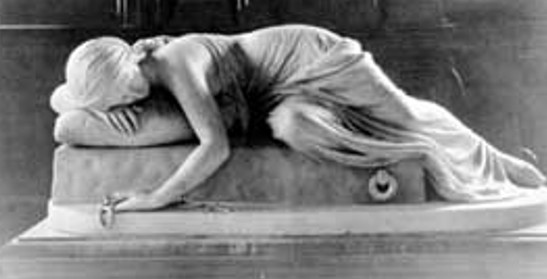
beatrice.jpg

St. Louis, Mo.

Statue of Beatrice Cenci (1856)
St. Louis Mercantile Library
Thomas Jefferson Library Building
One University Blvd.

Originally from Watertown, Massachusetts, Harriet Hosmer (1830-1908) applied to study anatomy – as preparation for sculpting the human body – at Boston Medical School and other eastern schools and was refused admittance. Wayman Crow, the father of one of her school friends, got her into the Missouri Medical College in St. Louis, where Hosmer lived with his family while she was a student. Crow, a prominent St. Louis businessman, became a lifelong benefactor of Hosmer, and his influence helped obtain important commissions for her. Among her public sculptures in the city are the Senator Thomas Hart Benton statue, Lafayette Park, and “Beatrice Cenci” at the Mercantile Library.

Back in Boston, Hosmer ran with a lesbian crowd, including Charlotte Cushman, the actress and art patron, and her lover, sculptor Emma Stebbins. While touring the country, Cushman was invited to visit the Crows, Hosmer’s second family, and became infatuated with Emma Crow, Wayman’s daughter, addressing her in letters as “my darling little lover,” much to Wayman’s dismay. When Cushman traveled to Rome, Hosmer went with her to study sculpture, writing to her worried benefactor: “I shall keep a sharper lookout on Miss Cushman and not allow her to go on in this serious manner with Emma – it is really dreadful and I am really jealous….” Knowing Wayman would disapprove, Hosmer used the convenient excuse of “keeping a lookout” on Cushman to justify living with her in Rome.

Throughout her life, Hosmer claimed that all she wanted to do was get married, but she never did. In a letter to Wayman, she joked, “I have been searching vainly for Mr. Hosmer.” In 1858, Nathaniel Hawthorne and his wife visited Hosmer at her studio in Rome, and the writer gave a telling description of her: “She had on a male shirt, collar, and cravat…. She was indeed very queer….”
matlovich_grave.jpg

Washington, D.C.

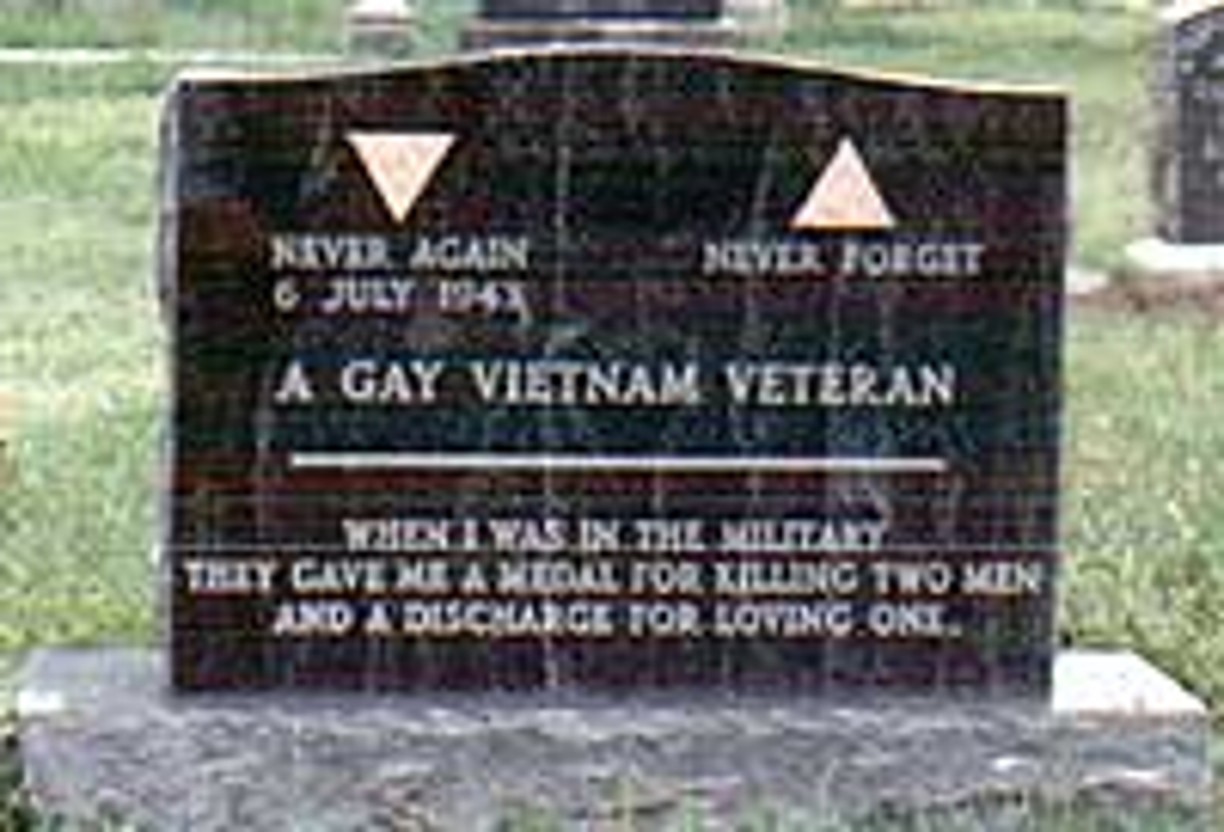
Leonard Matlovich grave
Congressional Cemetery
1801 E Street, S.E.

Air Force Sergeant Leonard Matlovich’s (1943-1988) tombstone reads “Never Again, Never Forget — A Gay Vietnam Veteran — When I was in the military they gave me a metal for killing two men and a discharge for loving one.” Matlovich, who did three tours of duty in Vietnam and earned a bronze star, was discharged from the Air Force in 1975 when he publicly declared his homosexuality. After three years of fighting the decision, Matlovich won his case and was given the opportunity to be reinstated in the USAF or settle. He chose to settle and donated some of his money to lesbian and gay organizations, including the San Francisco Gay Men’s Chorus. The rest he used to open a pizza parlor in Guerneville, the gay resort on the Russian River north of San Francisco, which he operated until illness made it impossible for him to work.

Matlovich succumbed to AIDS in 1988 and received a veteran’s burial in Washington, D.C., complete with caisson, eight-member honor guard, and an Air Force bugler playing taps. But gay activists were his pallbearers, and his mourners carried lavender flags. “I’ve always been gay,” Matlovich once said, “and for most of my life I prayed not to be that way…. However, the harder I prayed the queerer I got. That must have been God’s response.”


Gay Key West

I received the following press release today about an upcoming film that looks kind of interesting, on the history of gay Key West. A friend of mine – a gay male architect – once pointed out the fact that queer resorts often tend to be at the tips of land: Key West, Provincetown, Fire Island. Similarly, the gay part of any regular old beach tends to be the furthest point you can go – for privacy, I’m sure, but also possibly because of sodomy laws, when those were in existence.

Anyway, here’s the release (or most of it anyway – I cut the begging for money part for space):

Gay History Film To Begin Production in Key West

KEY WEST, Fla./EWORLDWIRE/April 19, 2007 — “I didn’t come out of the closet, I came out of an armoire,” quipped over 40-year Key West resident Larry Harvey in a pre-interview for the upcoming film, No Closet Space, the History of Gay Key West.

No Closet Space, the History of Gay Key West will be the first-ever film about the impact the lesbian, gay, bisexual, transgender (LGBT) community has had on the city of Key West, and, in turn, about Key West’s impact on American LGBT history in general.

“There is quite a story here,” says local filmmaker Tim Dahms. “Key West just wouldn’t be Key West without the LGBT community, and American LGBT history in general wouldn’t be nearly as rich and interesting if not for Key West.”

Notables such as Tennessee Williams, Gore Vidal, Truman Capote, and Leonard Bernstein spent leisure time there, and their stories are the stuff of local legend. [My note: Hm, they seem to have forgotten about Elizabeth Bishop…]

“In my research for this film, I’ve found many, many people who have lived much of the rich LGBT history of the island and who have wonderful stories to tell,” added Dahms, “and they tell them with such color and panache.”

“I’m very excited about what the final film will be like – it will be definitely entertaining!”

No Closet Space, the History of Gay Key West will combine the stories of notable locals and historians with old photographs, film, and especially music, to tell the fascinating tale of the history of LGBT Key West.

“It’s a project whose time has definitely come,” said Dahms.

CONTACT:
Tim Dahms
FLV Hosting
PHONE. 239-405-3316
EMAIL: tvpro1@comcast.net
http://noclosetspace.com

His Town

wilder.jpg

Hamden, Conn.

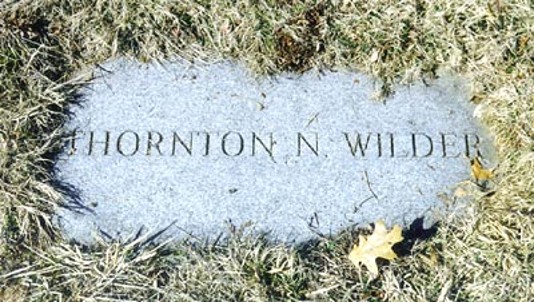
Thornton Wilder gravesite
Mt. Carmel Cemetery
3801 Whitney Avenue

If you’ve visited my other blog, “A Very Gay Play,” you know that I wrote a play called Their Town on the topic of same-sex marriage that was inspired by Thornton Wilder’s classic Our Town. It seemed to me the height of irony that the most-produced play in this country – one considered quintessentially American – was written by a closeted gay man.

Though he spent the early part of his life in Wisconsin, California, and Shanghai, Wilder (1897-1975) called Hamden, Conn., home from 1929 on (his home at 50 Deepwood Drive is still standing), and it is in this town that he’s buried.

Wilder won the Pulitzer Prize three times, for The Bridge of San Luis Rey (1927), Our Town (1938), and The Skin of Our Teeth (1942). A lifelong bachelor who as a young man described his own walk and mannerisms as “queer,” Wilder was intensely homophobic. He commented to Gore Vidal that “a writer ought not to commit himself to a homosexual situation of the domestic sort” because it would damage his career. As a result, Wilder experienced only arm’s-length infatuations, often with actors (including Montgomery Clift), and brief, clandestine sexual encounters. He would have hated this website (and my play!) – he believed that to speculate on the sexuality of famous writers was simply to “whip up a prurient oh-ha! in millions of people.”

courtroom.jpg

Monroeville, Ala.

Old Courthouse Museum
31 North Alabama Ave.

I’m currently reading Mockingbird, a portrait of writer Harper Lee, and enjoying the bits and pieces of her life that match up with her classic novel, To Kill a Mockingbird. That novel is a favorite of mine, as is the movie of the same name – I even have much of the dialogue committed to memory. (“Miss Jean Louise – Miss Jean Louise, stand up! Your father’s passing!”)

Scout Finch is, of course, the quintessential queer kid, along with her friend Dill (based on Lee’s childhood friend and neighbor Truman Capote). I dissected the queerness of Lee’s story and the film a few years back – on the occasion of Gregory Peck’s death – in an article called “To Queer a Mockingbird.”

The town of Monroeville – where Lee still lives part of the time – boasts Lee as its claim to fame. The town hosts an amateur performance of a play based on Lee’s novel every May (billed as “Alabama‘s hottest theater ticket”). The play is staged in the Old Courthouse, which was the inspiration for the Maycomb County Courthouse of Lee’s story – the place where Atticus Finch makes his impassioned defense of Tom Robinson (see photo above). The courthouse is also a year-round museum with three permament exhibits, including one on Lee and another on Capote. In town, there is also a guided tour, pointing out local spots of note to fans of Lee and Capote.

yaddo42.jpg

Saratoga Springs, N.Y.

Yaddo
Union Avenue (between racetrack and Interstate 87)

Originally the home of wealthy stockbroker Spencer Trask and his wife, Katrina, Yaddo was named by one of the Trask children – her mispronunciation of “shadow.” The Trasks had four offspring, all of whom died young, and Katrina’s grief made her try to envision a brighter future for the estate as an artists’ colony, after she and her husband had died. In 1926, following the Trasks’ wishes, Yaddo welcomed its first colonists and continues to sponsor writers who must apply for residence.

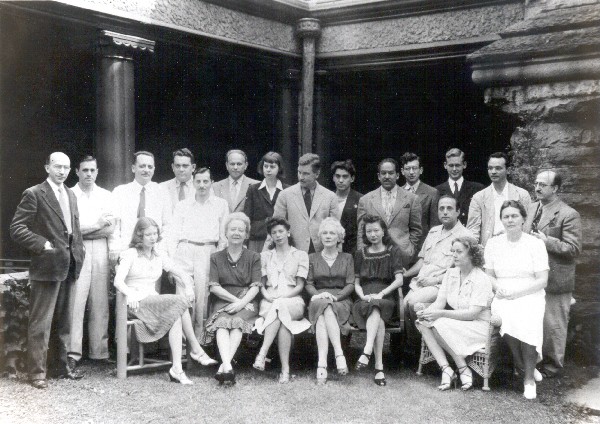
Yaddo is a gloomy, gothic estate, and on an overcast day, it’s easy to believe the rumors that it is haunted by the ghosts of the Trask children. It is also easy to imagine Patricia Highsmith creating her great psychological thriller, Strangers on a Train, in this “shadowy” setting. Yaddo was also a favorite writing retreat for other queer writers, including John Cheever, James Baldwin, Langston Hughes (fifth from the right, second row, in this 1942 photo), and Carson McCullers (three to the left of Hughes), who finished The Member of the Wedding while in residence. McCullers was a frequent visitor to the colony; on her very first visit, she was placed in the coveted “tower room” that had belonged to Katrina Trask. A few years later, Truman Capote worked on his first novel, Other Voices, Other Rooms, in the very same room.

A Gay Culinary Star

Portland, Ore.

James Beard home
2223 SW Salmon Street (private)

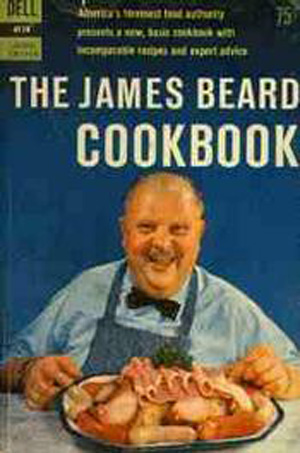
Now an apartment building, this site was once the home of culinary great James Beard (1903-1985). His mother operated a boarding house at this location – she was, in Beard’s words, “a strong-headed, opinionated woman, addicted to theater and the art of entertaining.” She also ran a catering service for her wealthy friends, along with her business partner, Canton-born Jue Let. Beard recalled that his mother’s culinary colleague “taught me ‘taste memory,’ my trump card ability to recapture thousands of memories of eating, right back to my childhood.”

Beard studied locally at Reed College, but in 1922, was expelled from the school for homosexual liaisons with other students and with a professor. (Ironically, in 1974, he received an honorary degree from Reed, after he had become a celebrity.) After the scandal, Beard took voice lessons in London from Enrico Caruso’s coach and later returned to Portland, where he pursued a career as an actor.

Eventually, Beard relocated to New York City, where he achieved fame as the author of numerous best-selling cookbooks.

beard.jpg

The well-known culinary institute, the James Beard Foundation, was named in his honor and is located at the site of the Greenwich Village home he shared with his lover, architect Gino Cofacci.

The Gay White House

Washington, D.C.

The White House
1600 Pennsylvania Avenue, NW

Oh, come on, you’re saying – the White House? A queer place?

Yes, the White House. The resident who comes immediately to mind is Abraham Lincoln, who, as a young lawyer in 1837, rode into Springfield, Ill., looking for a place to stay and found that storekeeper Joshua Speed had a large double bed that he was more than willing to share.

And then there’s James Buchanan, the 15th president, who enjoyed an intimate friendship with William Rufus King, whom he met when both were U.S. senators. King was referred to by Washington insiders as “little Miss Nancy,” “she,” and “Aunt Fancy” – need I say more?

But the person I was really thinking of in listing this most famous address wasn’t a president at all, but a president’s sister. When Grover Cleveland took office as president for the first time in 1885, he was a bachelor in need of a First Lady and White House hostess. His spinster sister, Rose Cleveland, a teacher and editor of a literary magazine, stepped in to help her brother during his first term.

eastroom.jpg

19th-century view of the White House East Room

Cleveland was defeated for re-election, and Rose was once again her own woman. In 1890, she met and fell in love with a young widow named Evangeline Marss Simpson. Gay historian Jonathan Ned Katz has written in detail about the two women’s passionate relationship, including their intimate correspondence: “Oh, Eve,” Rose wrote, “I tremble at the thought of you….Sweet, Sweet, I dare not think of your arms.” The two lived together until 1892, when Eve backed away from the relationship to seek a traditional heterosexual one. In 1893, Rose (once again ensconced at the White House, following her brother’s successful campaign in 1892) wrote to Eve on White House stationery, wishing her dear companion “my best blessing – whatever you do.” Eve went on to marry an elderly Episcopal bishop, Henry Whipple.

Following the bishop’s death in 1901, Eve and Rose renewed their correspondence and finally reunited in Italy, where they lived together until Rose’s death in 1918. Eve died in 1930 and requested that she be buried beside Rose.

Notes on a Native Son

New York, N.Y.

James Baldwin home
131st Street and Fifth Avenue (private)

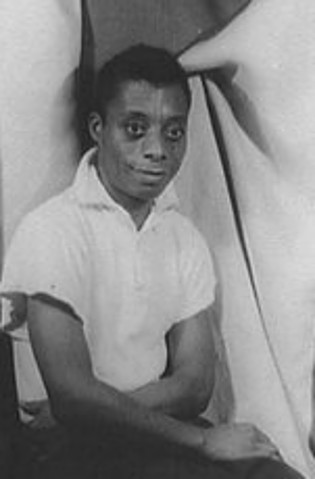
A housing project has been on this site in Harlem for almost 50 years, but the first home of writer James Baldwin (1924-1987) was once located here. Baldwin wrote vividly and movingly of the deteriorating neighborhood in his essay, “Fifth Avenue Uptown: A Letter from Harlem,” calling the avenue “wide, filthy, hostile.” “Walk through the streets of Harlem,” he admonished his readers, “and see what we, this nation, have become.”

jamesbaldwin.jpg

Baldwin remembered a bleak, poverty-stricken childhood, where his playgrounds were the roof of his building and a nearby garbage dump. He escaped a brutal stepfather and a troubled home life through books and writing. One of his junior-high teachers, Countee Cullen, spent much time working with him on his fiction and poetry. Baldwin also found solace in the church, becoming an evangelical minister at the age of fourteen. Go Tell It On the Mountain (1953), his first novel, is an autobiographical work focused on his early life in Harlem.

Baldwin worked a number of after-school jobs to help his family, and at one such job in downtown Manhattan in 1940, he met the painter Beauford Delaney, who became his mentor and possibly his lover. Delaney introduced Baldwin to jazz, art, and to a circle of African-American artists. “The reality of his seeing,” Baldwin later wrote, “caused me to begin to see.” As a young man Baldwin left his family and Harlem for Greenwich Village, where he worked odd jobs to support his writing. In 1948, he took off for Paris, where he lived on and off for the rest of his life. Though he returned to live in New York for periods of time, he didn’t like to stay long, saying that the racism of the city made him too sad.

Baldwin addressed homosexuality and bisexuality in many of his works, most notably Giovanni’s Room (1956), Another Country (1962), and Tell Me How Long the Train’s Been Gone (1968). His own life included affairs with both men and women, but the love of his life seems to have been a Frenchman named Lucien Happersberger, whom he met in 1949. “I starved in Paris for a while, but I learned something,” Baldwin later wrote. “For one thing I fell in love.” Happersberger became Baldwin‘s lover for a while but didn’t share the dream of two men building a life together; he eventually married a woman and named his son after Baldwin.

In addition to fiction writing, Baldwin authored numerous important nonfiction works exploring race and racism. He was himself active in the civil rights movement of the 1960s and continued to speak out about racism until his death from cancer in 1987.

San Francisco, Calif.

Harvey Milk home and Castro Camera
573-575 Castro Street

While we’re on the topic of walking tours…

Cruisin’ the Castro is a popular walking tour of the oh-so-gay Castro district of San Francisco, led by community historian Trevor Howard. The tour includes stops at many sites associated with Harvey Milk (1930-1978), the most famous openly gay politician of our time. Reservations can be made by calling 415-550-8110.

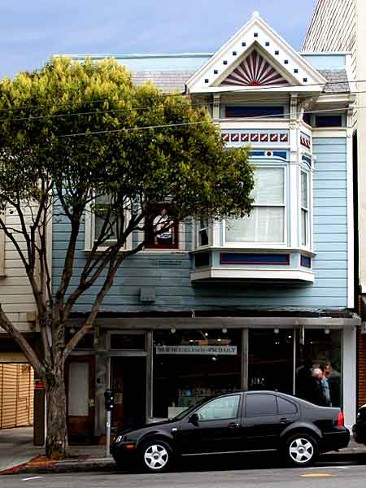
Originally from Brooklyn, Milk moved to San Francisco in 1968, where he worked as a financial analyst and eventually owned a camera shop in the Castro district. This Victorian storefront was the site of Castro Camera, which Milk opened with his lover, Scott Smith, in 1972 and operated for four years. The couple didn’t care that they knew little about cameras – Milk wanted to own a real neighborhood store, like his family back in Brooklyn had. The roomy store had a hand-painted shingle on the door that read “Yes, We Are Very Open.” Harvey and Scott lived upstairs.

castro_camera.jpg

As Milk became increasingly active in local politics, Castro Camera functioned as an ad hoc community center and Milk was the “unofficial mayor of Castro Street.” Signs in the store’s large picture windows advertised demonstrations, protests, and neighborhood meetings; camera and film sales became secondary to politics (the store’s sorry financial picture led the couple to close it in 1976). At night, Milk transferred the addresses from every check written to the store into his own political mailing list.

Milk became involved in organizing gay voter registration drives, helping to establish the first Castro Street Fair, speaking out against Anita Bryant’s antigay campaign, and working against the Briggs initiative, a proposal to bar lesbians and gay men from teaching in California public schools. During the mid-1970s, he made several bids for public office, all of which were unsuccessful. His goal, he once told a friend, was to be mayor of San Francisco.

Then the election of the liberal, gay-supportive mayor George Moscone in 1975 paved the way for Milk’s election to the San Francisco Board of Supervisors in 1977, making Milk the first openly gay elected official in the city’s history. Sadly, both he and Moscone were gunned down by the radically conservative supervisor, Dan White, the following year. White’s lawyer pleaded the infamous “Twinkie defense” – that eating too much junk food had diminished White’s ability to reason. White went to jail anyway, but on the charge of manslaughter rather than murder one. After he was released in 1985, he committed suicide.