Feeds:
Posts
Comments

Archive for the ‘writers’ Category

Indianapolis, Ind.

Janet Flanner birthplace
952 North Delaware

It’s a paint store now, but it was at this location in the St. Joseph Historic District – a fashionable neighborhood of large homes and wide avenues – that journalist Janet Flanner (1892-1978) was born. Her father was a mortician who co-owned a funeral home, ambulance service, and the state’s only crematorium. Her mother was a published poet and producer of amateur theatricals. Though his family was embarrassed by his profession, Frank Flanner’s social position in Indianapolis was suggested by a notice in a local newspaper: “A newcomer to our fair city asked what she might do to become adjusted socially and correctly in our city. The reply was join the Riviera Club, send your children to Mrs. Gates’ Dancing School, and be buried by Flanner and Buchanan.”

Sadly, when Janet was 20 years old, her father poisoned himself in his own mortuary. The scandal rocked Indianapolis, and gossip-mongers blamed everyone from his wife to his business partner to his mother. In her novel The Cubicle City (1926), Janet Flanner based the idealistic, yet suicidal real estate broker, James Poole, on her own father.

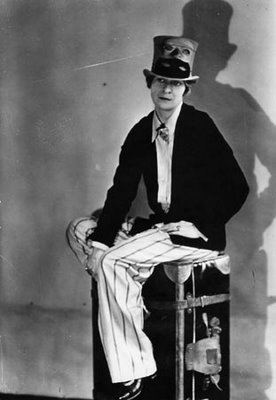
Flanner became a journalist after a brief stint at the University of Chicago. After a few years in New York mingling with the literati and married to a man she didn’t love, Flanner spent most of her adult life abroad, following her first love, journalist Solita Solano, there in 1922. The two women settled in Paris, becoming part of the American artists’ community. Flanner was a regular at Natalie Barney’s salon, and she and Solano were so well known among expatriate lesbians that they appeared as “Nip and Tuck” in Djuna Barnes’ lesbian roman a clef, Ladies Almanack. (She is shown above in a 1927 photo by another lesbian expatriate, Berenice Abbott.)

Flanner is perhaps best remembered for the column “Letter from Paris,” on French culture and personalities, which she wrote for The New Yorker for 50 years, from 1925 until 1975. For her pen name, New Yorker publisher Harold Ross suggested “Genet,” a Gallicized “Janet.” The best of her columns were later collected in the volume Paris Was Yesterday (1972).

Read Full Post »

nyackhouse2

Nyack, N.Y.

Carson McCullers home
131 South Broadway

This rambling, three-story house in the sleepy village of Nyack was home to the writer Carson McCullers (1917-1967) from 1945 until her death. The front of the grand Victorian house faces one of the main streets of Nyack, while the rear sun porch enjoys a stunning view of the Hudson River. It is still a private residence, and was added to the National Register of Historic Places in 2006.

After the death of Carson’s father in 1944, her mother, Marguerite Smith, didn’t have the heart to remain in the Georgia house where she and her husband, Lamar, had raised their family. At the time, Carson’s husband, Reeves, had gone into the army, and she, too, was faced with living alone. She loved the scenic village of Nyack, just twenty-five miles up the river from New York City, so she, her mother, and sister decided to take up residence there in the fall of 1944. Nyack reminded Marguerite of the small, friendly towns she had known in Georgia, so she felt immediately at home.

Carson’s family first rented a specious apartment at 129 South Broadway, and then in the spring of 1945, moved to the house next door, which Marguerite purchased with $9,000 from the sale of her Georgia home. When her mother’s funds dipped in the early 1950s, Carson purchased the house from her with the money she received from selling the screen rights to The Member of the Wedding.

Carson used Nyack as her base in between trips to the artists’ colony of Yaddo, where she did much of her writing, and speaking and teaching engagements all over the country. It was at this home that she gave a luncheon to honor her idol, Isak Dinesen, after the two met at a literary function in 1959. Other guests included Marilyn Monroe and husband Arthur Miller. The high point of the afternoon was apparently a spellbinding tale Dinesen related – in true Scheherazade fashion – about killing her first lion in Africa.

Plagued by ill health, depression, and alcoholism through much of her adult life, Carson suffered her final stroke in this house in the summer of 1967. According to her biographer, Virginia Spencer Carr, the last words she spoke were to the young actor who rented living space in the basement. He stopped by her bedroom and told her he was appearing in the play Stop the World, I Want to Get Off. “Oh, darling, isn’t that a marvelous title,” Carson said. “Ahh, to get off. Wouldn’t that be something. Wouldn’t that be marvelous.” She suffered a massive brain hemorrhage twenty minutes later and died at Nyack Hospital.

Read Full Post »

QUATRE_FINAL_E-BOOK-18

Minneapolis, Minn.

Quatrefoil Library
1619 Dayton Avenue, Suite 105

Quatrefoil Library, the country’s second oldest lending library of materials related to sexual minorities (the Gerber/Hart Library in Chicago was the first), takes its name from the 1951 novel by James Barr, Quatrefoil, which was one of the first to depict gay characters positively. In the mid-1970s, David Irwin and his partner, Dick Hewetson, each began collecting gay-themed books. When they moved in together in 1977, they combined their collections and kept them in the linen closet of their condo, which was soon overflowing with volumes. The two men incorporated their holdings as Quatrefoil Library in 1983, and the first public home of the library opened several years later at 1021 West Broadway. Though their relationship ended not long after the library was incorporated, their important collection of gay literature was able to live on.

The library grew exponentially during its early years and in 1987 found larger, much-needed space at this address (“a cozy set of rooms,” according to one reporter), a former school renovated to house the offices of various organizations. Today, still located at this address, Quatrefoil collects not only books and magazines, but memorabilia, audio and video, games, newspaper clippings, and historical erotica related to sexual minorities. At a celebration in 1991, Quatrefoil‘s author, James Barr, was the library’s guest of honor.

In 2008, the library published its own history; it is available online here.

Read Full Post »

chimney

Pittsfield, Mass.

Herman Melville home
“Arrowhead”
780 Holmes Road

There’s a marked difference in the way that Emily Dickinson’s home and Herman Melville’s are interpreted for the public. Both were prominent 19th-century literary figures, but at the Dickinson homestead (not far from here in Amherst), guides focus on Emily’s “petite figure” and the number of her supposed suitors. By contrast, at Arrowhead, Melville’s writing is of foremost importance, his study the centerpiece of the house.

At Arrowhead, where he lived from 1850 to 1863, Herman Melville (1819-1891) wrote what is considered his masterpiece, Moby-Dick (1851). He was reportedly inspired by the view from the window of his study of Mount Greylock, a rolling mountain with the vague shape of a giant whale. Melville would rise early to feed the farm animals, and then after breakfast light the fire in his study and work on his writing until late afternoon.

It was also here in the Berkshires that his friendship and fascination with Nathaniel Hawthorne, who lived nearby, blossomed, though there is no evidence that the relationship between the two writers was anything but platonic. Melville held a lifelong attraction for sailors, filling his sea tales with homoerotic undertones. If you look carefully at the document displayed under glass on his desk at Arrowhead, you may smile at a line in a letter to his seafaring brother, who had complained about the laziness of his fellow sailors. “For my part I love sleepy fellows,” Herman Melville wrote, “and the more ignorant the better.”

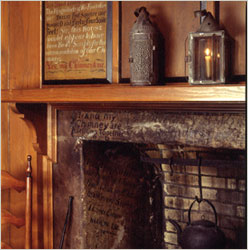
Melville wrote many other works at Arrowhead, including the humorous short story “I and My Chimney,” in which he extolled the virtues of his large stone chimney. Later, Melville’s brother Allan lived at Arrowhead and had the opening sentences of the story inscribed into the fireplace in honor of his famous brother (see photo). At this location, Melville also penned the six stories known as The Piazza Tales, named for the piazza that ran the width of the house, which he added to Arrowhead during his years there.

When he purchased Arrowhead with the help of his wife’s father, Melville had the idea that he would write part time and farm the rest. But he was unprepared for the strenuous life of a farmer, and his experiment finally ended. He moved his family to New York City, where he became a customs inspector. Arrowhead is now operated by the Berkshire County Historical Society and is open to the public for tours.

I have been building some shanties of houses (connected with the old one) and likewise some shanties of chapters and essays. I have been ploughing & sowing & raising & printing & praying, and now begin to come out upon a less bristling time, and to enjoy the calm prospect of things from a fair piazza at the north of the old farmhouse here.”

–Herman Melville

Read Full Post »


mountaingrove2-m

Sunny Valley, Ore.

Rootworks
2000 King Mountain Trail

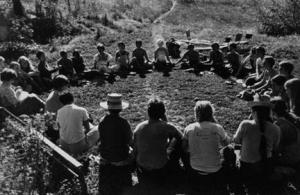
Southern Oregon has a rich history of lesbian and gay back-to-the-land projects. One lesbian separatist community, Rootworks, was established in the 1970s by Ruth and Jean Mountaingrove, when both women were in their 50s. “The philosophy was that we would live without men, separate from the patriarchal world,” Ruth told me in the late ’90s. “That is still pretty much the idea.” (The photo above was taken by Ruth at the commune in the 1970s.)

At Rootworks, there were originally only two houses – the Moonhouse and the Kitchen cabin. In the years that followed the founding, Ruth and Jean added the Sunhouse, a barn (called “Natalie Barney”), and the All Purpose crafts cabin. In the barn is a study and a feminist library. From 1974 to 1984, Ruth and Jean also published the magazine WomanSpirit from an office in the barn, and The Blatant Image, a feminist magazine about photography, was published there from 1981 to 1983; back issues of both are stored in the barn.

Ruth has credited WomanSpirit with bringing a lot of women to the southern Oregon region, by encouraging their creativity and spirituality. Though the magazine folded, Jean said, “the main elements of WomanSpirit are still being lived in the community – feminism, spirituality, all forms of creativity, sisterhood, nature, art, music, dance, literature, healing and personal development.”

Gardens that are nestled around some of the Rootworks buildings are filled with vegetables, beans, and berries. Solar energy provides heat and hot water and also powers the community’s lights. Ruth noted that it’s “not easy in the winter, and that’s when women usually leave.”

In 2008, Linda Long, Manuscripts Librarian for the Special Collections and University Archives at the University of Oregon in Eugene, told Lambda Book Report:

Rootworks is a historical site that is a perfect exemplar of the feminist-lesbian dream. From the 1970s to today, the women’s back-to-the-land community in Oregon was, and is, a dynamic expression of the separatist dream. As part of that dream, women experimented with new ways to live and work together – and with all sorts of activities and rituals, from house-building projects and collective gardening to the sacred circle. Many of the women were aspiring artists of one kind or another – writers, painters, photographers—and they hoped to be able to combine life on the land with their creative work. All of this lesbian/feminist life and work is represented in Rootworks…The permanence of Rootworks and its status as a women-owned land trust in perpetuity makes it a perfect example of a historic site. I think a living museum would be an effective and dynamic way to preserve the lesbian land dream and the history of the lesbian community in Southern Oregon.”

Read Full Post »

A Home by the Sea

21

South Berwick, Maine

Sarah Orne Jewett house
5 Portland Street

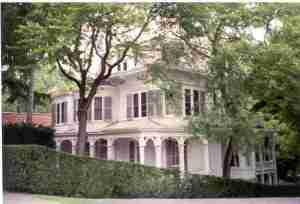
Fiction writer Sarah Orne Jewett was born in 1849 in the smaller dwelling next door (“Haggens House”), but she lived much of her life in this comfortable frame house owned by her grandparents. Eventually, she inherited the house from her grandfather, who was a wealthy trader and sea captain. Jewett’s friend Willa Cather once wrote that she was “born within the scent of the sea but not within sight of it, in a beautiful old house full of strange and lovely things brought home from all over the globe by seafaring ancestors.” Today, the house – a national historic landmark that is open to the public – still contains the Jewett family furnishings, including many items Captain Theodore Jewett brought back from his extensive sea travels.

In the downstairs library hangs a portrait of Annie Fields, Jewett’s intimate companion of more than 25 years, with whom she lived half the year in Boston. (The two held a lively weekly salon at Fields’ home on Charles Street.) The months Jewett spent alone in South Berwick constituted her time for writing and contemplation. “Here I am at my desk again,” read one forlorn letter to Fields, “remembering that this is the first morning in more than seven months that I haven’t waked up to hear your dear voice and see your dear face.”

Upstairs in the writer’s combination bedroom and study is another picture of Fields, as well as a portrait of writer George Sand, given to Jewett by Cather. Next to her bed Jewett kept a container of pencils and pens so that she would have them at the ready in case she woke up with the desire to write. In this house, Jewett penned such novels as A Country Doctor (1884) and The Country of Pointed Firs (1896), which abound in local color. Inspired by the Maine landscape, her fiction focused on “the people who grew out of the soil and the life of the country near her heart,” as Cather phrased it.

Read Full Post »

012072A

New Orleans, La.

Truman Capote home
Monteleone Hotel
214 Royal Street

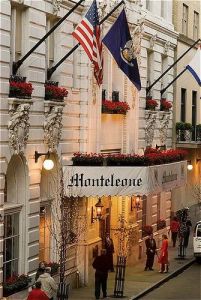
A suite in this elegant, historic hotel at the edge of the French Quarter was the first home of Truman Streckfus Persons (later Capote) after his birth in 1924. Truman’s mother was a 16-year-old beauty queen, his father a traveling salesman, and the boy’s first years were spent in a variety of hotel rooms. When his parents went out, Truman recalled later, they locked him in the hotel room alone.

Truman’s parents were ill-matched and divorced after only a few years, leaving young Truman to the care of different eccentric maternal relative in Monroeville, Ala., where his childhood best friend was Harper Lee. His creative imagination was forged early on. “By the time I was ten,” he remembered as an adult, “I was sitting up all night long to write.” He was also already putting himself to sleep by taking a few swigs of whiskey.

Capote first achieved literary recognition in his early 20s with a number of critically acclaimed short stories in major publications. He wrote much of his first novel, Other Voices, Other Rooms (1948), the story of a young homosexual Southerner, while living in a rented room in New Orleans, also on Royal Street. His subject matter was considered scandalous and offensive, and a reviewer in The New York Times complained, “The distasteful trappings of its homosexual theme overhang it like Spanish moss.” Capote went on to an active literary career anyway – his most famous works included Breakfast at Tiffany’s (1958) and In Cold Blood (1966) – though one that was marred by alcoholism and ill health.

Read Full Post »

A Forgotten Writer

pict08_The-Alice-French-Bell-Pavilion

Clover Bend, Ark.

Alice French bell pavilion
4679 Highway 63

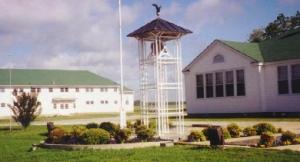
This 500-pound bell (see photo) was given to the town of Clover Bend by writer Alice French (1850-1934), who spent winters here with her life partner, Jane Crawford. French was a novelist and essayist who wrote under the name Octave Thanet, which she used to avoid anti-female bias in the publishing world. Though one of the highest paid writers of her day (money she invested wisely in banks and railroads), French’s work has now fallen into obscurity.

French and Crawford first lived in a lavish plantation house, but it burned to the ground in 1895 and was rebuilt not far away, on a curve in the Black River, as “Thanford.” French spared no expense for the 15-room house, bringing building materials up the river and importing shrubs for the garden from England. The couple lived there during the winters until 1909, making it the site of literary and social activities. French also pursued her interests in woodworking and photography at Thanford.

The U.S. government purchased the Clover Bend land in 1937 and moved the house back from the river for safety. It is no longer standing; a marker on State 228 (6 miles west of Mentura) notes its location.

Read Full Post »

locke

Washington, D.C.

Alain Locke home
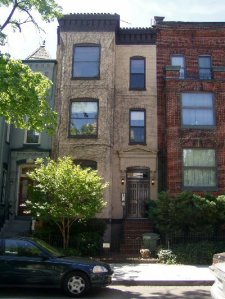
1326 R Street NW

African-American scholar and intellectual Alain LeRoy Locke (1886-1954) defined his role in the Harlem Renaissance as that of “philosophical midwife to a generation of young Negro poets, writers, and artists.” His anthology, The New Negro, was the defining text of that artistic movement.

The Harvard- and Oxford-educated Locke was a professor of philosophy at Howard University for many years, and lived at this address near Logan Circle from 1912 until his death (it is marked with a historic plaque). At Howard, Locke encouraged the study of black culture and history along with the European classics, and founded The Stylus, the university’s literary journal, in which Zora Neale Hurston published her first story. His attention tended to focus on the brightest and most attractive male students, and he routinely warned female students that they could expect no better than C’s in his classes.

Locke shuttled back and forth between Washington and Harlem, where he mentored several queer young poets of the Harlem Renaissance. His protégé Countee Cullen introduced him to Langston Hughes. “You will like him,” Cullen told Locke of the elusive and sexually ambivalent Hughes; “I love him.” A romantic triangle formed and may have been the root of the mysterious rift between Cullen and Hughes from 1924 on.

Read Full Post »

The Real Barbary Lane

800px-Macondray_Lane_1

San Francisco, Calif.

Macondray Lane

Macondray Lane is best known as the inspiration for Barbary Lane, the fictional Russian Hill street of Armistead Maupin‘s Tales of the City series. In 1976, Maupin’s story began as a daily serial in the San Francisco Chronicle, relating the adventures of an eclectic group of residents at 28 Barbary Lane. When it was published as a book in 1978, Tales was an immediate best-seller. Maupin followed a community of friends and lovers, straight and gay, through six volumes, ending with Sure of You in 1989. His chronicle of Barbary Lane proved a keenly observant satire of the ’70s and ’80s, and was an early chronicler of the AIDS epidemic in fiction. In 2008, he revisited the characters in a new novel, Michael Tolliver Lives.

Read Full Post »

« Newer Posts - Older Posts »