
Feeds:
Posts
Comments

Archive for the ‘poets’ Category

fire.jpg

Harlem, N.Y.

267 House
267 West 136th Street

Zora Neale Hurston once wryly dubbed the rooming house that queer writers Wallace Thurman, Bruce Nugent, and Langston Hughes all called home “Niggerati Manor.” The tenement building (also known as “267 House”) was owned by Iolanthe Sydney, a black philanthropist who offered rooms rent-free to artists in order to support their work. Nugent – a painter as well as a writer – reportedly painted brightly colored phalluses on the interior walls.

It was at this address that Thurman, Nugent, Hurston, Hughes, and others started the experimental literary journal Fire!! in the summer of 1926. Each of its seven founders pledged 50 dollars to the effort, but, according to Hughes’s memoirs, only three ever paid up. Since Thurman was the only one with a steady job, his checks paid for the printing bill for the first and only issue.

The journal had a high price tag for the day – one dollar. Hughes later remembered that Fire!! never seemed to make money because Bruce Nugent – who was unemployed at the time – distributed it to booksellers on foot, using the little bit of cash he got from its sale to buy food. (Nugent’s “Smoke, Lilies and Jade,” the first published piece with a homosexual theme by an African-American, was one of the notable pieces included in Fire!!) Ironically, several hundred copies of the journal, which were being stored in the printer’s basement, were burned in an actual fire. It took Thurman four years to pay off the printing bills.

Within two years, the inhabitants of 267 House had all moved elsewhere; but Thurman’s 1932 novel, Infants of the Spring, still provides a glimpse into life at artists’ residence.

“… they walked in silence … Alex turned in his doorway … no need for words … they had always known each other . . .”

–from Richard Bruce Nugent, “Smoke, Lilies and Jade,” 1926
Read Full Post »

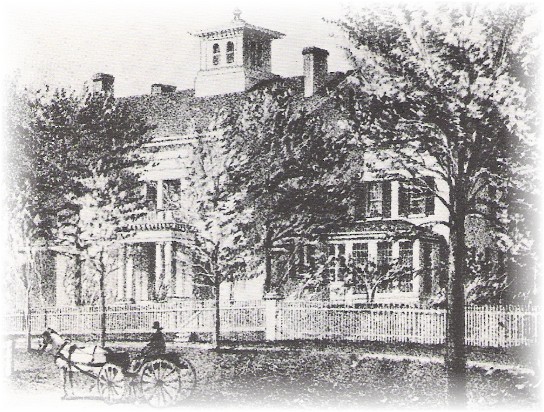
Dickinson homestead

Amherst, Mass.

Emily Dickinson home
280 Main Street

Emily Dickinson, pre-eminent 19th-century American poet, rarely left her stately yellow clapboard house in the sleepy town of Amherst. Literary history has portrayed her as a recluse, a pathologically shy spinster, when, in fact, she suffered from Graves disease, which caused frequent urination and quite possibly the need to stay close to home. A dedicated artist, she enjoyed a full life writing in her second-floor bedroom, where she composed reams of poems that she sewed together into handmade books. When Dickinson died, her sister discovered the books in a bureau drawer and unwittingly took apart the stitching, so that the poet’s original intent in ordering her manuscripts has been lost.

Dickinson’s home is now owned by Amherst College and is open only by appointment. When I was there, the caretakers of the Dickinson Homestead seemed a tad nervous about the suggestion that the great poet was a lesbian – in affectional orientation, if not in actual sexual practice. During the tour, visitors see the famous photograph of Emily at eighteen (the only one in existence), in which she looks every inch the serious poet. But they also see a retouched photo, in which Emily is burdened with elaborately curled hair and a frilly lace collar – a painstaking attempt on the part of the curators to “femme” her up. This is probably how she looked in later life, the guide contends, not as “plain” as in the early photo.

On the tour I took, there was much discussion about the men in Emily’s life – her alleged “gentlemen callers” – and almost nothing about Sue Gilbert, the sister-in-law with whom she shared an ardent daily correspondence via a clothesline connecting their adjacent homes. “If you were here – and Oh that you were, my Susie, we need not talk at all, our eyes would whisper for us, and your hand fast in mine, we would not ask for language. . . .” Beloved “Susie” may also have been the subject of some of Emily’s passionate poetry. One of Emily’s bedroom windows wistfully faces the home Sue shared with Austin Dickinson. Describing Emily’s room, the guide told us, “There were no closets in the 19th century” – ironic, considering how careful the Dickinson caretakers are to “straighten out” Emily!

“Susie, will you indeed come home next Saturday, and be my own again, and kiss me as you used to? . . . I hope for you so much and I feel so eager for you, feel that I cannot wait, feel that now I must have you–that the expectation once more to see your face again, makes me hot and feverish. . . .”

–Emily Dickinson to her sister-in-law, Sue Gilbert Dickinson

Read Full Post »

Whitman birthplace, 1903

Huntington, N.Y.

Walt Whitman birthplace
246 Old Walt Whitman Road (off Route 110)

In the midst of a sprawl of suburban development (across from the “Walt Whitman Mall”) is the carefully preserved family home of the Good Gray (Gay?) Poet, Walt Whitman. Built somewhere between 1810 and 1816 by Whitman’s father, the small shingle house, originally located on sixty acres of farmland, was the site of the poet’s birth and very early childhood. By that year, Whitmans had been farming in the vicinity known as West Hills since the mid-1600s, and the region is still sprinkled with historic structures associated with the extended family.

Whitman’s birthplace is now a museum and state historic site that is open to the public. (It’s shown above in a 1903 photo.) Downstairs are period rooms, while upstairs is a modern exhibit with photos and documents from Whitman’s life, including a first edition of Leaves of Grass. Not surprisingly, the museum’s interpretation of Whitman is missing any overt reference to his homosexuality. His lover Peter Doyle, for example, is referred to as his “Confederate veteran pal” – but to their credit, the curators do display the well-known photo of Walt and Pete sitting close together, looking very much like a queer couple.

Whitman’s father moved his family to Brooklyn in 1823 to pursue a career in carpentry and construction, but when an economic depression hit in the late 1830s, the family returned to Long Island. Over the next few years, young Walt – who himself left his formal schooling behind at age 11 – taught school in a number of Long Island towns, including briefly at the Smithtown Schoolhouse, 9 Singer Lane, earning $72.70 for five months of work. The desk he used as a schoolmaster at the Woodbury School, Woodbury Road and Jericho Turnpike, is on display at the birthplace.

During his teaching years, Whitman used his early training in printing to found The Long Islander, a weekly newspaper out of Huntington that is still in circulation (its masthead includes, “Founded by Walt Whitman”). On his own, he wrote, edited, typeset, and delivered the paper. Restless to try something else, he sold the paper the following year, but over the next 20 years, he continued to hold editorial positions at various newspapers on Long Island, in Brooklyn, and in New York. In his editorials he was outspoken in his advocacy of social, economic, and political reform.

The years he spent on Long Island proved an influential part of Walt Whitman’s upbringing. A frequent swimmer at Montauk Point, Whitman’s poetry abounds with sensual references to the power and beauty of the ocean. Many of his early sketches and short stories from the 1830s contain typical Long Island scenes. And his 1882 reminiscences, Specimen Days and Collect, include many recollections of the people among whom he had lived – the most “hospitable, upright, common-sensible people anywhere about.”

You sea! I resign myself to you also – I guess what you mean,
I behold from the beach your crooked inviting fingers,
I believe you refuse to go back without feeling of me,
We must have a turn together, I undress, hurry me out of sight of the land,
Cushion me soft, rock me in billowy drowse,
Dash me with amorous wet, I can repay you.

–Walt Whitman, “Song of Myself”


Read Full Post »

« Newer Posts