Feeds:
Posts
Comments

Archive for the ‘New York’ Category

CDmthTrkshBths

Lancaster, Pa.

The Demuth Museum
120 East King Street

Born at 109 North Lime Street in Lancaster, the artist Charles Demuth (1883-1935) moved at the age of 7 with his family to this location. Demuth’s family was wealthy, owning the oldest tobacco and snuff factory in the country; their tobacco shop was next door to their home.

Demuth suffered from a childhood disease that left him lame, and he spent several years confined to his bed. But he showed an early talent for painting, and as a young man, was able to study at the Pennsylvania Academy of Fine Arts. Later, he came under the aesthetic mentoring of gay artist Marsden Hartley. Inspired by Hartley’s work, Demuth developed a precisionist style of painting, and his depictions of modern city architecture are what many critics consider his greatest contributions.

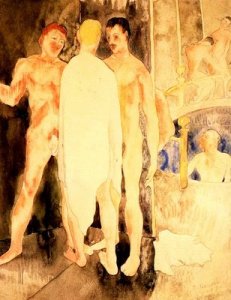
But gay critics are more interested in Demuth’s renderings of the early homosexual community in New York City. In 1918, Demuth accomplished a series of paintings depicting gay men at bathhouses in lower Manhattan (see above). Another group of paintings from 1930 bear names such as “Two Sailors Urinating” and “Three Sailors on the Beach,” and also have a strong gay sensibility. Even Demuth’s later still-life paintings of fruits and flowers are amazingly phallic.

According to one biographer, Demuth was more a voyeur of gay life than an active participant. He traveled in bohemian circles, frequented Mabel Dodge’s salon in New York, was an ancillary members of the Provincetown Players, and spent several summers rooming in Provincetown with Hartley. Eugene O’Neill patterned the sexually ambivalent Charles Marsden in his play Strange Interlude (1928) after the closeted Demuth.

Demuth’s home on King Street is now The Demuth Museum, but at the website, you’ll find scant reference to his homosexuality.
Read Full Post »

Abbott

New York, N.Y.

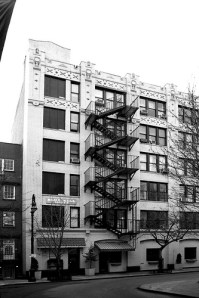
Berenice Abbott studio
50 Commerce Street

Photographer Berenice Abbott (1898-1991) is probably best known for her portraits of artists and writers in the 1920s expatriate community in Paris. Born in Ohio, she left the Midwest at age 22 to study in New York, Berlin, and Paris. While in Paris, she was assistant to the celebrated Man Ray, from 1923 to 1925. She later set out to do her own photographic portraits of such subjects as Jean Cocteau, Andre Gide, and James Joyce.

In 1929, Abbott returned to New York and began a visual chronicle of the city. For years, she lived and worked here on one of the most charming streets in Greenwich Village, above a restaurant called The Blue Mill Tavern, which is still there.

Much of the city’s old architecture was scheduled for demolition, and Abbott wanted to capture it on film before it disappeared. Her important volume, Changing New York (1937), recorded the shifting cityscape before the advent of World War II.

In the years after the war, Abbott became fascinated with new technology, particularly with using photographs to illustrate the laws of physics. Much of her later work was done at the Massachusetts Institute of Technology.

Though she never openly identified as gay, Abbott had several intimate relationships with women during her life. In the early 1920s, she was lovers with Thelma Wood, whom Abbott introduced to writer Djuna Barnes (Nightwood). Wood and Barnes subsequently had a stormy, alcohol-driven love affair. Barnes once commented: “I gave Berenice the extra ‘e’ in her name, and she gave me Thelma. I don’t know who made out better.”

Read Full Post »

yaddo42.jpg

Saratoga Springs, N.Y.

Yaddo
Union Avenue (between racetrack and Interstate 87)

Originally the home of wealthy stockbroker Spencer Trask and his wife, Katrina, Yaddo was named by one of the Trask children – her mispronunciation of “shadow.” The Trasks had four offspring, all of whom died young, and Katrina’s grief made her try to envision a brighter future for the estate as an artists’ colony, after she and her husband had died. In 1926, following the Trasks’ wishes, Yaddo welcomed its first colonists and continues to sponsor writers who must apply for residence.

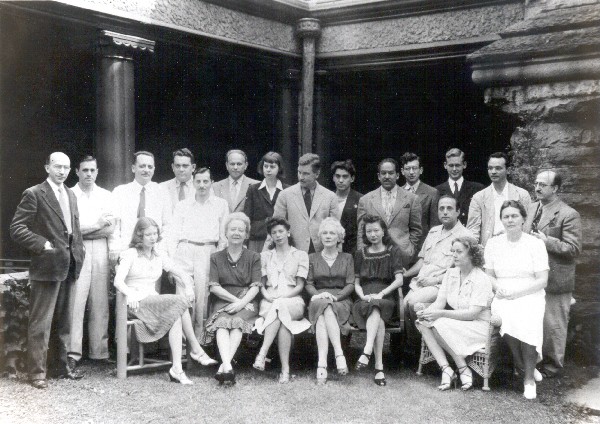
Yaddo is a gloomy, gothic estate, and on an overcast day, it’s easy to believe the rumors that it is haunted by the ghosts of the Trask children. It is also easy to imagine Patricia Highsmith creating her great psychological thriller, Strangers on a Train, in this “shadowy” setting. Yaddo was also a favorite writing retreat for other queer writers, including John Cheever, James Baldwin, Langston Hughes (fifth from the right, second row, in this 1942 photo), and Carson McCullers (three to the left of Hughes), who finished The Member of the Wedding while in residence. McCullers was a frequent visitor to the colony; on her very first visit, she was placed in the coveted “tower room” that had belonged to Katrina Trask. A few years later, Truman Capote worked on his first novel, Other Voices, Other Rooms, in the very same room.

Read Full Post »

New York, N.Y.

James Baldwin home
131st Street and Fifth Avenue (private)

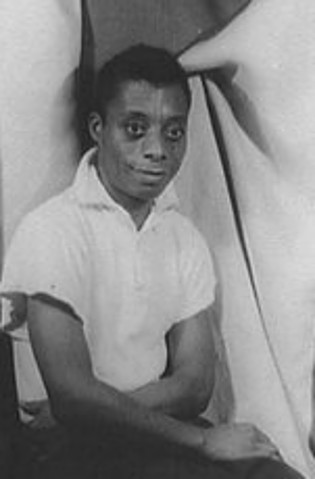
A housing project has been on this site in Harlem for almost 50 years, but the first home of writer James Baldwin (1924-1987) was once located here. Baldwin wrote vividly and movingly of the deteriorating neighborhood in his essay, “Fifth Avenue Uptown: A Letter from Harlem,” calling the avenue “wide, filthy, hostile.” “Walk through the streets of Harlem,” he admonished his readers, “and see what we, this nation, have become.”

jamesbaldwin.jpg

Baldwin remembered a bleak, poverty-stricken childhood, where his playgrounds were the roof of his building and a nearby garbage dump. He escaped a brutal stepfather and a troubled home life through books and writing. One of his junior-high teachers, Countee Cullen, spent much time working with him on his fiction and poetry. Baldwin also found solace in the church, becoming an evangelical minister at the age of fourteen. Go Tell It On the Mountain (1953), his first novel, is an autobiographical work focused on his early life in Harlem.

Baldwin worked a number of after-school jobs to help his family, and at one such job in downtown Manhattan in 1940, he met the painter Beauford Delaney, who became his mentor and possibly his lover. Delaney introduced Baldwin to jazz, art, and to a circle of African-American artists. “The reality of his seeing,” Baldwin later wrote, “caused me to begin to see.” As a young man Baldwin left his family and Harlem for Greenwich Village, where he worked odd jobs to support his writing. In 1948, he took off for Paris, where he lived on and off for the rest of his life. Though he returned to live in New York for periods of time, he didn’t like to stay long, saying that the racism of the city made him too sad.

Baldwin addressed homosexuality and bisexuality in many of his works, most notably Giovanni’s Room (1956), Another Country (1962), and Tell Me How Long the Train’s Been Gone (1968). His own life included affairs with both men and women, but the love of his life seems to have been a Frenchman named Lucien Happersberger, whom he met in 1949. “I starved in Paris for a while, but I learned something,” Baldwin later wrote. “For one thing I fell in love.” Happersberger became Baldwin‘s lover for a while but didn’t share the dream of two men building a life together; he eventually married a woman and named his son after Baldwin.

In addition to fiction writing, Baldwin authored numerous important nonfiction works exploring race and racism. He was himself active in the civil rights movement of the 1960s and continued to speak out about racism until his death from cancer in 1987.

Read Full Post »

Found Image

alberta.jpg


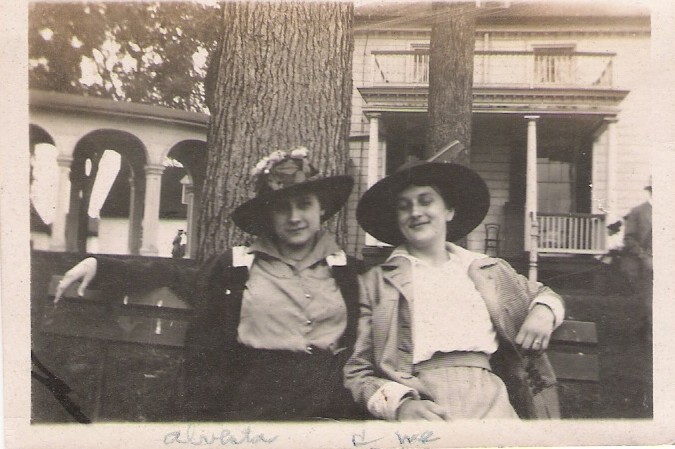
For a change of pace, I thought I’d include this found image that I bought for $1.50 at the 26th Street flea market in New York, probably about 10 years ago. Anyone who knows me can tell you that I’m as fascinated with found images as I am with historic sites; friends of mine have given such photos to me as presents, and they line the mantle in our dining room. In fact, I wrote my first novel, Out of Time, about found images of women together.

What struck my imagination about this photo from the early 20th century was the casual, butch pose of the woman on the left, with her arm around the other, and the cryptic, almost tantalizing note at the bottom: “Alberta & me.” Who was Alberta? Who was “me”? Where are they? Who took the picture? I’d love to hear my readers’ thoughts.

One thing I’d bet money on is that Alberta was a dyke.

Read Full Post »

Handsome Monty

clift.jpg

Brooklyn, N.Y.

Montgomery Clift grave
Brooklyn Friends Cemetery
Prospect Park

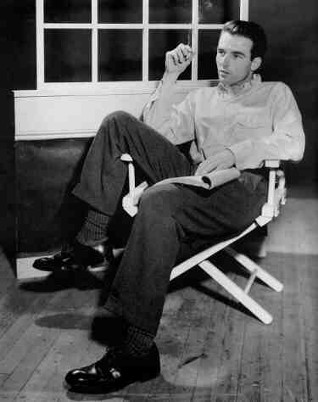
Born in Omaha, Montgomery Clift (1920-1966) began his career as a stage actor, before becoming a leading film star of the late 1940s and 1950s. He starred in such now-classic movies as A Place in the Sun, Suddenly Last Summer (both with Elizabeth Taylor, who was unrequitedly in love with him), Red River, Judgment at Nuremberg, and From Here to Eternity.

But an automobile accident in 1956 nearly ended his career, and Clift underwent massive reconstructive surgery on his handsome face. In the middle of filming Raintree County, again with Taylor, Clift had to take months off before he was able to resume work on the film. Mentally and physically affected by his ordeal, Clift continued to make movies but more and more mourned his “disfigurement” through alcohol and drug abuse and died at the early age of 45 of a heart attack.

Clift’s homosexuality was well known in Hollywood, though he tried to keep it from becoming public knowledge for fear it would hurt his career. He had the reputation for being a loner, and most of his sexual encounters were one-night-stands with male hustlers. In 1949, he was arrested for trying to pick up a hustler on 42nd Street in Manhattan, but the incident was hushed up by his handlers. In the early ’50s, he seems to have had a quiet romance with the playwright Thornton Wilder, another gay man who prized “discretion” and suffered from internalized homophobia.

Clift’s primary residence was in Manhattan from 1951 until his death, first at 209 East Sixty-first Street (destroyed by fire in 1960), and then at the elegant three-story brownstone down the block at 217, a house with four bedrooms and six baths. After a funeral service at the Friends Meeting House, East 15th Street, he was buried at this Quaker cemetery in Brooklyn, and his grave was planted with crocuses by his friend, actress Nancy Walker.

Read Full Post »

caffe_cino_exterior.jpg

New York, N.Y.

Caffe Cino
31 Cornelia Street

From 1958 to 1967, Joe Cino ran a coffeehouse at this address that has gone down in performance history as the place where both gay theater and Off-Off-Broadway were born. The Beat generation cafe was not intended at the beginning as either a theater or a gay hangout, though Cino himself was gay. “My idea,” he said in a Village Voice interview in 1965, “was…to start with a beautiful, intimate, warm, non-commercial, friendly atmosphere where people could come and not feel pressured or harassed. I also thought anything could happen. The one thing I never thought of was fully staged productions of plays.” But that’s exactly what happened. On a dark, narrow street in Greenwich Village, in a room described by one reporter as a “shoebox,” gay playwrights such as William M. Hoffman, Doric Wilson, Robert Patrick, and Lanford Wilson got their start, as did gay-friendly writers Sam Shepard and John Guare.

Sadly, the accidental death of his lover, lighting designer John Torrey, sent Cino into despair and drugs. Cino committed suicide in 1967, and the “magic time,” as William Hoffman called it, came to a close.

Read Full Post »

fire.jpg

Harlem, N.Y.

267 House
267 West 136th Street

Zora Neale Hurston once wryly dubbed the rooming house that queer writers Wallace Thurman, Bruce Nugent, and Langston Hughes all called home “Niggerati Manor.” The tenement building (also known as “267 House”) was owned by Iolanthe Sydney, a black philanthropist who offered rooms rent-free to artists in order to support their work. Nugent – a painter as well as a writer – reportedly painted brightly colored phalluses on the interior walls.

It was at this address that Thurman, Nugent, Hurston, Hughes, and others started the experimental literary journal Fire!! in the summer of 1926. Each of its seven founders pledged 50 dollars to the effort, but, according to Hughes’s memoirs, only three ever paid up. Since Thurman was the only one with a steady job, his checks paid for the printing bill for the first and only issue.

The journal had a high price tag for the day – one dollar. Hughes later remembered that Fire!! never seemed to make money because Bruce Nugent – who was unemployed at the time – distributed it to booksellers on foot, using the little bit of cash he got from its sale to buy food. (Nugent’s “Smoke, Lilies and Jade,” the first published piece with a homosexual theme by an African-American, was one of the notable pieces included in Fire!!) Ironically, several hundred copies of the journal, which were being stored in the printer’s basement, were burned in an actual fire. It took Thurman four years to pay off the printing bills.

Within two years, the inhabitants of 267 House had all moved elsewhere; but Thurman’s 1932 novel, Infants of the Spring, still provides a glimpse into life at artists’ residence.

“… they walked in silence … Alex turned in his doorway … no need for words … they had always known each other . . .”

–from Richard Bruce Nugent, “Smoke, Lilies and Jade,” 1926

Read Full Post »

valkilllstudy.jpg


Hyde Park, N.Y.

Eleanor Roosevelt home
“Val-kill”
Route 9G

Intrepid First Lady, women’s rights activist, and humanitarian Eleanor Roosevelt (1884-1962) was most at home here at her private retreat, Val-kill, named after the stream that ran beside it. Orphaned as a child, Eleanor was raised by a grandmother and educated in England at a girls’ academy. At 20, she married her fifth cousin, Franklin Roosevelt, and for the next dozen years was a “proper” wife to an aspiring politician, living mostly in homes owned by her controlling mother-in-law, Sara Delano Roosevelt. But after Eleanor discovered Franklin‘s affair with her social secretary, Lucy Mercer, she offered him a divorce, and they reached the turning point of their marriage. The ambitious Franklin opted for his wife and children – and his political ambitions. Not long after, he contracted polio, which Eleanor nursed him through and which threatened to cut short his career. While he was recovering, Eleanor kept the Roosevelt name alive by making public appearances and speeches and becoming involved in Democratic politics herself. Within the party, she made many good friends, among them the lesbian couple, Nancy Cook and Marion Dickerman.

In 1924, Franklin offered Eleanor, Nancy, and Marion (“the girls,” as he called them) some wooded land on the Roosevelt estate in Hyde Park, on a rocky stream called Val-kill, where they could build a house and enjoy the serenity of the place without being at the large, imposing Roosevelt mansion two miles away. By 1925, a stone cottage in the Dutch colonial style (now called “Stone Cottage”) was built on the site, and Nancy laid out the grounds and gardens. Nancy and Marion began living at the cottage full time that year, with Eleanor visiting them on weekends and during the summers. According to historian Blanche Wiesen Cook, Franklin teasingly dubbed the place “The Honeymoon Cottage,” and Eleanor embroidered the linens “E.M.N.,” the women’s three initials.

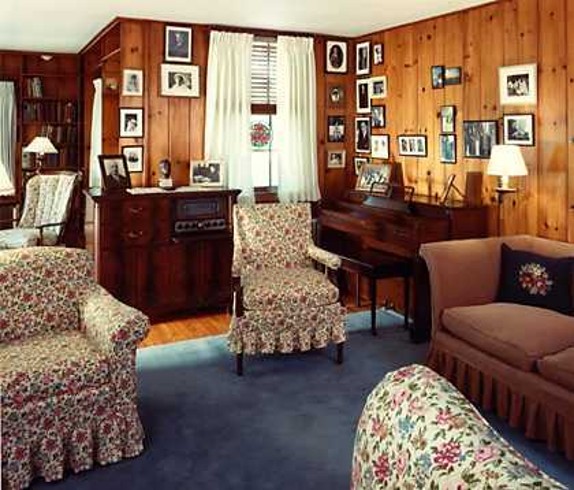
After a year, the trio (with another Democratic Party friend, Caroline O’Day, a former companion of Lillian Wald) had a second cottage constructed on the grounds for Val-kill Industries, an experimental business designed to provide work for local residents. A furniture factory trained artisans to create high-quality early American reproductions, but it folded ten years later under the financial pressures of the Depression. Nancy and Marion continued to occupy the Stone Cottage until 1947, and Eleanor had the factory remodeled into her own home (now “Val-kill Cottage”), the first and only house that belonged to her. After Franklin‘s death in 1945, Val-kill became Eleanor’s permanent residence. Now operated by the National Park Service and open to the public, Val-kill Cottage is a cozy, unpretentious house filled with comfortable furnishings (most made by Val-kill Industries) and decorated with photographs of Eleanor’s friends and family. You can almost see her in the warm pine-paneled rooms, relishing her independence and freedom from the Roosevelt family.

Eleanor has largely been constructed by history as an unattractive, asexual woman whose main function was to further her husband’s career. But Blanche Cook’s biography shows Eleanor in a different light, revealing her activity within the women’s committee of the Democratic Party, her feminist activism, her circle of lesbian friends, and most importantly, her decade-long intimate relationship with reporter Lorena Hickock, nicknamed Hick. At Val-kill, however, you won’t hear even a hint about Eleanor’s lesbianism in the official Park Service interpretation and film, in which Nancy and Marion are painted as “good friends,” and Hick – one of the major relationships of her life – isn’t mentioned at all.

Read Full Post »

Whitman birthplace, 1903

Huntington, N.Y.

Walt Whitman birthplace
246 Old Walt Whitman Road (off Route 110)

In the midst of a sprawl of suburban development (across from the “Walt Whitman Mall”) is the carefully preserved family home of the Good Gray (Gay?) Poet, Walt Whitman. Built somewhere between 1810 and 1816 by Whitman’s father, the small shingle house, originally located on sixty acres of farmland, was the site of the poet’s birth and very early childhood. By that year, Whitmans had been farming in the vicinity known as West Hills since the mid-1600s, and the region is still sprinkled with historic structures associated with the extended family.

Whitman’s birthplace is now a museum and state historic site that is open to the public. (It’s shown above in a 1903 photo.) Downstairs are period rooms, while upstairs is a modern exhibit with photos and documents from Whitman’s life, including a first edition of Leaves of Grass. Not surprisingly, the museum’s interpretation of Whitman is missing any overt reference to his homosexuality. His lover Peter Doyle, for example, is referred to as his “Confederate veteran pal” – but to their credit, the curators do display the well-known photo of Walt and Pete sitting close together, looking very much like a queer couple.

Whitman’s father moved his family to Brooklyn in 1823 to pursue a career in carpentry and construction, but when an economic depression hit in the late 1830s, the family returned to Long Island. Over the next few years, young Walt – who himself left his formal schooling behind at age 11 – taught school in a number of Long Island towns, including briefly at the Smithtown Schoolhouse, 9 Singer Lane, earning $72.70 for five months of work. The desk he used as a schoolmaster at the Woodbury School, Woodbury Road and Jericho Turnpike, is on display at the birthplace.

During his teaching years, Whitman used his early training in printing to found The Long Islander, a weekly newspaper out of Huntington that is still in circulation (its masthead includes, “Founded by Walt Whitman”). On his own, he wrote, edited, typeset, and delivered the paper. Restless to try something else, he sold the paper the following year, but over the next 20 years, he continued to hold editorial positions at various newspapers on Long Island, in Brooklyn, and in New York. In his editorials he was outspoken in his advocacy of social, economic, and political reform.

The years he spent on Long Island proved an influential part of Walt Whitman’s upbringing. A frequent swimmer at Montauk Point, Whitman’s poetry abounds with sensual references to the power and beauty of the ocean. Many of his early sketches and short stories from the 1830s contain typical Long Island scenes. And his 1882 reminiscences, Specimen Days and Collect, include many recollections of the people among whom he had lived – the most “hospitable, upright, common-sensible people anywhere about.”

You sea! I resign myself to you also – I guess what you mean,
I behold from the beach your crooked inviting fingers,
I believe you refuse to go back without feeling of me,
We must have a turn together, I undress, hurry me out of sight of the land,
Cushion me soft, rock me in billowy drowse,
Dash me with amorous wet, I can repay you.

–Walt Whitman, “Song of Myself”


Read Full Post »

« Newer Posts