Feeds:
Posts
Comments

Archive for the ‘gay and lesbian’ Category

caffe_cino_exterior.jpg

New York, N.Y.

Caffe Cino
31 Cornelia Street

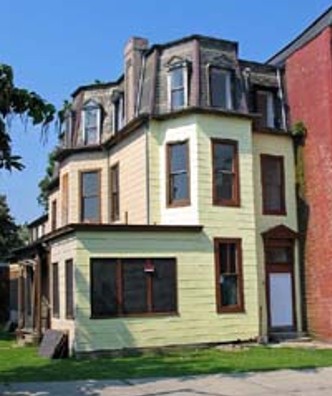
From 1958 to 1967, Joe Cino ran a coffeehouse at this address that has gone down in performance history as the place where both gay theater and Off-Off-Broadway were born. The Beat generation cafe was not intended at the beginning as either a theater or a gay hangout, though Cino himself was gay. “My idea,” he said in a Village Voice interview in 1965, “was…to start with a beautiful, intimate, warm, non-commercial, friendly atmosphere where people could come and not feel pressured or harassed. I also thought anything could happen. The one thing I never thought of was fully staged productions of plays.” But that’s exactly what happened. On a dark, narrow street in Greenwich Village, in a room described by one reporter as a “shoebox,” gay playwrights such as William M. Hoffman, Doric Wilson, Robert Patrick, and Lanford Wilson got their start, as did gay-friendly writers Sam Shepard and John Guare.

Sadly, the accidental death of his lover, lighting designer John Torrey, sent Cino into despair and drugs. Cino committed suicide in 1967, and the “magic time,” as William Hoffman called it, came to a close.
Read Full Post »

ada_dwyer_russell.jpg

Salt Lake City, Utah

Ada Dwyer Russell home
166
W. North Temple Street

Born in 1863, actress Ada Dwyer (later Russell) was raised as a Mormon. Her father, James Dwyer, had come west in a covered wagon and opened the first bookstore in the far west. He also helped found the Latter Day Saints University. The Dwyers’ residence is listed at this location on North Temple Street beginning in 1867, when Ada was four, but the building is no longer extant.

Ada grew up to be an actress who first performed at the Salt Lake Theater (corner of South First and State) and later on the Broadway and London stages. She married the British actor Harold Russell, and was later widowed. In 1912, she met poet Amy Lowell, a cigar-smoking butch 11 years her junior, at a women’s luncheon club in Boston. The two were instantly smitten; Lowell wrote that “between us lept a gold and scarlet flame.” Two years later, after much coaxing on Lowell‘s part, Russell moved into the Lowell family estate, Sevenels, in Brookline, Mass. She gave up her own career for Lowell‘s, organizing her partner’s life, and became the subject of Lowell‘s explicit lesbo-erotic poetry. Lowell died in 1925, leaving her fortune to Russell; still, Russell maintained until her own death in 1952 that the two of them had only been “friends.”

Read Full Post »

stein.jpg

Baltimore, Md.

Gertrude Stein residence
2408 Linden Avenue (private)

Gertrude Stein’s (1874-1946) first ambition was not to be a writer, but a psychologist. After studying psychology with William James at Harvard, Stein was accepted at the John Hopkins Medical School, where her brother, Leo (with whom she was very close), was also enrolled. She lived with relatives at this address (on the National Register of Historic Places since 1985) for about a year, then moved in with Leo at 215 East Biddle Street.

Stein was unhappy and unfulfilled in medical school. She was also on the brink of discovering her lesbianism. While living in Baltimore, Stein ran with a lesbian crowd, a group of Bryn Mawr College graduates led by a young woman named Mabel Haynes. Sadly for her, Stein fell unrequitedly in love with Haynes’ “romantic friend,” May Bookstaver. The experience made a deep impression on Stein, whose first novel, Q.E.D., completed in Baltimore in 1903, was an autobiographical account of this lesbian love triangle.

Unlike most of Stein’s work, Q.E.D. was openly lesbian in content and language. Stein put the finished manuscript away for 30 years, and then, in 1932, unearthed it and showed it to her agent, who advised against trying to publish it because of its “controversial” theme. Q.E.D. was finally published in 1950, four years after Stein’s death.

Stein left Baltimore in 1903 to visit Leo, who had moved to Paris, and to try to forget May Bookstaver. Paris agreed with her, and she lived there the rest of her life, meeting Alice B. Toklas, her life companion, in 1907. And May Bookstaver and Mabel Haynes? They both pursued much more traditional lives, ending their affair and marrying men.

Read Full Post »

newportarmynavyymca.jpg

Newport, R.I.

Army and Navy YMCA
50 Washington Square

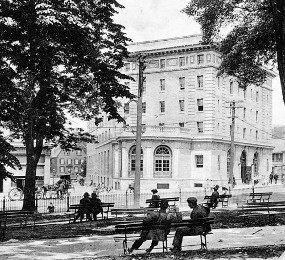
Since the early 20th century, YMCAs have been gathering places for gay men. Newport‘s Army and Navy YMCA, a Beaux Arts-style building, opened in 1911, and when the fleet was in – Newport was home to an important naval training station – the building was often filled beyond capacity. Here soldiers and sailors could bank, shop at the canteen, and eat a homestyle meal. Activities included swimming, bowling, and jogging (and numerous other “indoor sports,” to be sure). The administrators also showed movies and sponsored cabaret evenings of song and performances.

In his article, “Christian Brotherhood or Sexual Perversion? Homosexual Identities and the Construction of Sexual Boundaries in the World War I Era,” historian George Chauncey relates the story of an official navy investigation in 1919-20 of homosexuality in Newport. Under orders from then-Assistant Secretary of the Navy, Franklin Roosevelt, young enlisted men acted as decoys to entrap homosexuals, gathering information and later testifying before a naval court of inquiry and at several civilian trials. Twenty sailors and sixteen civilians were arrested as a result of the “investigation.”

The decoys reported that the YMCA, as well as nearby beaches and wharfs, were havens of homosexual activity. Some gay sailors lived at the Y, while others just rented rooms for the night. “Fagott” [sic] parties, the investigators found, were commonplace at the Y in the evenings. The gay men who frequented the Y also engaged in homosexual activities in other cities and maintained contacts with gay men in New York, Providence, and Fall River. But, Chauncey found, in addition to the men who identified as “queer,” there were men who regularly enjoyed homosexual sex but thought of themselves as heterosexual.

Newport‘s YMCA reached its peak in 1951, during the Korean War. When the Navy began downsizing during the Nixon administration, attendance at the Y fell off, and it was closed in 1973. It is now an apartment building for low-income residents.

“The Army and Navy Y.M.C.A. was the headquarters of all cocksuckers [in] the early part of the evening…. everybody who sat around there in the evening…knew it.”

–Navy investigator, 1920

Read Full Post »


glasshouse.jpg

New Canaan, Conn.

Glass House
798-856 Ponus Ridge Rd.

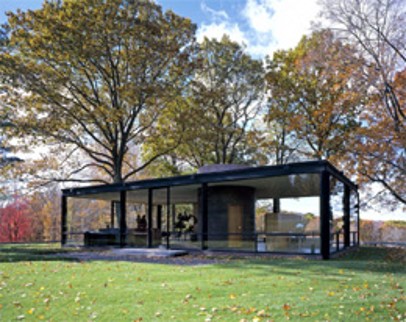
Philip Johnson (1906-2005) – the celebrated architect who designed the sculpture garden and east wing of the Museum of Modern Art, among numerous other structures – built this home in 1949 in one of the wealthiest areas of Connecticut. The idea for a “glass house” came from an argument with his mentor, Mies van der Rohe – could it actually be done? The two competed to solve the problem at the same time, with Johnson finishing his house first. (Van der Rohe’s, located in Plano, Ill., was not completed until the following year.)

Johnson’s Glass House is located in a thickly wooded area on a knoll overlooking a pond. “I learned from the Japanese…[that] a shelf keeps good spirits from straying, and the evil spirits will be unable to climb up to you,” Johnson noted about the location. The Glass House is a simple, modern structure, a 32-x-56-foot rectangle with one door centered on each side. Eight black steel columns form the framework, holding sheets of clear glass between them. A central brick cylinder extending the height of the house contains a bathroom. When Frank Lloyd Wright visited the completed house, he reportedly asked, “Am I indoors or am I out?” Said Johnson, “With the lights out and the snow falling, it is almost like a celestial elevator.”

Over the next 30 years, Johnson added other structures to his 40 acres of land – a solid brick guesthouse to contrast with the glass structure; an arched pavilion in the pond; an underground art gallery; and a climbable tower in the woods, built to honor his friend Lincoln Kirstein, co-founder of the New York City Ballet. One critic calls the compound Johnson’s “architectural autobiography”; he himself labeled it “the diary of an eccentric architect.” Johnson willed the property and all the buildings to the National Trust for Historic Preservation in 1986. The architect died in 2005, followed shortly thereafter by his longtime partner, David Whitney. The compound – complete with a visitors’ center designed by Johnson – opened to the public in April, 2007. 

Read Full Post »

blackcat.jpeg

San Francisco, Calif.

Black Cat Cafe
710 Montgomery Street

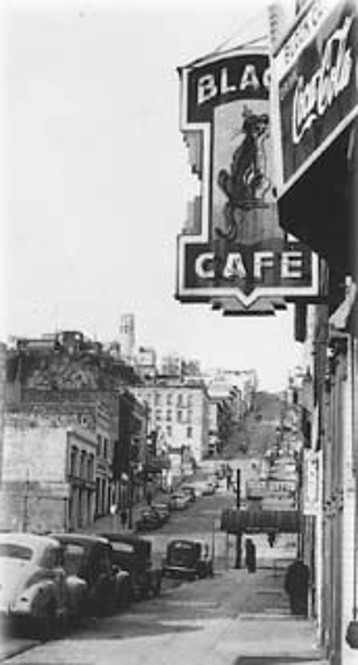
Like many early gay bars, the famous Black Cat didn’t start out that way. Just a few blocks from the center of North Beach, the Black Cat was first distinguished as a bohemian hang-out (it billed itself as Bohemia of the Barbary Coast) and provided the backdrop for part of Jack Kerouac’s On the Road. Following World War II, when gay men and lesbians swarmed San Francisco after service in the Pacific, the Black Cat assumed a “gayer” personality. The poet Allen Ginsburg, who knew it in the ’50s, described it as an enormous bar with a honky-tonk piano that “everyone” went to: “All the gay screaming queens would come, the heterosexual gray flannel suit types, longshoremen. All the poets went there.”

At a time when homophile organizations like the Mattachine Society were largely conciliatory to the police and to city officials, the Black Cat was noteworthy as a site of resistance. Its owner, Sol Stoumen, refused to pay off the police for protection against harassment, and his bar was routinely raided and fined from the 1940s through the early 1960s. During the 1950s, the Black Cat’s flamboyant drag performer, Jose Sarria, sang campy parodies of torch songs, giving them political twists, and finished each set by leading the bar’s patrons in his rendition of “God Save Us Nelly Queens,” even when members of the vice squad were present. His brand of activist theater made him extremely popular among gays, and in 1961 Sarria decided to campaign for city supervisor, knowing that he had no chance of winning. Though he received only a few thousand votes, Sarria said later that his intention had been to show his peers that a gay man had the right to run, whether he won or lost.

The Black Cat was closed in 1963. Said the attorney for the club, “That place is like an institution. This is like closing the cable cars or the Golden Gate Bridge.” There is now an upscale tapas and wine bar called Bocadillos on the site.

Read Full Post »

fire.jpg

Harlem, N.Y.

267 House
267 West 136th Street

Zora Neale Hurston once wryly dubbed the rooming house that queer writers Wallace Thurman, Bruce Nugent, and Langston Hughes all called home “Niggerati Manor.” The tenement building (also known as “267 House”) was owned by Iolanthe Sydney, a black philanthropist who offered rooms rent-free to artists in order to support their work. Nugent – a painter as well as a writer – reportedly painted brightly colored phalluses on the interior walls.

It was at this address that Thurman, Nugent, Hurston, Hughes, and others started the experimental literary journal Fire!! in the summer of 1926. Each of its seven founders pledged 50 dollars to the effort, but, according to Hughes’s memoirs, only three ever paid up. Since Thurman was the only one with a steady job, his checks paid for the printing bill for the first and only issue.

The journal had a high price tag for the day – one dollar. Hughes later remembered that Fire!! never seemed to make money because Bruce Nugent – who was unemployed at the time – distributed it to booksellers on foot, using the little bit of cash he got from its sale to buy food. (Nugent’s “Smoke, Lilies and Jade,” the first published piece with a homosexual theme by an African-American, was one of the notable pieces included in Fire!!) Ironically, several hundred copies of the journal, which were being stored in the printer’s basement, were burned in an actual fire. It took Thurman four years to pay off the printing bills.

Within two years, the inhabitants of 267 House had all moved elsewhere; but Thurman’s 1932 novel, Infants of the Spring, still provides a glimpse into life at artists’ residence.

“… they walked in silence … Alex turned in his doorway … no need for words … they had always known each other . . .”

–from Richard Bruce Nugent, “Smoke, Lilies and Jade,” 1926

Read Full Post »

williams.jpg

St. Louis, Mo.

Tennessee Williams home
4633 Westminster Place  (private)

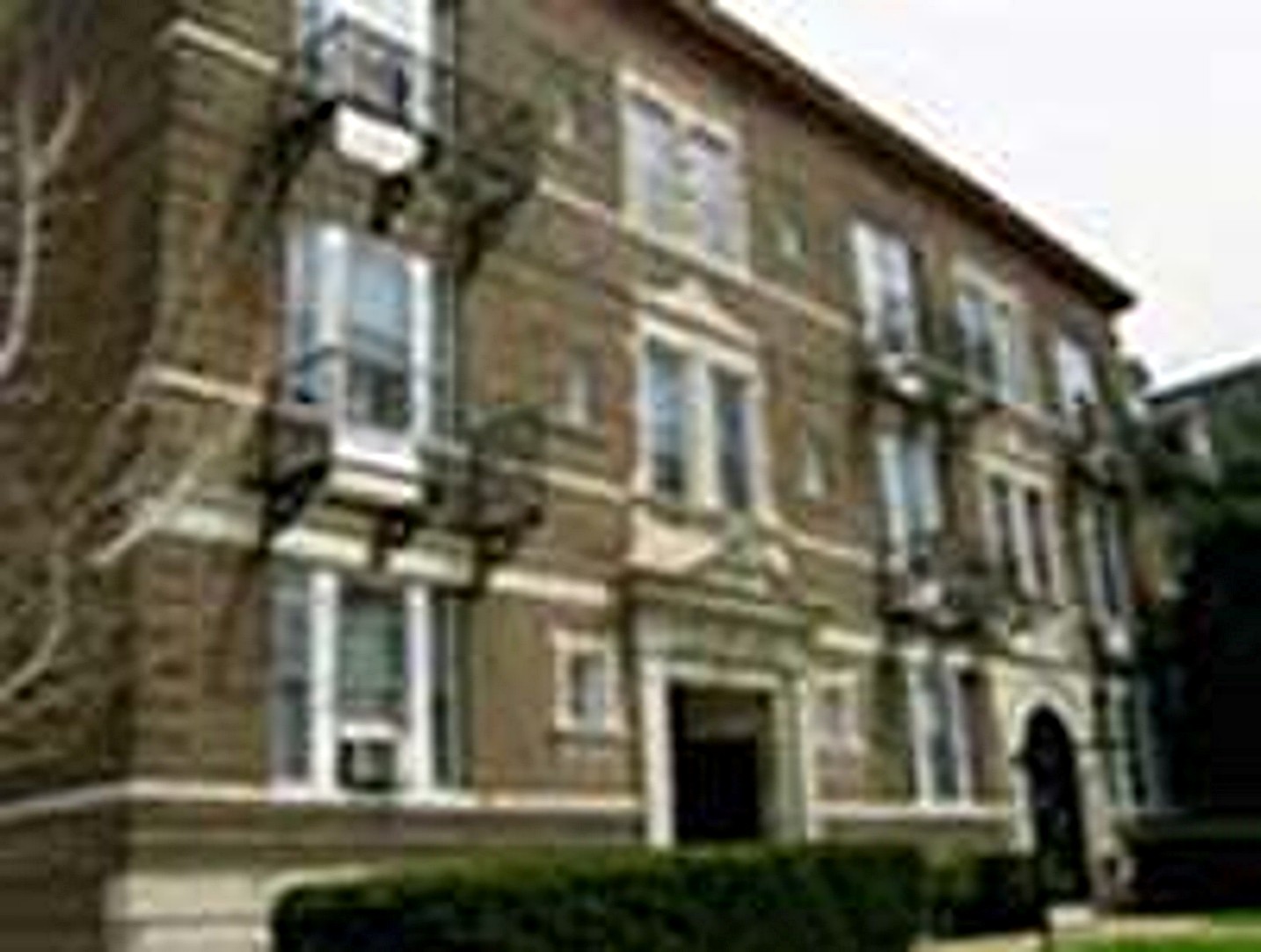
Born in Mississippi, Thomas Lanier “Tennessee” Williams (1911-1983) spent most of his childhood and young manhood in St. Louis, after his father, a shoe salesman, secured employment there. But Williams’ father often drank or gambled away his paycheck, forcing the family to live in a variety of crowded, rented rooms, moving a dozen times in just a few years. In 1921 a small, dark apartment on the third floor of this building was home. A rear window was blocked by a fire escape, allowing only minimal light into the rooms. Williams’ parents were openly hostile to each other, and his mother was increasingly unhappy to be so far removed from the genteel life she had known as a Southern minister’s daughter.

Williams set his first successful play, the autobiographical Glass Menagerie, here on Westminster Place, though the actual events he depicted in that play happened at a later time in another apartment in St. Louis (see below). According to Williams’ stage instructions, the building in which the Wingfields lived was “one of those vast hive-like conglomerations of living-units that flower as warty growths in overcrowded urban centers of lower middle-class population.” This building was later named “The Glass Menagerie Apartments,” in recognition of its place in theatrical history; in 2006, it was gutted, converted into luxury condos, with a starting price of $220,000 each, and renamed “The Tennessee.”

During his last years of high school, Williams and his family moved to five small rooms at 6254 Enright Avenue. Though Williams went off to the university in Columbia in 1929, he returned to the apartment for summers and to live in 1932, when his father could no longer afford to finance his education. It was events at this address that Williams depicted in The Glass Menagerie. His older sister, Rose, who suffered from phobias and hysteria and had twice been hospitalized, was living at home and retreating more and more into herself. The social call that is at the heart of The Glass Menagerie occurred in 1933, when Tennessee’s mother tried unsuccessfully to set Rose up with one of her son’s college friends. Williams’ younger brother, Dakin, later recalled that “the events of The Glass Menagerie are a virtually literal rendering of our family life at 6254 Enright Avenue.”

Read Full Post »

marymaclane1911.jpg

Butte, Mont.

Mary MacLane home (private)
419 North Excelsior Avenue

In 1902, the little town of Butte became a household word with the publication of The Story of Mary MacLane. The diary of MacLane (1881-1929), a 20-year-old originally from Canada, revealed her shockingly passionate thoughts and desires. The diary was an instant hit even by today’s standards, selling 80,000 copies in its first month alone.

What made MacLane’s diary such a hot ticket? In it, she wrote of her passion for the “anemone lady,” the only person in the world of any importance to her. The “lady” was in fact MacLane’s English teacher at Butte High school (southwest corner of Idaho and Park Streets), Fannie Corbin, and MacLane proclaimed that she loved Corbin “with a peculiar and vivid intensity, and with all the sincerity and passion that is in me.” MacLane wondered why she could not have been born a man, so that she could love Corbin in the way she wished. “Do you think a man,” wrote MacLane, “is the only creature with whom one may fall in love?”

When the book was published, MacLane was living at this address, a bay-fronted duplex building. (Fannie Corbin lived at 117 North Montana Street.) MacLane left Butte after her meteoric rise to celebrity and spent the rest of her days living a bohemian life in Chicago. Despite her early literary success, she died poor and obscure in a small hotel room. “I don’t know whether I am good and sweet…or evil and untoward,” MacLane wrote in her diary. “And I don’t care.” Talk about lesbian pride!

“…I am someway the Lesbian woman….all women have a touch of the Lesbian: an assertion all good non-analytic creatures refute with horror, but quite true: there is always the poignant intensive personal taste, the flair of inner-sex, in the tenderest friendships of women.”

–Mary MacLane, The Story of Mary MacLane (1902)

Read Full Post »

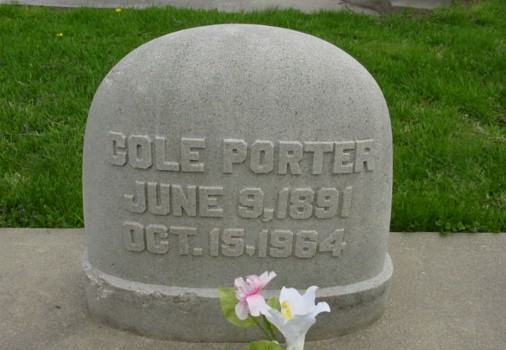
porter.jpg

Peru, Ind.

Cole Porter grave site
Mt. Hope Cemetery

He lived at swell-egant addresses in Manhattan, Beverly Hills, and the Berkshires, but the ultra-sophisticated Cole Porter (1891-1964) chose to be buried in his hometown of Peru, Indiana, with an unassuming marker. Porter was the son of a local druggist, and at age 8 was enrolled at the nearby Marion Conservatory of Music. There the boy first studied violin and piano and performed at recitals dressed like Little Lord Fauntleroy in a velvet suit with lace cuffs. Though one of his biographers claims young Porter was “no prodigy,” he played with a vigor and zest that stole the show. At 10, he composed his first song, “Song of the Birds.”

Read Full Post »

« Newer Posts - Older Posts »