Feeds:
Posts
Comments

Archive for the ‘gay and lesbian’ Category

Washington, D.C.

The White House
1600 Pennsylvania Avenue, NW

Oh, come on, you’re saying – the White House? A queer place?

Yes, the White House. The resident who comes immediately to mind is Abraham Lincoln, who, as a young lawyer in 1837, rode into Springfield, Ill., looking for a place to stay and found that storekeeper Joshua Speed had a large double bed that he was more than willing to share.

And then there’s James Buchanan, the 15th president, who enjoyed an intimate friendship with William Rufus King, whom he met when both were U.S. senators. King was referred to by Washington insiders as “little Miss Nancy,” “she,” and “Aunt Fancy” – need I say more?

But the person I was really thinking of in listing this most famous address wasn’t a president at all, but a president’s sister. When Grover Cleveland took office as president for the first time in 1885, he was a bachelor in need of a First Lady and White House hostess. His spinster sister, Rose Cleveland, a teacher and editor of a literary magazine, stepped in to help her brother during his first term.

eastroom.jpg

19th-century view of the White House East Room

Cleveland was defeated for re-election, and Rose was once again her own woman. In 1890, she met and fell in love with a young widow named Evangeline Marss Simpson. Gay historian Jonathan Ned Katz has written in detail about the two women’s passionate relationship, including their intimate correspondence: “Oh, Eve,” Rose wrote, “I tremble at the thought of you….Sweet, Sweet, I dare not think of your arms.” The two lived together until 1892, when Eve backed away from the relationship to seek a traditional heterosexual one. In 1893, Rose (once again ensconced at the White House, following her brother’s successful campaign in 1892) wrote to Eve on White House stationery, wishing her dear companion “my best blessing – whatever you do.” Eve went on to marry an elderly Episcopal bishop, Henry Whipple.

Following the bishop’s death in 1901, Eve and Rose renewed their correspondence and finally reunited in Italy, where they lived together until Rose’s death in 1918. Eve died in 1930 and requested that she be buried beside Rose.
Read Full Post »

New York, N.Y.

James Baldwin home
131st Street and Fifth Avenue (private)

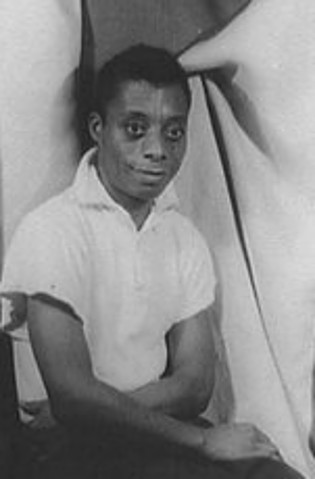
A housing project has been on this site in Harlem for almost 50 years, but the first home of writer James Baldwin (1924-1987) was once located here. Baldwin wrote vividly and movingly of the deteriorating neighborhood in his essay, “Fifth Avenue Uptown: A Letter from Harlem,” calling the avenue “wide, filthy, hostile.” “Walk through the streets of Harlem,” he admonished his readers, “and see what we, this nation, have become.”

jamesbaldwin.jpg

Baldwin remembered a bleak, poverty-stricken childhood, where his playgrounds were the roof of his building and a nearby garbage dump. He escaped a brutal stepfather and a troubled home life through books and writing. One of his junior-high teachers, Countee Cullen, spent much time working with him on his fiction and poetry. Baldwin also found solace in the church, becoming an evangelical minister at the age of fourteen. Go Tell It On the Mountain (1953), his first novel, is an autobiographical work focused on his early life in Harlem.

Baldwin worked a number of after-school jobs to help his family, and at one such job in downtown Manhattan in 1940, he met the painter Beauford Delaney, who became his mentor and possibly his lover. Delaney introduced Baldwin to jazz, art, and to a circle of African-American artists. “The reality of his seeing,” Baldwin later wrote, “caused me to begin to see.” As a young man Baldwin left his family and Harlem for Greenwich Village, where he worked odd jobs to support his writing. In 1948, he took off for Paris, where he lived on and off for the rest of his life. Though he returned to live in New York for periods of time, he didn’t like to stay long, saying that the racism of the city made him too sad.

Baldwin addressed homosexuality and bisexuality in many of his works, most notably Giovanni’s Room (1956), Another Country (1962), and Tell Me How Long the Train’s Been Gone (1968). His own life included affairs with both men and women, but the love of his life seems to have been a Frenchman named Lucien Happersberger, whom he met in 1949. “I starved in Paris for a while, but I learned something,” Baldwin later wrote. “For one thing I fell in love.” Happersberger became Baldwin‘s lover for a while but didn’t share the dream of two men building a life together; he eventually married a woman and named his son after Baldwin.

In addition to fiction writing, Baldwin authored numerous important nonfiction works exploring race and racism. He was himself active in the civil rights movement of the 1960s and continued to speak out about racism until his death from cancer in 1987.

Read Full Post »

San Francisco, Calif.

Harvey Milk home and Castro Camera
573-575 Castro Street

While we’re on the topic of walking tours…

Cruisin’ the Castro is a popular walking tour of the oh-so-gay Castro district of San Francisco, led by community historian Trevor Howard. The tour includes stops at many sites associated with Harvey Milk (1930-1978), the most famous openly gay politician of our time. Reservations can be made by calling 415-550-8110.

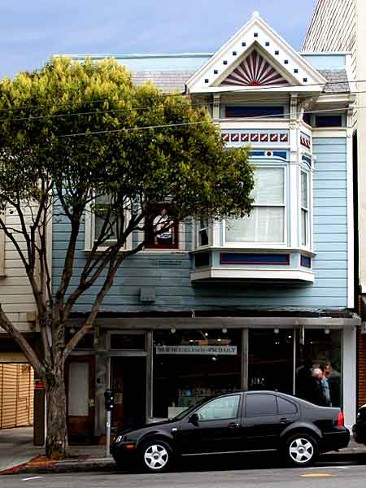
Originally from Brooklyn, Milk moved to San Francisco in 1968, where he worked as a financial analyst and eventually owned a camera shop in the Castro district. This Victorian storefront was the site of Castro Camera, which Milk opened with his lover, Scott Smith, in 1972 and operated for four years. The couple didn’t care that they knew little about cameras – Milk wanted to own a real neighborhood store, like his family back in Brooklyn had. The roomy store had a hand-painted shingle on the door that read “Yes, We Are Very Open.” Harvey and Scott lived upstairs.

castro_camera.jpg

As Milk became increasingly active in local politics, Castro Camera functioned as an ad hoc community center and Milk was the “unofficial mayor of Castro Street.” Signs in the store’s large picture windows advertised demonstrations, protests, and neighborhood meetings; camera and film sales became secondary to politics (the store’s sorry financial picture led the couple to close it in 1976). At night, Milk transferred the addresses from every check written to the store into his own political mailing list.

Milk became involved in organizing gay voter registration drives, helping to establish the first Castro Street Fair, speaking out against Anita Bryant’s antigay campaign, and working against the Briggs initiative, a proposal to bar lesbians and gay men from teaching in California public schools. During the mid-1970s, he made several bids for public office, all of which were unsuccessful. His goal, he once told a friend, was to be mayor of San Francisco.

Then the election of the liberal, gay-supportive mayor George Moscone in 1975 paved the way for Milk’s election to the San Francisco Board of Supervisors in 1977, making Milk the first openly gay elected official in the city’s history. Sadly, both he and Moscone were gunned down by the radically conservative supervisor, Dan White, the following year. White’s lawyer pleaded the infamous “Twinkie defense” – that eating too much junk food had diminished White’s ability to reason. White went to jail anyway, but on the charge of manslaughter rather than murder one. After he was released in 1985, he committed suicide.

Read Full Post »

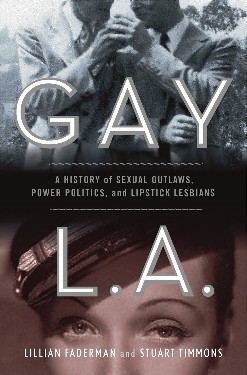
gay-la.jpg

I received this press release today, so I’m excerpting it here – those of you living in Southern California, or visiting the area, will be interested, I’m sure:

Frontiers Magazine, Southern California’s oldest and largest gay magazine, will be launching a series of audio walking tours on the gay & lesbian history of Los Angeles beginning March 28 and available online through the magazine’s website or iTunes. Frontiers readers will be able to download the tours onto their portable media devices and explore the hidden and mysterious history of gay life in downtown Los Angeles, as well as Silver Lake and West Hollywood.

Frontiers partnered with Stuart Timmons, a Lambda Literary Award nominee and co-author of the first comprehensive history book on Los Angeles gay life, Gay L.A., to produce the series. Listeners will join Stuart as he shares sordid tales of backroom trysts, cruel oppression, and defiant struggle at the very places these events occurred. An accompanying map and guide will be printed in the magazine, and will also be available online to download.

Arts & Entertainment Editor Japhy Grant explains the program, saying, “We wanted to present the history of gay Los Angeles in a way that would be compelling and fun for our readers. Much of our history has been covered over, both physically and through ignorance and homophobia. L.A. is such a dynamic and transient city that we don’t have a real sense of the past. Through the Frontiers Historywalk program, we’re helping people find a new way to connect to their community on foot and online.”

Frontiers Historywalk is not only the first audio walking tour of gay Los Angeles, but the first professional audio walking tour of gay history anywhere.

Frontiers Historywalk consists of three audio walking tours: Downtown, Silver Lake and West Hollywood. This progression matches that of the gay community in Los Angeles.

The release dates of each tour are as follows:

Frontiers Historywalk- Downtown – March 28
Frontiers Historywalk- Silver Lake – April 11
Frontiers Historywalk- West
Hollywood – April 25

Each tour will be available through the website at tours.frontierspublishing.com, as well as on iTunes. They will be available in a variety of formats, including a format that will display photos of the sites as the tour is playing (requires video iPod).


Read Full Post »

bishop.jpg

Key West, Fla.

Elizabeth Bishop home
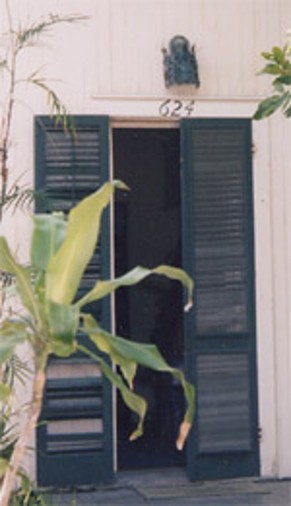
624 White Street

Poet Elizabeth Bishop (1911-1979) was born into a wealthy family from Worcester, Mass. After her graduation from Vassar, she used a family inheritance to live a nomadic life in New York City, Europe, Florida, and other places. In 1938, she and her lover at the time, Louise Crane, purchased a house in Key West. Bishop lived at this residence off and on for the next nine years, first with Crane, then with a subsequent lover, Marjorie Stevens.

In letters to friends, Bishop described her island home this way: “It is very well made, with slightly arched beams so that it looks either like a ship’s cabin or a freight car.” The house was located right on the beach and was to Bishop “perfectly beautiful…inside and out.” Bishop’s first volume of poems, North and South, was published during the time she lived in Key West.

It may sound idyllic, but Bishop battled alcoholism throughout her adult life, and the relationship with Stevens did not last. After they broke up, Bishop sold the Key West house and returned to an itinerant life, eventually being hospitalized for both depression and alcohol-related problems. In 1951, with the help of her mentor, Marianne Moore, Bishop secured a fellowship from Bryn Mawr College that enabled her to travel around the world.

But Bishop never got farther than Brazil, where she met the wealthy Lota de Macedo Soares, who became her lover and tried to nurture her away from alcoholism. Bishop kept postponing her return to the States, until her stay in Brazil had lengthened to 16 years. At her home, Lota built a studio for Bishop that was separate from the house and had a stream running beside it. In that peaceful setting, Bishop was very productive and composed some of her greatest poems. But Bishop eventually returned to the United States after Lota committed suicide in 1967 and her own alcoholism worsened.

Read Full Post »

brick-palace.jpg

Maui Island, Hawaii
Lahaina

Brick Palace
Lahaina Harbor

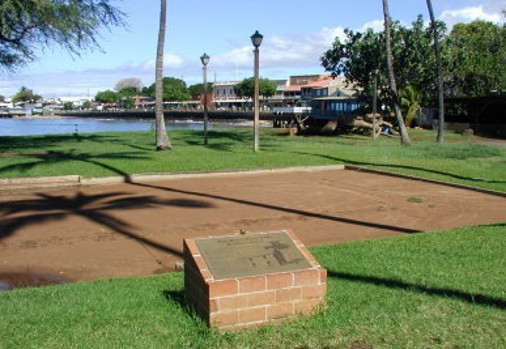
The first royal capital of the Hawaiian Islands, much of the town of Lahaina has been given National Historic Landmark status. Facing the scenic harbor was the Brick Palace, which was the first royal residence of Kamehameha I (1758-1819), Hawaii‘s queer king. All that’s left now are the foundations of what was once a western-style structure, a modest two-story brick building. In some mainstream guidebooks, the story is that Kamehameha located his capital here to be close to the grave of his beloved first wife. But since he also had a beloved aikane, or male lover, we might wonder how much of the story has been “straightened out” by history.

Read Full Post »

hullhouse2.jpg

Chicago, Ill.

Hull-House
800 South Halsted Street

In 1889, Jane Addams and Ellen Gates Starr, intimate companions since their college days, founded one of the most famous social experiments in this country’s history, Hull-House. It was their intention, Addams wrote later, “to rent a house in a part of the city where many primitive and actual needs are found, in which young women…might learn of life from life itself….”

The house they located was built in 1856 for Charles Hull, a prominent Chicagoan. Addams described the building as “a fine old house…, surrounded on three sides by a broad piazza which was supported by wooden pillars of exceptionally pure Corinthian design and proportion.” It stood, she noted with amusement, “between an undertaking establishment and a saloon.” Though the house was being used for offices and storerooms for a neighboring factory, Addams and Starr were able to rent the second floor and a downstairs drawing room, and the following year, they obtained the lease on the entire building. They furnished it with “a few bits of family mahogany” and items from their travels abroad and officially took up residency in September, 1889.

In an era when foreigners were feared and xenophobia was rampant, Addams, Starr, and the women who came to work with them offered immigrants (mainly Italian) education, medical care, guidance, and day care facilities. Expanding to thirteen buildings over the years, Hull-House became a model for settlement houses across the country. It was also a training ground for numerous reformers, including Julia Lathrop and Florence Kelley.

Addams’ biographers have generally ignored her personal life, assuming that she didn’t have one because she wasn’t attached to a man. Yet, though her intimacy with Ellen Starr had waned by the early 1890s, Addams shared a 40-year relationship with Mary Rozet Smith, who was one of the many idealistic young women from wealthy backgrounds who came to work at Hull-House. Smith routinely accompanied Addams on her lecture tours, and Addams was always sure to wire ahead to the hotel where they were staying for a room with a big double bed.

Although Hull-House as a social-service organization is still in existence, the original building at Polk and Halsted is now a museum, under the auspices of the University of Illinois-Chicago.

Read Full Post »

Found Image

alberta.jpg


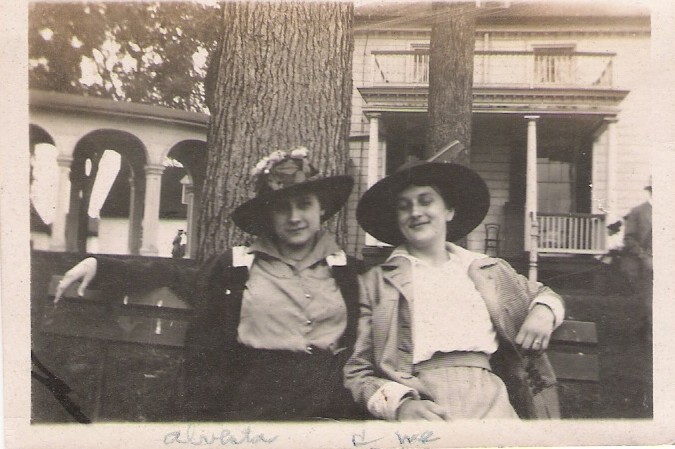
For a change of pace, I thought I’d include this found image that I bought for $1.50 at the 26th Street flea market in New York, probably about 10 years ago. Anyone who knows me can tell you that I’m as fascinated with found images as I am with historic sites; friends of mine have given such photos to me as presents, and they line the mantle in our dining room. In fact, I wrote my first novel, Out of Time, about found images of women together.

What struck my imagination about this photo from the early 20th century was the casual, butch pose of the woman on the left, with her arm around the other, and the cryptic, almost tantalizing note at the bottom: “Alberta & me.” Who was Alberta? Who was “me”? Where are they? Who took the picture? I’d love to hear my readers’ thoughts.

One thing I’d bet money on is that Alberta was a dyke.

Read Full Post »

strayhorn.jpg

Pittsburgh, Pa.

Billy Strayhorn marker
Westinghouse High School
1101 North Murtland Street

Billy Strayhorn home
7212 Tioga Street Rear (demolished)

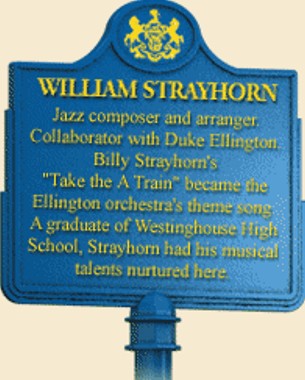
Born in Ohio, composer Billy Strayhorn (1915-1967) lived in the Homewood section of Pittsburgh from his early years until he left for New York as a young adult. In those days, white families lived on the main streets of Homewood, while blacks lived in the alleys behind them (the “Rear” in the Strayhorn address). The Strayhorn home was “a four-room shack,” according to one of Billy’s childhood friends, with two rooms on each floor and a toilet in the basement. The kitchen was the biggest and most significant room in the house. Because of the crowded living conditions and Billy’s father’s alcoholic binges, Billy’s mother often sent her eldest son for long stays with his grandparents in Hillsborough, North Carolina. Billy’s grandmother owned and played a piano, and it was in Hillsborough that Billy first learned to play.

Though he was a musical prodigy, Strayhorn’s family could not afford lessons to further his talent. As an adolescent, Billy found odd jobs selling papers and working as a soda jerk to purchase his first piano, a broken-down upright. “All the money he [Billy] could get hold of,” a friend remembers, “he bought [sheet] music….the house was swamped with music.”

At Westinghouse High School (where there is now a historical marker honoring him), Strayhorn pursued music, becoming first pianist in the Senior Orchestra and playing at local social events and banquets with the school’s Orchestra Club. Though he was often made fun of at school for being a “sissy,” the shy, withdrawn Strayhorn concentrated on his work and his passion for music. After graduation, Strayhorn formed his own interracial jazz trio, The Madhatters, and played local nightspots. But he still had to work days at the drugstore soda fountain and pick up extra money by arranging music.

His big break came in 1938, when a friend of a friend got him an “audience” with Duke Ellington, who was playing with his band at the Stanley Theater in downtown Pittsburgh (now the Benedum Center, a performing arts space). Ellington was impressed by the talented young pianist who could seemingly do everything – write music, lyrics, and arrangements. But he didn’t have an opening in his band. Ellington made Strayhorn a promise of a job if the young musician ever got to New York and gave him exact directions to his home in Harlem. Eager to please Ellington, Strayhorn turned the directions into a song – “Take the A Train” turned out to be his most famous composition and eventually became Ellington’s theme song.

Strayhorn did indeed make it to New York, where he hooked up with Ellington and worked with him for the next 30 years. While Ellington was the public artist, Strayhorn worked behind the scenes as collaborator and arranger. Ellington supported Strayhorn’s career, but he also occasionally took credit for the younger man’s work. Strayhorn consoled himself with drink and died of cancer and alcohol abuse at the age of 51. His song “Lush Life” (1936) sadly defines his own short, intense life.

Strayhorn knew early on that he was gay and was open about his sexual orientation. According to his biographer, he never even danced with a girl. Ellington, who was straight, seems to have been supportive and tolerant of his collaborator’s homosexuality. Strayhorn had a number of significant relationships in his life, most notably in his final years with a graphic designer, a white man named Bill Grove. Grove was the only man Strayhorn ever brought home to meet his family.

Read Full Post »

736alabama.jpg

Lawrence, Kan.

Langston Hughes home
732 Alabama Street (demolished)

Langston Hughes statue
Elizabeth Watkins Community Museum
1047 Massachusetts Street

Poet and memoirist Langston Hughes (1902-1967) was born in Joplin, Missouri, but his earliest memories were of living at his grandmother’s house in Lawrence, Kansas, at 732 Alabama Street after his parents’ marriage fell apart. The house is no longer standing, but the one pictured here, which was just next door to his grandmother’s and possibly similar in style, is being renovated.

Hughes was one of Lawrence‘s most celebrated residents, and a bronze statue of him at the age of the age of 13 stands in the local Watkins Community Museum. Hughes spent most of his childhood in his grandmother’s simple, two-bedroom house with a wood shed and outhouse in the back, plus a pump for water. Occasionally, his grandmother rented out a room to make money, and sometimes she let the entire house, moving herself and Langston to the home of friends James and Mary Reed, who lived at 731 New York Street. Later, Langston remembered “the mortgage man…always came worrying my grandmother for the interest due.”

Langston endured a solitary boyhood in a mostly white Lawrence neighborhood; he did not play with many other children and felt his loneliness like “a dull ache.” One of his favorite pastimes was visiting the morgue at the nearby University of Kansas, where he snuck in and watched, fascinated, as students worked on cadavers. Langston attended predominantly white schools and though he rarely studied, he was always near the top of his class.

Langston’s grandmother died in 1915, and he lived briefly with the Reeds. When his mother remarried, he moved with her to Lincoln, Ill., where her new husband had secured work. It was in Lincoln, Langston later said, that he first started writing poems and was chosen class poet in eighth grade, where he was again one of only a few black students. “My classmates,” he recalled, “knowing that a poem had to have rhythm, elected me unanimously – thinking, no doubt, that I had some, being a Negro.”

Read Full Post »

« Newer Posts - Older Posts »