Feeds:
Posts
Comments

Archive for the ‘gay and lesbian’ Category

Los Angeles, Calif.

Autry National Center
4700 Western Heritage Way

The Los Angeles Times carried an interesting story about queers in the Old West this week. It seems there’s a new series on the history of homosexuals and transgendered people at L.A.’s Autry National Center of the American West. The shirts worn by Heath Ledger and Jake Gyllenhaal in Brokeback Mountain have been on exhibit at the Autry since July of this year (see above), but this is a broader exhibit, a milestone in the presentation and recognition of queer history – it’s the first exhibit of its kind at a western heritage museum.

Here’s the complete story from the LA Times. And just to remind you, I had already written about Charley/Charlotte Parkhurst on this blog, so take a look at that if you missed it the first time around.

Read Full Post »

Bridgeport, Conn.

Bloodroot
85 Ferris Street

The 1970s saw a flourishing of women-owned feminist and/or lesbian businesses, including bookstores, cafes, and publishing companies. Among the many ventures was Bloodroot, a “feminist restaurant/bookstore with a seasonal vegetarian menu,” which is, remarkably, still in operation after more than 30 years. The name derived from an Eastern wildflower. “We found something symbolic in its slow spreading rhizomatous root system and the way each piece of root throws up its own grey-green leaf furled protectively around the eight-petaled white flower,” say owners Selma Miriam, 74, and Noel Furie, 64.

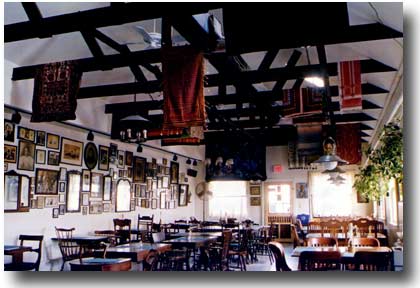
At its waterfront site, Bloodroot consists of a large room furnished with mismatched tables and chairs, and one wall covered in herstoric photos of women (see photo). “People gave us pictures [for] the wall,” Miriam told The Connecticut Post; one person gave her a photo and said, “This is my sister. I want her here.”

Off the restaurant is a small bookstore crammed with books by women, where authors occasionally come to read. There is also an outdoor patio facing scenic Long Island Sound.  Meals are strictly self-service – from ordering to picking up food to bussing tables. The veggie menu – printed daily on a chalkboard – includes ethnic soups and salads, crusty breads, and rich desserts.

Bloodroot also published four cookbooks in its “Political Palate” series, which included not only recipes but the most appropriate seasons in which to make the various dishes. Although the older cookbooks are now out of print, two Best of Bloodroot volumes are available.

Read Full Post »

Pittsburgh, Pa.

Pegasus
818 Liberty Avenue

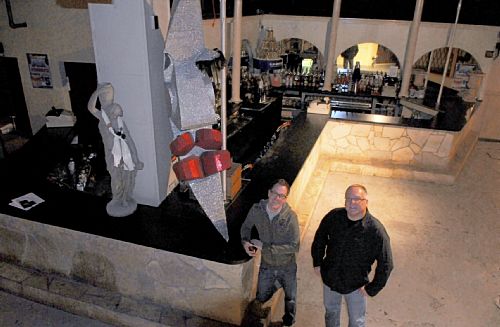
Pittsburgh’s longtime gay men’s bar, Pegasus, has closed in the location it occupied for the past 30 years; it has moved across the river to a new space. “If you ever saw Queer as Folk on TV, that’s what Pittsburgh was like back then [in the ’80s],” according to one bar-goer.

Read the complete story here.

Read Full Post »

nyackhouse2

Nyack, N.Y.

Carson McCullers home
131 South Broadway

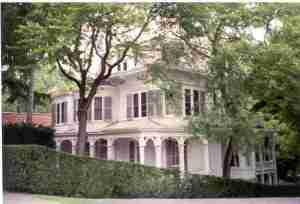
This rambling, three-story house in the sleepy village of Nyack was home to the writer Carson McCullers (1917-1967) from 1945 until her death. The front of the grand Victorian house faces one of the main streets of Nyack, while the rear sun porch enjoys a stunning view of the Hudson River. It is still a private residence, and was added to the National Register of Historic Places in 2006.

After the death of Carson’s father in 1944, her mother, Marguerite Smith, didn’t have the heart to remain in the Georgia house where she and her husband, Lamar, had raised their family. At the time, Carson’s husband, Reeves, had gone into the army, and she, too, was faced with living alone. She loved the scenic village of Nyack, just twenty-five miles up the river from New York City, so she, her mother, and sister decided to take up residence there in the fall of 1944. Nyack reminded Marguerite of the small, friendly towns she had known in Georgia, so she felt immediately at home.

Carson’s family first rented a specious apartment at 129 South Broadway, and then in the spring of 1945, moved to the house next door, which Marguerite purchased with $9,000 from the sale of her Georgia home. When her mother’s funds dipped in the early 1950s, Carson purchased the house from her with the money she received from selling the screen rights to The Member of the Wedding.

Carson used Nyack as her base in between trips to the artists’ colony of Yaddo, where she did much of her writing, and speaking and teaching engagements all over the country. It was at this home that she gave a luncheon to honor her idol, Isak Dinesen, after the two met at a literary function in 1959. Other guests included Marilyn Monroe and husband Arthur Miller. The high point of the afternoon was apparently a spellbinding tale Dinesen related – in true Scheherazade fashion – about killing her first lion in Africa.

Plagued by ill health, depression, and alcoholism through much of her adult life, Carson suffered her final stroke in this house in the summer of 1967. According to her biographer, Virginia Spencer Carr, the last words she spoke were to the young actor who rented living space in the basement. He stopped by her bedroom and told her he was appearing in the play Stop the World, I Want to Get Off. “Oh, darling, isn’t that a marvelous title,” Carson said. “Ahh, to get off. Wouldn’t that be something. Wouldn’t that be marvelous.” She suffered a massive brain hemorrhage twenty minutes later and died at Nyack Hospital.

Read Full Post »

allah_performers-s

Seattle, Wash.

The Garden of Allah
1213 First Avenue

Seattle’s first gay-owned bar (also one of the first in the country) was located at this downtown address from 1946 to 1956, in the basement of the Victorian-era Arlington hotel. The hotel sat midway between a gambling and red-light district at one end of First Avenue and an upper-class commercial district at the other.

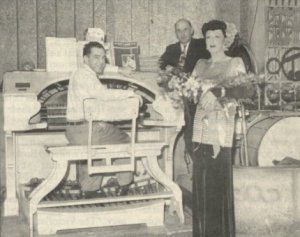
The Garden of Allah, as the club was called (it had also been the name of a famous apartment complex in West Hollywood owned by Alla Nazimova), operated as a gay cabaret. From First Avenue, a guest descended a white marble staircase and slipped a $1 bill through a peephole for admittance. Inside, blue and pink lightbulbs provided a sensual ambience, and palm trees and stars stenciled on the walls gave the place a “Casbah” feeling. Tables were tightly packed in front of a stage, the centerpiece of which was a 1924 Wurlitzer pipe organ that accompanied every cabaret show (see photo, ca. 1948). The owners paid off the police to avoid raids, and an ever-present off-duty cop was stationed in the club to make sure that same-sex couples didn’t touch.

Drag entertainers were the highlight of the cabaret’s shows, and gay men, lesbians, and straight people alike made up the boisterous audiences. On opening night in 1946, the featured attraction was the Jewel Box Revue, the famous drag show that started touring clubs in 1939. Over the years, some of the Garden’s drag entertainers also performed striptease.

With a decline in interest in drag during the repressive 1950s, the Garden of Allah eventually closed. For a while, the space was used to store nuclear-attack rations. Later, it became a biracial rock club called House of Entertainment, where Jimi Hendrix once played. The hotel was razed in 1974. For more about the club, see Don Paulson and Roger Simpson’s excellent book, An Evening at the Garden of Allah: A Gay Cabaret in Seattle.

Read Full Post »

LGBT Icons

In case you haven’t seen it yet, the Equality Forum in Philadelphia has put together this video for LGBT History Month (October), which briefly profiles their picks for LGBT icons.

Read Full Post »

SkinnyHouse_articlebox

New York, N.Y.

Edna St. Vincent Millay home
75-1/2 Bedford Street

Following her 1923 marriage to businessman Eugen Boissevain, bisexual poet Edna St. Vincent Millay lived at this address in Greenwich Village in what she nicknamed “the dollhouse.” The diminutive brick house on Bedford Street is only 9-1/2 feet wide, and when Millay lived there, had one room and a fireplace on each of the three floors. Behind the house was a beautiful but tiny courtyard. In 1995, New York’s Historic Landmarks Preservation Center installed an oval medallion at the residence with the inscription, “The irreverent poet, who wrote ‘My candle burns at both ends,’ lived here in 1923-1924 at the time she wrote the Ballad of the Harp-Weaver, for which she won the Pulitzer Prize. Conveniently, Millay’s house was only a few blocks from Chumley’s, a speakeasy (still in operation as a bar and eatery) that was one of her favorite hangouts. From Bedford Street, Millay and Boissevain moved to a farmhouse in Austerlitz, N.Y., which they renovated and lived in until their deaths.

Millay’s “dollhouse” is now on sale for $2.7 – read more about it here.

Read Full Post »

1034627404_l

Albany, N.Y.

Capital District Gay and Lesbian Community Center
332 Hudson Avenue

One of the two LGBT community centers founded in 1971, Capital District Gay and Lesbian Community Center has a unique distinction: it has been in this same location for all of its 38 years. (See photo above.) Executive Director Norah Yates wrote to me that:

We’ve been in this building since 1971; we were started in 1970 and had a storefront at one point, but then started meeting at our address when it was the home of one of our founders.

CDGLCC provides numerous services, including youth programs, cultural events, a café, an art gallery named after lesbian painter Romaine Brooks, an LGBT library, confidential AIDS testing, and a newspaper, commUNITY. The center also sponsors Albany’s annual Capital Pride celebration in June.

Read Full Post »

stonewallinn

New York, N.Y.

Stonewall Inn
51-53 Christopher Street

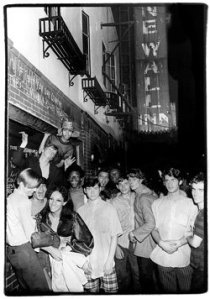
This weekend marks a historic event in lesbian, gay, bisexual, and transgender history: the 40th anniversary of the riots at the Stonewall Inn in New York City, a popular gay bar and hangout in the late 1960s, a place to meet friends and lovers. But at a time when homosexuality was criminalized, police raids of gay bars were de rigueur. On June 28, 1969, when cops raided the Stonewall in the early morning hours and forced the patrons outside, drag queens, young queer people of color, gay men, and a crowd of supporters on the street began pelting the police with beer cans and rocks. The crowd then set the bar on fire, but the police extinguished the flames and “secured” the area within a few hours. A weekend of rioting ensued, during which gay people stood off city cops and claimed their right to live openly – “Homo Nest Raided, Queen Bees Are Stinging Mad,” ran the headline in the New York Post.

The rebellion sparked a new movement that grew by leaps and bounds into the LGBT rights movement of today. The term “Stonewall” is now the international symbol of LGBT resistance and liberation, and the anniversary of the rebellion is celebrated around the world with marches, rallies, and parades. In 1999, the Stonewall Inn was added to the National Register of Historic Places, the only LGBT site on the list. Although the original bar has gone through many transformations since 1969 – in the early 1980s, for example, it was a bagel shop – it is once again a gay bar called the Stonewall Inn.

image_01

Read Full Post »

Cherry Grove (Fire Island), N.Y.

The Belvedere
Bay View Walk

In 1956, set designer and graphic artist John Eberhardt visited Fire Island for the first time and fell in love with the barrier island just a few hours from New York City. He bought a plot of land and with his partner, Joe Fiorentino, built this imposing three-story Rococco guest house on the bay, in the heart of the country’s oldest gay resort. With its gleaming cupolas, Roman statues and columns, mirrors, fountains, and formal wisteria-draped arbors, the antiques-furnished Belvedere sits in sharp contrast to the simple, shingled beach cottages of “the Grove,” rising above them like a sort of Taj Mahal. In the early days, Eberhardt was famous for the elaborate parties he threw at the Belvedere. He and Fiorentino went on to become the Grove’s largest landowners, buying up much of the eastern end of the resort and building numerous gingerbread cottages through the late 1960s. Gay men can still stay at the ultra-campy, clothing-optional Belvedere.

Read Full Post »

« Newer Posts - Older Posts »