Rachel Carson Sites
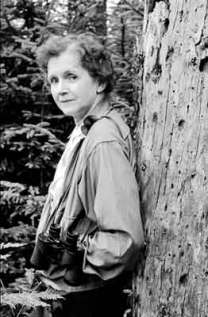
Environmentalist/scientist/writer Rachel Carson, the author of the historic Silent Spring, is generally credited as inspiring the modern environmental movement. She is also the most famous alumna of my own alma mater, Chatham College (when she attended, it was the Pennsylvania College for Women – see below).
Now, we can’t “prove” that Carson was a lesbian. It may be more accurate to call her a “woman-identified woman.” But see the story regarding her intimate friendship in Maine with Dorothy Freeman below.
Here are a few of the most significant sites associated with Carson:
Springdale, Pa.
Rachel Carson birthplace
613 Marion Avenue
Once surrounded by woods, this sweet farmhouse in the Allegheny Valley was the site of Carson‘s birth on May 27, 1907. Both her rural upbringing and her mother’s teaching instilled in her a deep appreciation of nature’s beauty and mystery. “I can remember no time,” Carson wrote, “when I wasn’t interested in the out-of-doors and the whole world of nature.” Her childhood love of the natural world translated into a career of interpreting environmental science for laypeople and exposing the harm being done to the physical environment by humans. “The beauty of the world I was trying to save has always been uppermost in my mind – that and the anger of the senseless, brutish things that were being done,” Carson wrote to a friend after the publication of Silent Spring, her attack on the use of pesticides. “I have felt bound by a solemn obligation to do what I could – if I didn’t at least try I could never again be happy in nature.” Each May, the Carson homestead hosts “Rachel’s Sustainable Feast,” featuring food and music in a day-long event.
Pittsburgh, Pa.
Chatham College
Woodland Road
Founded in 1869 and formerly called the Pennsylvania College for Women (PCW), this women’s college claims Carson, class of 1929, as its most celebrated alumna – the school’s science building and a scholarship are named for her. Born in rural Pennsylvania, Carson developed a love of writing early in childhood, which continued throughout high school and college. At PCW, Carson started as an English major but switched to science after an inspirational biology course with Professor Mary Skinker. “I have always wanted to write,” she affirmed, “and biology has given me something to write about. I will try to make animals in the woods and waters, where they live, as alive to others as they are to me.”
And she succeeded at that. Carson‘s brilliant exploration of sea life, The Sea Around Us (1951), won the National Book Award and was an instant bestseller that made her a celebrity and earned enough royalties to secure her living as a writer. The Sea Around Us remained on the bestseller lists for 86 weeks and prompted a reissuing of an earlier book, Under the Sea-Wind (1941), which also achieved success. The Edge of the Sea (1955) and her masterpiece, Silent Spring (1962), ensured their author a place in the annals of both science and literature.
White Oak, Md.
Rachel Carson home
11701 Berwick Road (private)
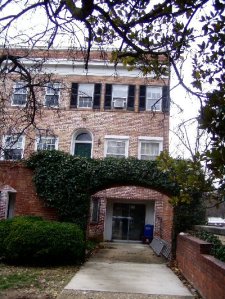
The phenomenal success of her book The Sea Around Us (1951) allowed Carson to purchase this Maryland home, “Quaint Acres,” and a summer cottage off the coast of Maine. It was at Quaint Acres that she feverishly wrote most of Silent Spring (1963), an attack on pesticides, while suffering from what she called “a catalogue of illnesses,” including breast cancer and heart disease. There has been speculation that Carson suspected environmental causes for her own cancer and that of a beloved college professor, which fired her to continue working tirelessly to expose the chemical industry. Between her hospital confinements, Carson worked late into the night on what was to be her final book. “No time for anything,” she wrote to her intimate friend Dorothy Freeman, “unless it is somehow related to the great projects that are uncompleted.”
Carson lived to see both the serialization of Silent Spring in the New Yorker and its publication as a book late in 1962. She was heartened by the public’s strong response and hoped it would bring about a ban on the use of DDT. But Carson quickly became too sick to enjoy the great acclaim that Silent Spring brought with it. “Now all the ‘honors’ have to be received for me by someone else,” she wrote to Freeman. “And all the opportunities to travel to foreign lands – all expenses paid – have to be passed up.” Carson died at her Maryland home in the spring of 1964. Two years later, the Environmental Protection Agency was born after a presidential commission corroborated Carson‘s findings about the hazards of pesticides.
Wells, Maine
Rachel Carson National Wildlife Refuge
Route 2
Beginning in the early 1950s, Carson spent summers in a cottage on Southport Island off the Maine coast, studying local ecology and wildlife. It was there that in 1953 she met Dorothy Freeman, a Massachusetts native who vacationed on the island with her husband and who was a fan of Carson‘s The Sea Around Us. Both women were intensely interested in sea life and the environment. Carson and Freeman became intimate friends who exchanged voluminous correspondence during the three seasons of the year they were not together, right up until Carson‘s death. As Rachel Carson wrote to her friend early in their relationship, “I think that the rapid flowering of our friendship, the head-long pace of our correspondence, reflects a feeling, whether consciously recognized or not, for the ‘lost’ years and a desire to make up for all the time we might have enjoyed this, had something brought us together earlier.” Those are pretty strong emotions for “friends.”
Freeman’s granddaughter was the recipient of the women’s correspondence, and she published it (hesitantly) in 1995. She explained that on one of Freeman’s visits to Carson‘s home in Maryland, the two women burned packets of Freeman’s letters together in the fireplace. In addition, each women independently destroyed some of the other’s letters. They were concerned how the intensity of their relationship might look from the outside. The “lesbian question,” however, was never raised by Freeman’s granddaughter.
In Wells, a wildlife refuge was dedicated to Carson‘s memory in 1970, six years after her death. In her best-selling Silent Spring, the book that helped launch the environmental movement, Carson decried the “senseless destruction” of Maine’s natural beauty, its “evergreen forests, roads lined with bayberry and sweet fern, alder and huckleberry.”
Read Full Post »


 The Queerest Places
You must be logged in to post a comment.