Pittsburgh, Pa.
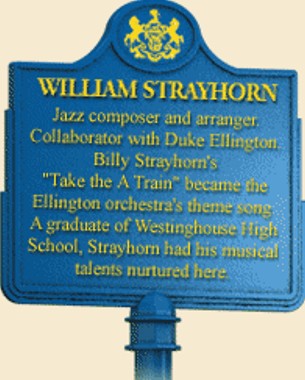
Billy Strayhorn marker
Westinghouse High School
1101 North Murtland Street
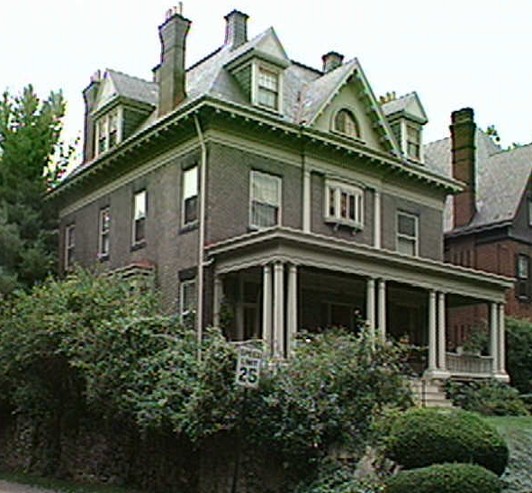
Billy Strayhorn home
7212 Tioga Street Rear (demolished)
Born in Ohio, composer Billy Strayhorn (1915-1967) lived in the Homewood section of Pittsburgh from his early years until he left for New York as a young adult. In those days, white families lived on the main streets of Homewood, while blacks lived in the alleys behind them (the “Rear” in the Strayhorn address). The Strayhorn home was “a four-room shack,” according to one of Billy’s childhood friends, with two rooms on each floor and a toilet in the basement. The kitchen was the biggest and most significant room in the house. Because of the crowded living conditions and Billy’s father’s alcoholic binges, Billy’s mother often sent her eldest son for long stays with his grandparents in Hillsborough, North Carolina. Billy’s grandmother owned and played a piano, and it was in Hillsborough that Billy first learned to play.
Though he was a musical prodigy, Strayhorn’s family could not afford lessons to further his talent. As an adolescent, Billy found odd jobs selling papers and working as a soda jerk to purchase his first piano, a broken-down upright. “All the money he [Billy] could get hold of,” a friend remembers, “he bought [sheet] music….the house was swamped with music.”
At Westinghouse High School (where there is now a historical marker honoring him), Strayhorn pursued music, becoming first pianist in the Senior Orchestra and playing at local social events and banquets with the school’s Orchestra Club. Though he was often made fun of at school for being a “sissy,” the shy, withdrawn Strayhorn concentrated on his work and his passion for music. After graduation, Strayhorn formed his own interracial jazz trio, The Madhatters, and played local nightspots. But he still had to work days at the drugstore soda fountain and pick up extra money by arranging music.
His big break came in 1938, when a friend of a friend got him an “audience” with Duke Ellington, who was playing with his band at the Stanley Theater in downtown Pittsburgh (now the Benedum Center, a performing arts space). Ellington was impressed by the talented young pianist who could seemingly do everything – write music, lyrics, and arrangements. But he didn’t have an opening in his band. Ellington made Strayhorn a promise of a job if the young musician ever got to New York and gave him exact directions to his home in Harlem. Eager to please Ellington, Strayhorn turned the directions into a song – “Take the A Train” turned out to be his most famous composition and eventually became Ellington’s theme song.
Strayhorn did indeed make it to New York, where he hooked up with Ellington and worked with him for the next 30 years. While Ellington was the public artist, Strayhorn worked behind the scenes as collaborator and arranger. Ellington supported Strayhorn’s career, but he also occasionally took credit for the younger man’s work. Strayhorn consoled himself with drink and died of cancer and alcohol abuse at the age of 51. His song “Lush Life” (1936) sadly defines his own short, intense life.
Strayhorn knew early on that he was gay and was open about his sexual orientation. According to his biographer, he never even danced with a girl. Ellington, who was straight, seems to have been supportive and tolerant of his collaborator’s homosexuality. Strayhorn had a number of significant relationships in his life, most notably in his final years with a graphic designer, a white man named Bill Grove. Grove was the only man Strayhorn ever brought home to meet his family.
 The Queerest Places